Inauguration of Ulysses S. Grant as the 18th President of the United States
1869 · Washington, D.C., United States
Ulysses S. Grant was inaugurated as the 18th President of the United States.
August 20, 1866
President Andrew Johnson formally declares the American Civil War over.
Washington D.C., USA | United States Government
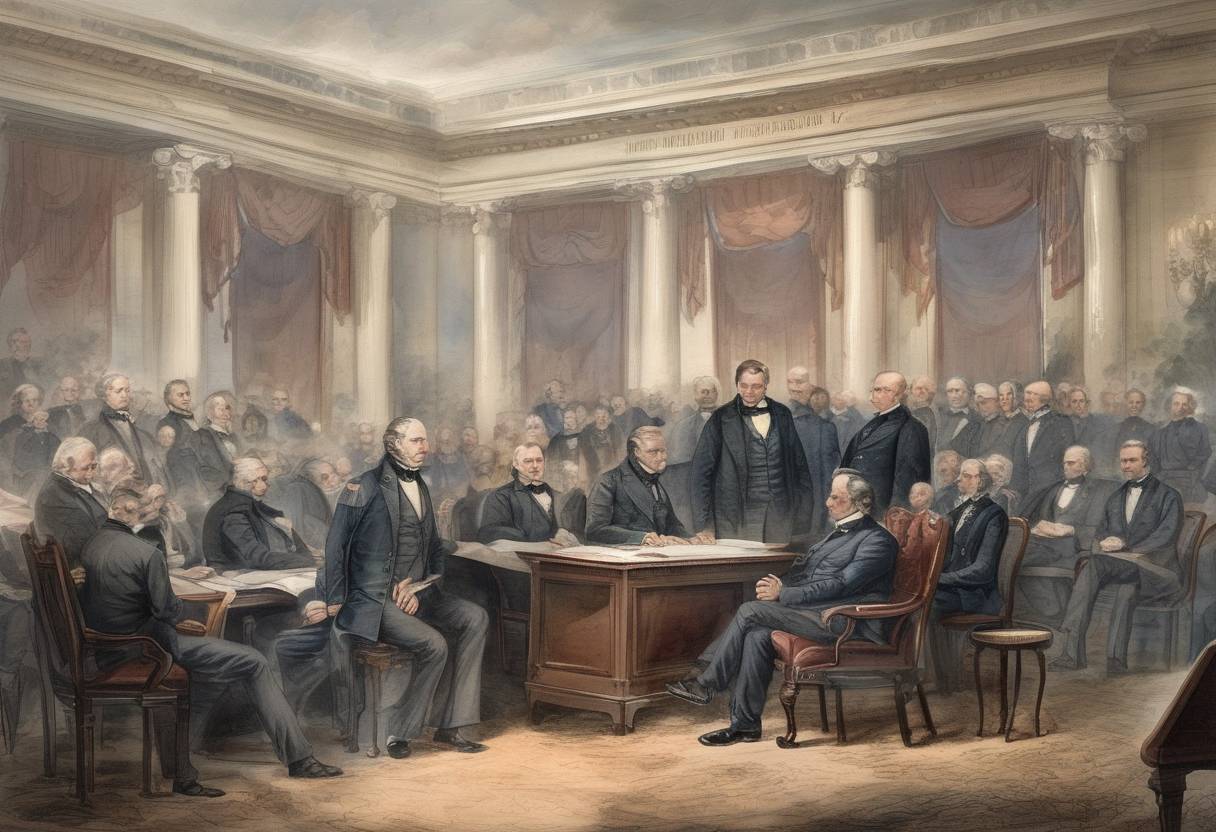
On August 20, 1866, President Andrew Johnson issued a proclamation that formally declared the American Civil War to be over. This marked the official conclusion of a conflict that had deeply divided the United States from 1861 to 1865. Although the major hostilities had ceased with the surrender of Confederate General Robert E. Lee at Appomattox Court House on April 9, 1865, and subsequent surrenders of other Confederate forces, the formal declaration was a significant step in the process of national reconciliation and reconstruction.
End of Hostilities: The Civil War effectively ended with the surrender of Confederate forces in the spring of 1865. However, the process of reuniting the nation and addressing the war’s aftermath was complex and fraught with challenges.
Reconstruction Era: Following the war, the United States entered the Reconstruction era, a period focused on rebuilding the South, integrating formerly enslaved people into society as free citizens, and restoring the Southern states to the Union.
Presidential Reconstruction: Andrew Johnson, who became president after the assassination of Abraham Lincoln in April 1865, pursued a lenient approach to Reconstruction. His policies aimed to quickly restore the Southern states without significant changes to their pre-war social structures, which led to tensions with Congress.
Content of the Proclamation: In his proclamation, President Johnson declared that “peace, order, tranquility, and civil authority now exist in and throughout the whole of the United States of America.” This statement was intended to signal the end of military governance in the South and the restoration of civil authority.
Significance: The proclamation was a symbolic gesture that underscored the Union’s victory and the restoration of the United States as a single, unified nation. It also marked the transition from wartime governance to peacetime policies.
Continued Challenges: Despite the formal end of the war, the United States faced ongoing challenges during Reconstruction. Issues such as the integration of freed slaves, the political reintegration of Southern states, and the protection of civil rights for African Americans remained contentious.
Legacy: The proclamation of August 20, 1866, is a reminder of the complex process of healing and rebuilding that followed the Civil War. It highlights the efforts to restore national unity and the enduring struggles over civil rights and equality that continued long after the war’s end.
In conclusion, President Andrew Johnson’s proclamation on August 20, 1866, was a pivotal moment in American history, marking the formal end of the Civil War and the beginning of a new chapter in the nation’s journey toward reconstruction and reconciliation.
Source: en.wikipedia.org