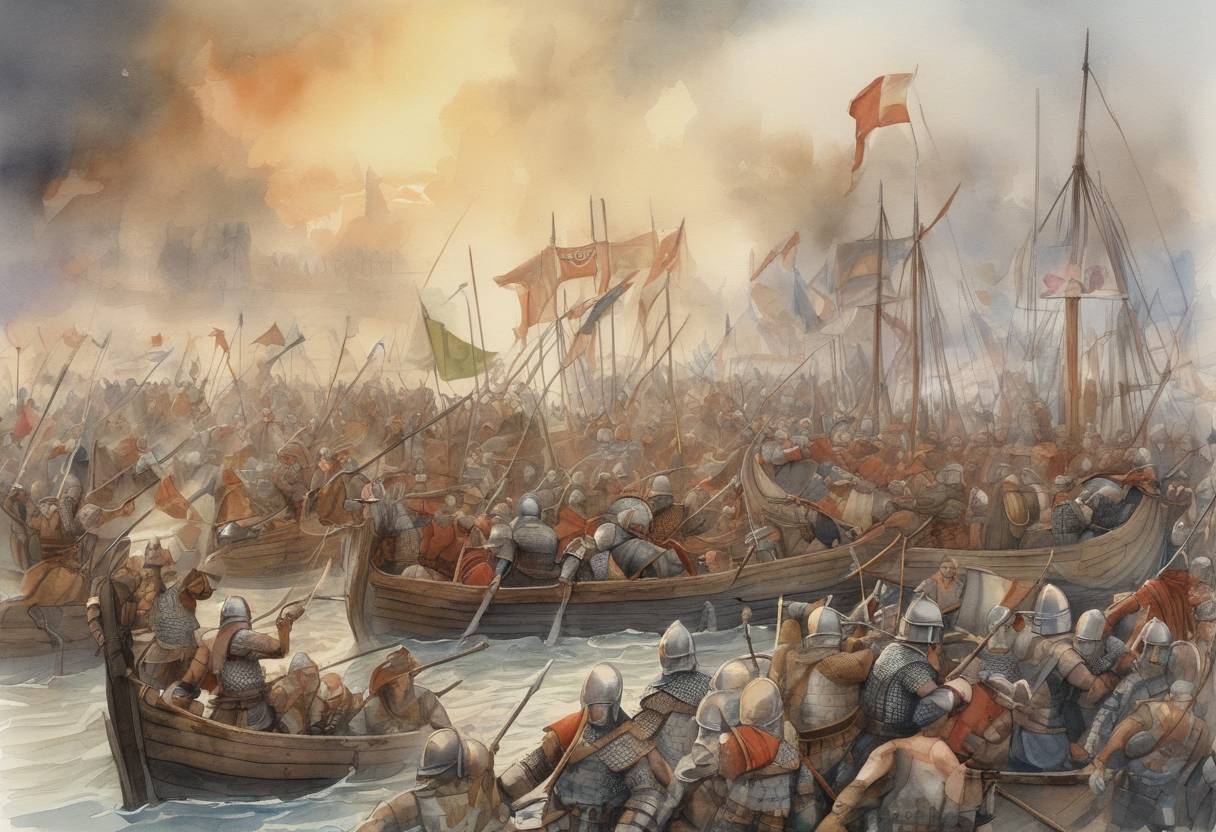
The Battle of Maldon: August 11, 991
The Battle of Maldon, fought on August 11, 991, stands as a significant event in the history of Anglo-Saxon England, marking a notable encounter between the Anglo-Saxons and Viking invaders. This battle is particularly remembered due to its depiction in an Old English poem, which provides a vivid account of the events and the heroism displayed by the Anglo-Saxon leader, Byrhtnoth.
Context and Prelude
During the late 10th century, England faced frequent raids by Viking forces, primarily from Scandinavia. These raids were part of a broader pattern of Viking expansion and incursions across Europe. The Vikings, known for their seafaring prowess, targeted the rich and relatively undefended English coastlines, seeking plunder and tribute.
By 991, the English kingdom, under King Æthelred the Unready, was struggling to effectively repel these incursions. The Vikings had already established a formidable presence in parts of England, and their raids were becoming increasingly bold and destructive.
The Battle
The Battle of Maldon took place near the town of Maldon in Essex, on the banks of the River Blackwater. The Anglo-Saxon forces were led by Byrhtnoth, the ealdorman of Essex, a respected and experienced military leader. The Viking forces, likely led by Olaf Tryggvason, were well-equipped and battle-hardened.
The battle is famously characterized by Byrhtnoth’s decision to allow the Vikings to cross a causeway to engage in open combat, a decision that has been both criticized and romanticized in historical accounts. This act of chivalry, intended to ensure a fair fight, ultimately contributed to the Anglo-Saxon defeat.
Despite their valiant efforts, the Anglo-Saxons were overwhelmed by the superior numbers and tactics of the Viking forces. Byrhtnoth himself was killed in the battle, and his death marked a turning point, leading to the collapse of the Anglo-Saxon resistance.
Aftermath and Significance
The defeat at Maldon had significant repercussions for England. In the immediate aftermath, King Æthelred was forced to pay a large tribute, known as Danegeld, to the Vikings to prevent further attacks. This payment set a precedent for future Viking demands and highlighted the vulnerabilities of the English defenses.
The battle and its outcome also underscored the need for stronger military organization and leadership within England, eventually leading to reforms in the English military system.
The poem “The Battle of Maldon,” composed shortly after the event, immortalizes the bravery and loyalty of Byrhtnoth and his men. It serves as a poignant reminder of the challenges faced by the Anglo-Saxons during this turbulent period and remains an important piece of Old English literature.
In the broader historical context, the Battle of Maldon exemplifies the ongoing struggle between the Anglo-Saxons and Viking invaders, a conflict that would continue to shape the political and cultural landscape of England for decades to come.