1649 · London, England
King Charles I of England went on trial for treason and other high crimes against the realm. This trial eventually led to his execution.
April 20, 1653
Oliver Cromwell dissolves the Rump Parliament by force, marking a significant moment in the English Interregnum.
London, England | English Parliament
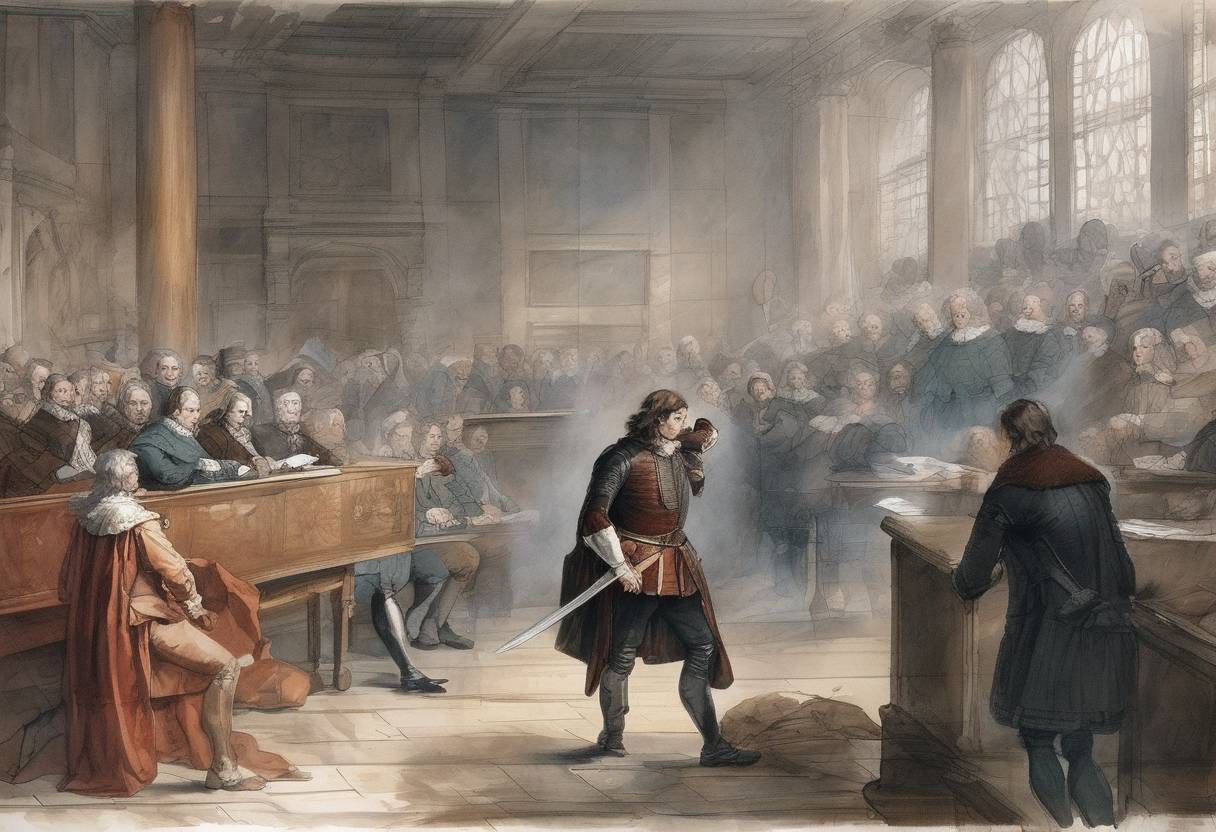
On April 20, 1653, Oliver Cromwell, a key figure in the English Civil War and the subsequent Interregnum, forcibly dissolved the Rump Parliament, marking a pivotal moment in English history. This event was a significant turning point in the governance of England during a period when the monarchy had been abolished, and the country was experimenting with republican forms of government.
The English Civil War (1642-1651): The conflict between Royalists, who supported King Charles I, and Parliamentarians, who sought greater parliamentary power, culminated in the execution of Charles I in 1649. This led to the establishment of the Commonwealth of England, a republic.
The Rump Parliament: After the execution of Charles I, the Rump Parliament, a remnant of the Long Parliament, assumed control. It was tasked with governing the nation and implementing reforms. However, it was often criticized for its inefficiency and perceived self-interest.
Cromwell’s Role: Oliver Cromwell, a leading military and political figure, had risen to prominence due to his leadership in the New Model Army. As Lord General, he wielded significant influence and was increasingly frustrated with the Rump Parliament’s inability to enact meaningful reforms and its reluctance to dissolve itself in favor of a more representative assembly.
The Dissolution: On April 20, 1653, Cromwell, accompanied by soldiers, entered the House of Commons. In a dramatic and forceful move, he interrupted proceedings and declared the Parliament dissolved. He accused the members of corruption and self-interest, famously stating, “You have sat too long for any good you have been doing lately… In the name of God, go!”
Aftermath: Following the dissolution, Cromwell and the Council of State assumed control. This led to the establishment of the Barebone’s Parliament (or the Nominated Assembly) later in 1653, which was an attempt to create a more godly and effective government. However, it too was short-lived, and Cromwell eventually became Lord Protector in 1653, ruling as a de facto monarch until his death in 1658.
Impact on Governance: The dissolution of the Rump Parliament underscored the challenges of establishing a stable republican government in England. It highlighted the tensions between military power and civilian authority during the Interregnum.
Legacy of Cromwell: Cromwell’s actions during this period remain controversial. While some view him as a champion of parliamentary democracy and religious freedom, others criticize him for his authoritarian rule and the use of military force to achieve political ends.
Prelude to the Restoration: The instability and dissatisfaction with republican rule eventually led to the Restoration of the monarchy in 1660, with Charles II ascending the throne. This event marked the end of the Interregnum and the re-establishment of the traditional monarchical system.
The dissolution of the Rump Parliament by Oliver Cromwell is a critical episode in the complex narrative of the English Interregnum, reflecting the turbulent struggle for power and governance in a nation grappling with the aftermath of civil war and regicide.
Source: www.britannica.com