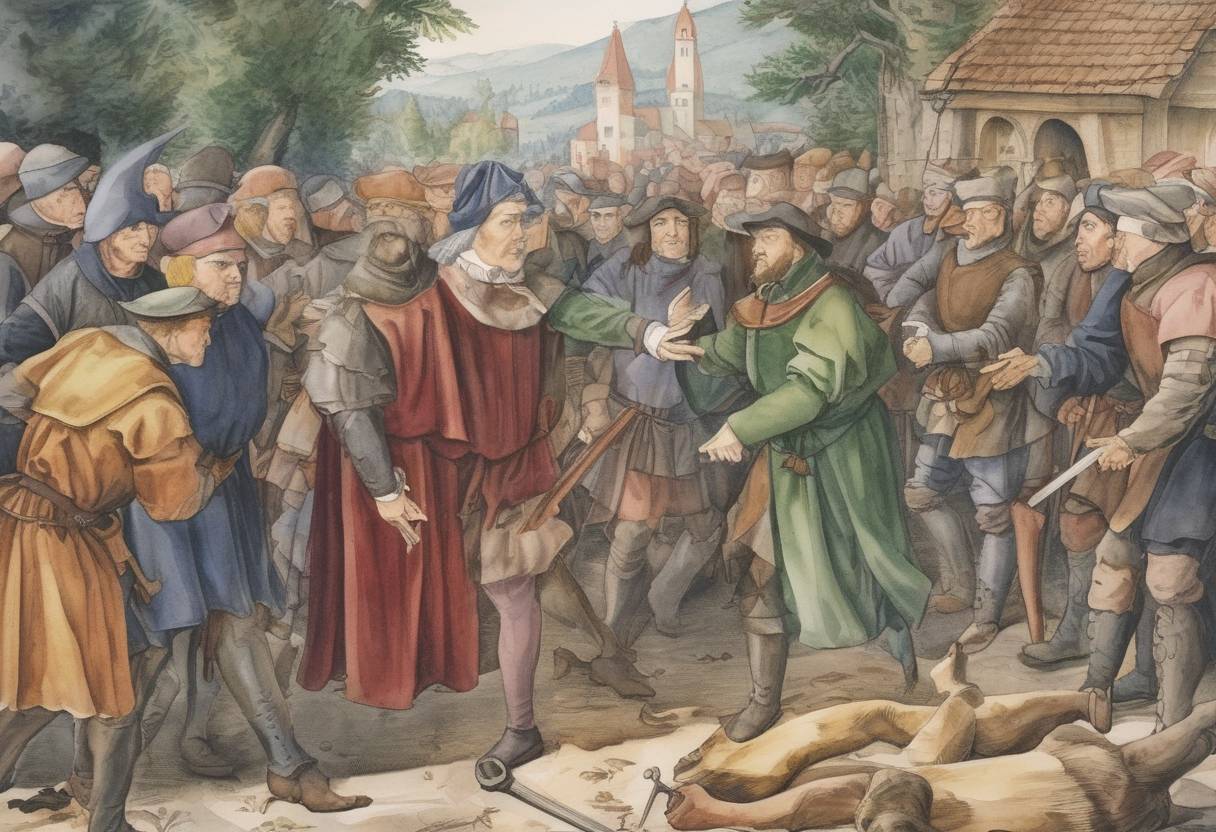
Huldrych Zwingli and the Battle of Kappel: October 11, 1531
On October 11, 1531, Huldrych Zwingli, a prominent leader of the Protestant Reformation in Switzerland, was killed in the Battle of Kappel. This event marked a significant moment in the religious and political landscape of 16th-century Europe.
Background
Huldrych Zwingli was born on January 1, 1484, in Wildhaus, Switzerland. He became a key figure in the Swiss Reformation, advocating for a version of Protestantism that was distinct from Martin Luther’s teachings. Zwingli’s reforms emphasized the authority of Scripture, the elimination of church corruption, and the simplification of religious practices.
Zwingli’s influence grew as he became the pastor of the Grossmünster in Zurich in 1519. Under his leadership, Zurich became a center for Protestant reform, implementing changes such as the abolition of the Mass and the removal of religious images from churches.
The Swiss Confederation was a loose alliance of cantons, each with significant autonomy. The Reformation led to divisions within the Confederation, as some cantons embraced Protestantism while others remained staunchly Catholic. This religious divide created tensions that threatened the unity of the Confederation.
Zwingli sought to expand the Reformation beyond Zurich, but his efforts were met with resistance from Catholic cantons. The conflict escalated into a series of confrontations known as the Kappel Wars.
The Battle of Kappel
The First War of Kappel in 1529 ended without significant bloodshed, resulting in a compromise that allowed each canton to choose its own religion. However, tensions remained high, and in 1531, the Catholic cantons formed an alliance to counter the Protestant influence.
On October 11, 1531, the Second War of Kappel culminated in a decisive battle near Kappel am Albis. The Protestant forces, led by Zwingli, were significantly outnumbered and poorly organized compared to the Catholic troops. Zwingli, who served as a chaplain and advisor rather than a military commander, was killed in the battle. His death was a severe blow to the Protestant cause in Switzerland.
Aftermath and Significance
The defeat at Kappel and Zwingli’s death led to the Peace of Kappel, which reaffirmed the right of each canton to determine its own religion. This agreement temporarily stabilized the region but underscored the deep religious divisions within the Swiss Confederation.
Zwingli’s legacy continued to influence the Reformation, particularly in Switzerland and parts of southern Germany. His theological ideas contributed to the development of Reformed Protestantism, which would later be advanced by figures like John Calvin.
The Battle of Kappel and Zwingli’s death highlighted the complex interplay of religion and politics during the Reformation, illustrating the challenges of achieving religious reform in a fragmented political landscape.