The Capture of Rome and the Installation of Olybrius as Emperor
472 · Rome, Italy
After a siege, the Roman general Ricimer captures Rome and installs Olybrius as the Western Roman Emperor.
September 21, 0454
The Roman general Flavius Aetius, often called the 'last of the Romans,' was assassinated by Emperor Valentinian III in Rome. Aetius had been a key military leader for the Western Roman Empire, notably defeating Attila the Hun at the Battle of the Catalaunian Plains in 451.
Rome, Western Roman Empire | Western Roman Empire
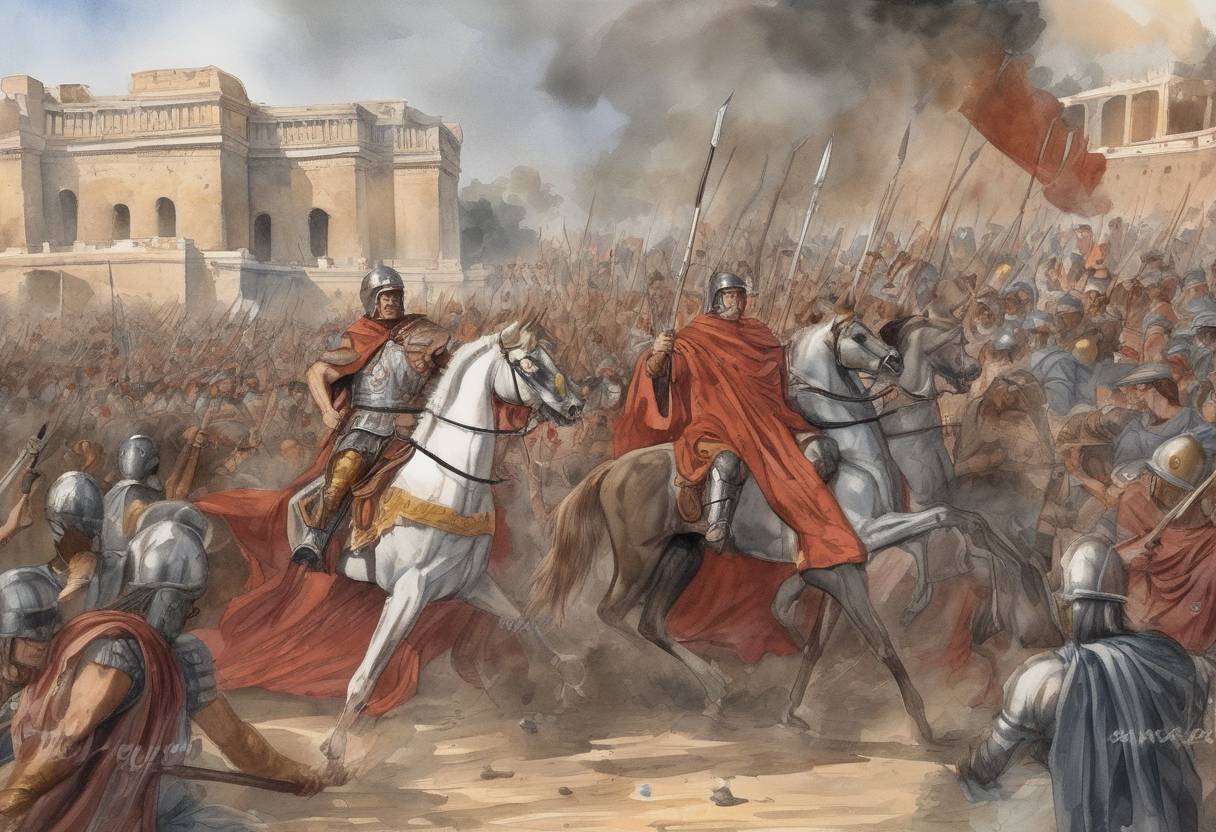
On September 21, 454, Flavius Aetius, a prominent Roman general often referred to as the “last of the Romans,” was assassinated by Emperor Valentinian III in Rome. Aetius was a crucial military leader for the Western Roman Empire during a period of significant decline and instability.
Flavius Aetius was born around 391 AD and rose through the ranks of the Roman military due to his strategic acumen and political savvy. He became a key figure in the Western Roman Empire, serving as magister militum (master of soldiers) and wielding considerable influence over military and political affairs.
Aetius is best known for his role in the Battle of the Catalaunian Plains (also known as the Battle of Chalons) in 451 AD. This battle was a decisive confrontation against Attila the Hun, where Aetius led a coalition of Roman and barbarian forces to halt Attila’s advance into Gaul. The victory was significant in maintaining the stability of the Western Roman Empire, albeit temporarily.
Despite his military successes, Aetius’s relationship with Emperor Valentinian III was fraught with tension. Aetius had accumulated substantial power, which made him a target of envy and suspicion at the imperial court. The emperor, influenced by court intrigues and possibly fearing Aetius’s growing influence, decided to eliminate him.
On September 21, 454, during a meeting in the imperial palace, Valentinian III personally attacked Aetius, stabbing him to death. The assassination was reportedly carried out in a fit of anger, with the emperor accusing Aetius of plotting against him.
The assassination of Aetius had profound consequences for the Western Roman Empire. Aetius had been one of the last effective military leaders capable of defending the empire against external threats. His death left a power vacuum that weakened the empire’s ability to resist invasions.
The Western Roman Empire continued to decline after Aetius’s assassination, facing increasing pressure from barbarian groups. Just two years later, in 476 AD, the Western Roman Empire would officially fall with the deposition of the last Roman emperor, Romulus Augustulus.
Aetius’s legacy as the “last of the Romans” underscores his role as a defender of the empire during its final years. His assassination marked the end of an era and highlighted the internal strife and political instability that contributed to the empire’s downfall.
Source: en.wikipedia.org