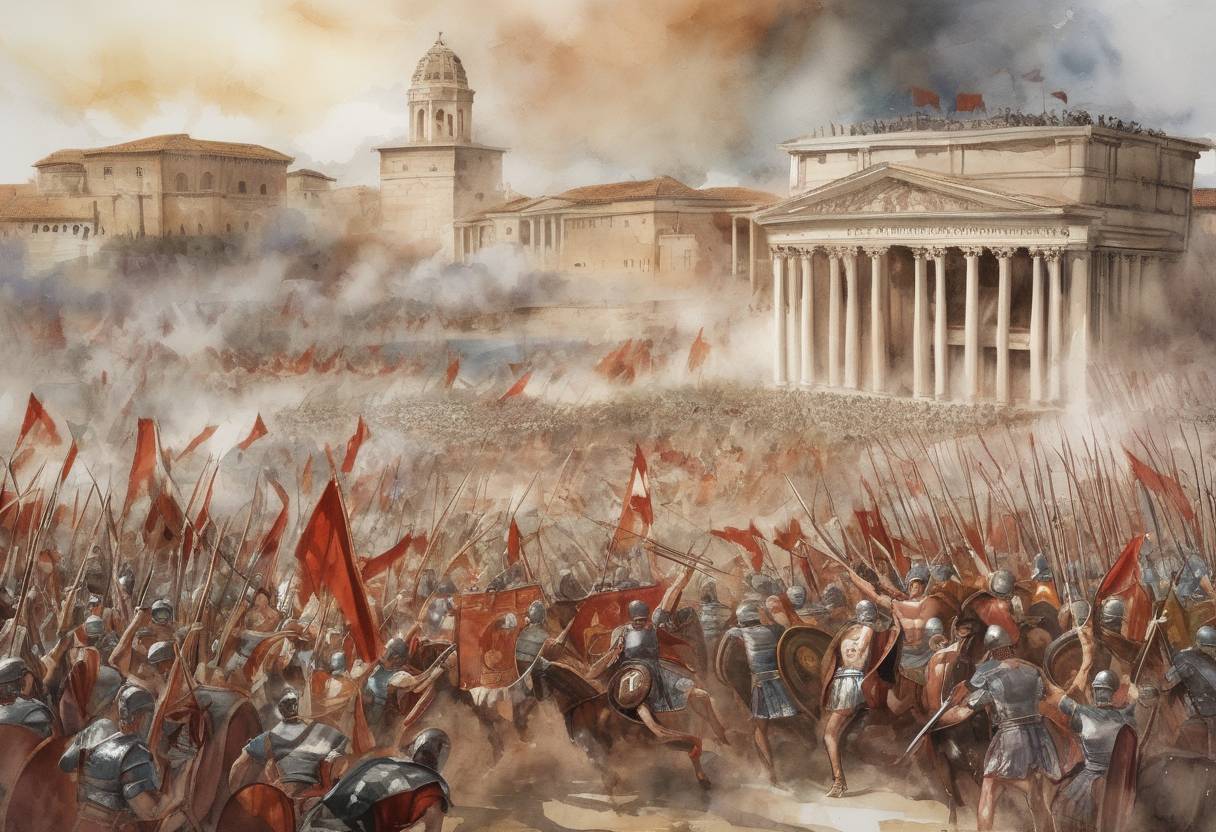
The Second Battle of Bedriacum: October 6, 69 AD
The Second Battle of Bedriacum, fought on October 6, 69 AD, was a pivotal conflict in the Year of the Four Emperors, a chaotic period in Roman history marked by civil war and political upheaval. This battle was instrumental in the rise of Vespasian to the position of Roman Emperor, marking the end of Vitellius’s short reign.
Context Leading to the Battle
- The Year of the Four Emperors: Following the suicide of Emperor Nero in 68 AD, the Roman Empire was plunged into a power struggle. Galba, Otho, Vitellius, and Vespasian each claimed the imperial throne in rapid succession.
- Vitellius’s Ascendancy: Vitellius became emperor in April 69 AD after defeating Otho at the First Battle of Bedriacum. His rule, however, was marred by excess and lack of discipline, leading to dissatisfaction among the Roman legions and the Senate.
- Vespasian’s Claim: Vespasian, a seasoned military commander known for his campaigns in Judea, was proclaimed emperor by his troops in July 69 AD. He garnered support from the Eastern provinces and key military leaders, including Marcus Antonius Primus, who played a crucial role in the upcoming battle.
The Battle
- Location: The battle took place near the town of Bedriacum (modern-day Calvatone, Italy), a strategic location in northern Italy.
- Forces Involved: Vespasian’s forces, led by Antonius Primus, were composed of legions from the Danube region, while Vitellius’s forces were primarily from the Rhine legions.
- Course of the Battle: The battle was fiercely contested, but Vespasian’s troops, motivated and better organized, gained the upper hand. The Vitellian forces, demoralized and poorly led, eventually crumbled under the pressure.
Aftermath and Significance
- Vitellius’s Downfall: Following the defeat, Vitellius attempted to negotiate his abdication but was ultimately captured and executed by Vespasian’s supporters in December 69 AD.
- Vespasian’s Rise: With Vitellius defeated, Vespasian was able to consolidate power and was officially recognized as emperor by the Senate. His reign marked the beginning of the Flavian Dynasty.
- Stabilization of the Empire: Vespasian’s rule brought much-needed stability to the Roman Empire. He implemented financial reforms, strengthened the military, and initiated significant building projects, including the construction of the Colosseum.
The Second Battle of Bedriacum was a decisive moment in Roman history, not only ending the tumultuous Year of the Four Emperors but also setting the stage for a period of relative peace and prosperity under Vespasian’s leadership.