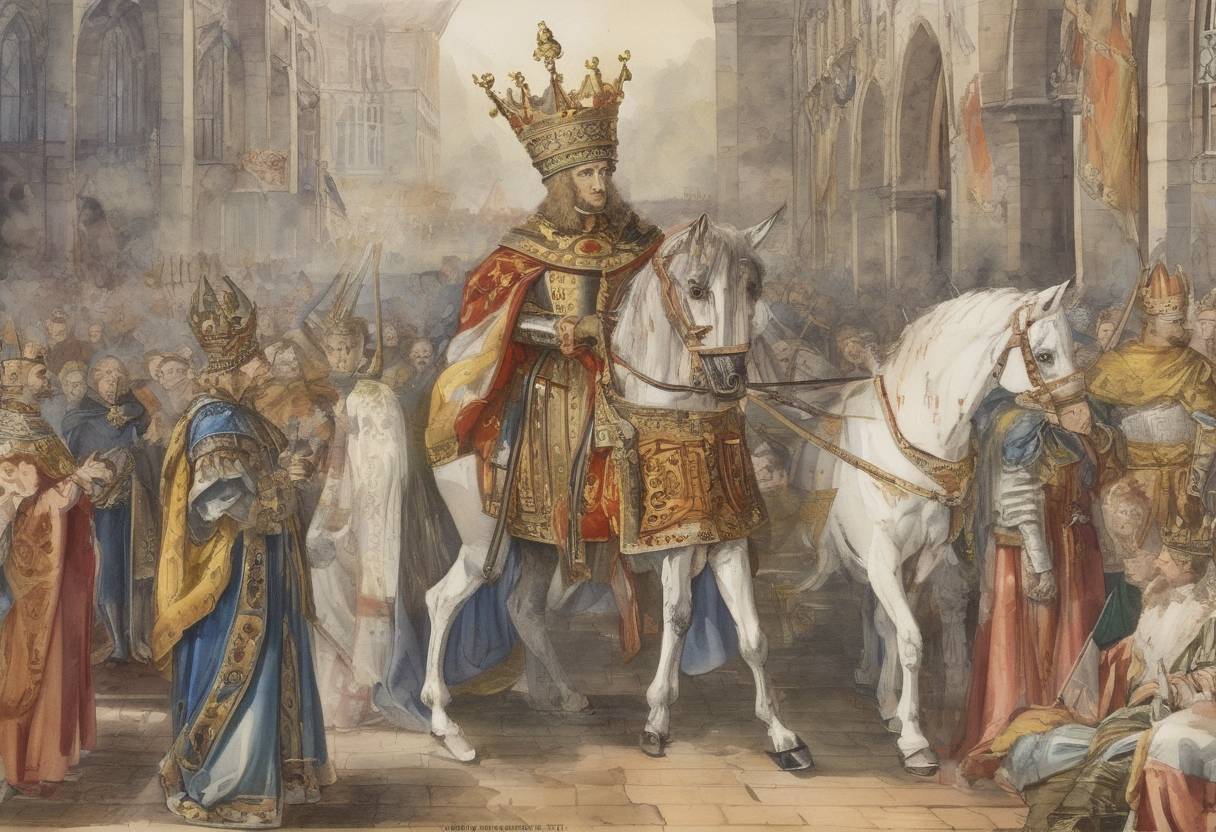
Rudolf I of Habsburg Elected King of Germany
On October 1, 1273, Rudolf I of Habsburg was elected King of Germany, a pivotal moment that marked the beginning of the Habsburg dynasty’s long-standing influence in European politics.
Background
The election of Rudolf I came at a time of significant political fragmentation within the Holy Roman Empire. The period known as the Great Interregnum (1250-1273) followed the death of Emperor Frederick II, during which the empire lacked a universally recognized ruler. This era was characterized by political instability and the weakening of central authority, as various noble families vied for power.
The Election
Rudolf’s election was facilitated by the need for a strong leader who could restore order and consolidate power within the empire. The electors, comprising influential princes and bishops, sought a candidate who could balance the competing interests of the powerful German states and the papacy. Rudolf, a relatively minor count from the Habsburg family, was seen as a compromise candidate who could be more easily controlled than a more powerful noble.
Rudolf’s Reign
Upon his election, Rudolf I focused on restoring imperial authority and expanding his family’s influence. He was crowned in Aachen on October 24, 1273. One of his significant achievements was the acquisition of the Duchy of Austria in 1278, following his victory over Ottokar II of Bohemia at the Battle of Marchfeld. This victory laid the foundation for the Habsburgs’ future territorial expansion.
Rudolf’s reign was marked by efforts to strengthen the monarchy and reassert control over the empire’s territories. He worked to establish peace and stability, which included negotiating with the papacy and other European powers.
Aftermath and Significance
Rudolf I’s election and subsequent reign were crucial in establishing the Habsburg dynasty’s prominence in European affairs. Although he was never crowned Holy Roman Emperor, his efforts to consolidate power set the stage for his descendants to become one of the most influential royal families in Europe.
The Habsburgs would go on to rule over vast territories, including Austria, Spain, and parts of Italy and the Netherlands, shaping European politics for centuries. Rudolf’s election marked the beginning of this enduring legacy, as the Habsburgs became synonymous with the Holy Roman Empire and later the Austro-Hungarian Empire.
In summary, the election of Rudolf I of Habsburg as King of Germany on October 1, 1273, was a turning point that initiated the rise of the Habsburg dynasty, a family that would leave an indelible mark on European history.