1679 · , United States
French explorer René-Robert Cavelier, Sieur de La Salle reached the mouth of the Mississippi River, claiming the surrounding territory for France.
April 9, 1682
René-Robert Cavelier, Sieur de La Salle, claimed the Mississippi River basin for France, naming it La Louisiane.
Mississippi River Basin, United States | France
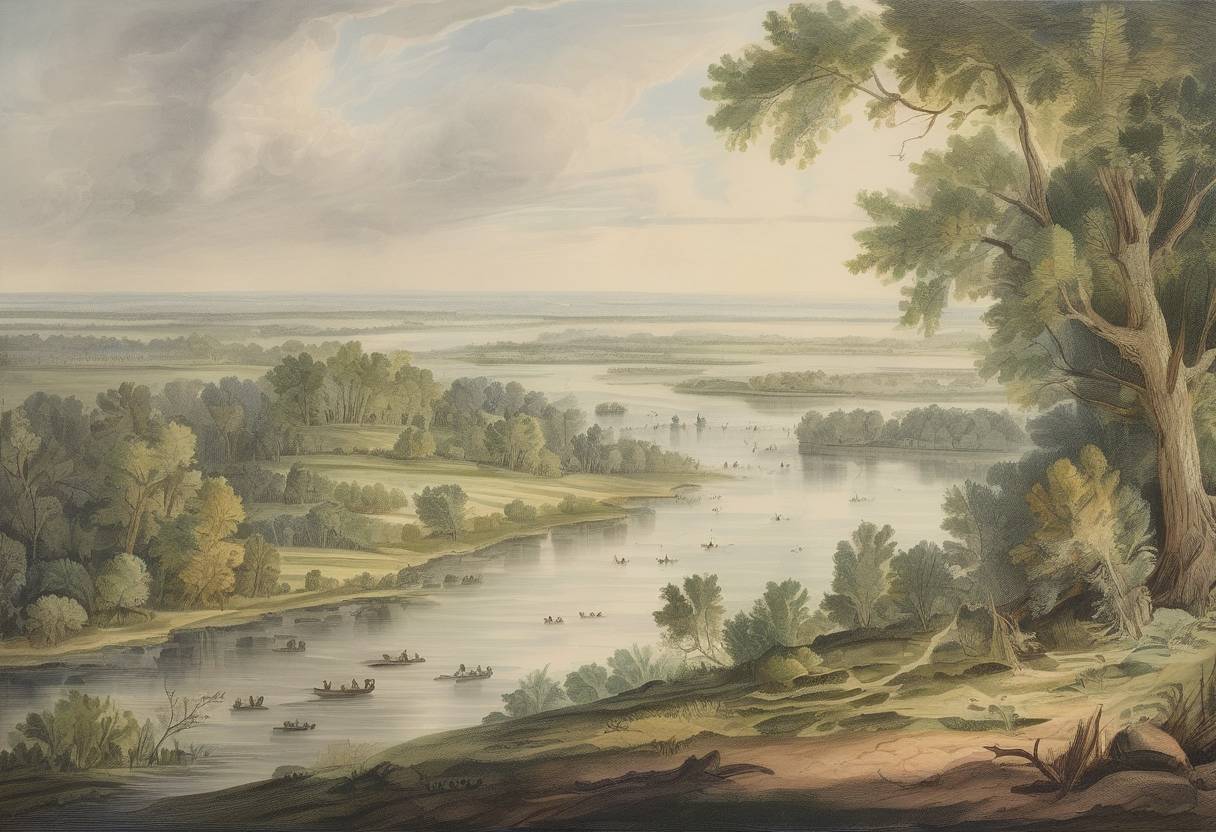
On April 9, 1682, the French explorer René-Robert Cavelier, Sieur de La Salle, made a significant mark in the history of North America by claiming the Mississippi River basin for France. This event was pivotal in the expansion of French territorial claims in the New World and had lasting implications for the geopolitical landscape of North America.
René-Robert Cavelier, born in 1643 in Rouen, France, was a prominent explorer in the late 17th century. Initially joining the Jesuit order, he later left to pursue a career in exploration. La Salle’s ambition was to find a western passage to China, but his ventures led him to explore the vast interior of North America.
In the late 1670s, La Salle embarked on expeditions to explore the Great Lakes region and the Mississippi River. His goal was to establish a French presence in the interior of the continent and to find a route to the Gulf of Mexico.
La Salle’s expedition down the Mississippi River began in 1681. Accompanied by a group of Frenchmen and Native American allies, he navigated the river from the Illinois Country to its mouth at the Gulf of Mexico. On April 9, 1682, upon reaching the river’s delta, La Salle performed a formal ceremony to claim the entire Mississippi River basin for France.
During the ceremony, La Salle erected a cross and a column bearing the arms of France. He named the vast territory “La Louisiane” in honor of King Louis XIV. This claim extended French territorial rights over a vast area that included parts of present-day Canada, the United States, and the Gulf Coast.
The claiming of La Louisiane was a strategic move by France to expand its influence in North America and to counter the territorial claims of Spain and England. It laid the groundwork for future French settlements and trade networks in the region.
La Salle’s claim was not without challenges. The vastness of the territory and the presence of other European powers made it difficult for France to maintain control. Nonetheless, the claim symbolized France’s ambitions in the New World and contributed to the complex colonial dynamics that would unfold over the following centuries.
In the years following the claim, La Salle attempted to establish a colony at the mouth of the Mississippi River. However, his efforts were fraught with difficulties, and he was ultimately killed by his own men in 1687 during a subsequent expedition.
La Salle’s exploration and claim of La Louisiane had a lasting impact on the history of North America. It set the stage for the establishment of New Orleans in 1718 and the eventual development of the Louisiana Territory. The region remained under French control until it was ceded to Spain in 1762, and later sold to the United States in the Louisiana Purchase of 1803.
La Salle’s legacy is remembered as one of ambition and exploration, marking a significant chapter in the history of European colonization in North America.
Source: en.wikipedia.org