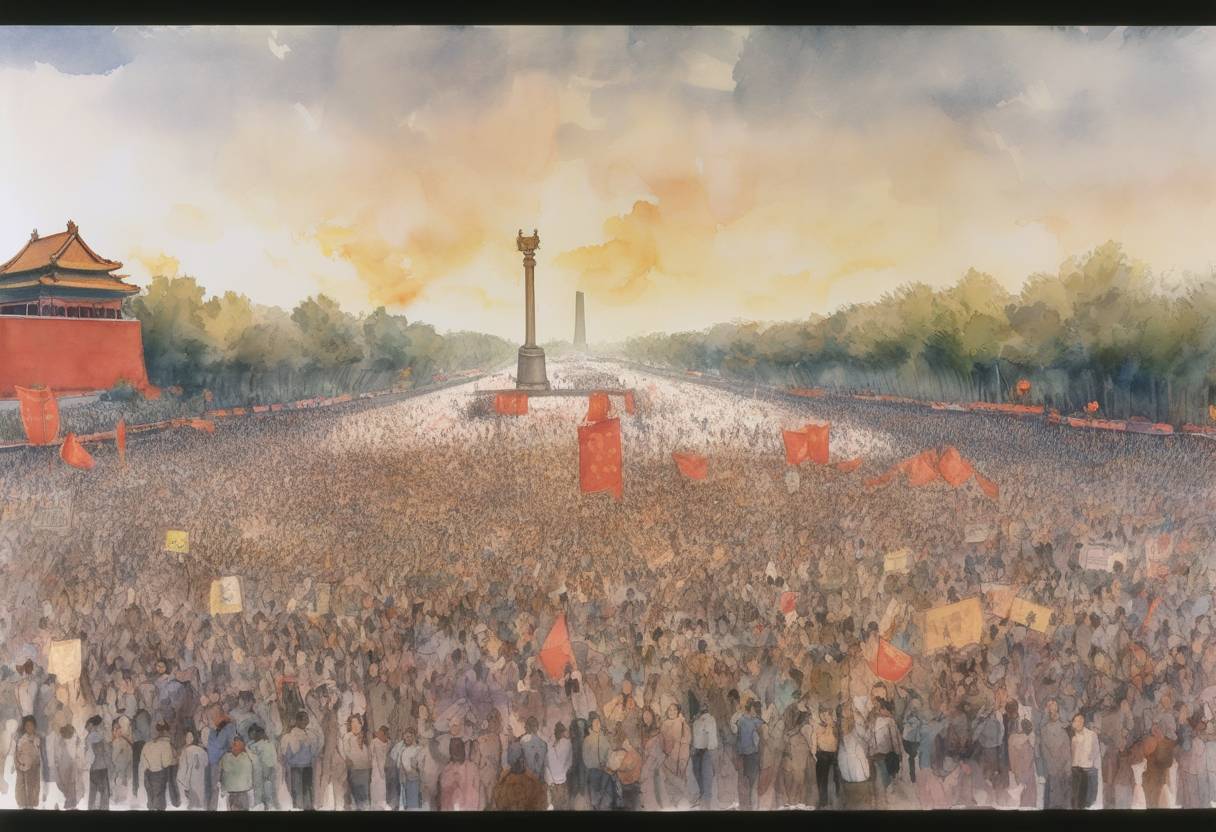
Tiananmen Square Protests and the Military Crackdown - June 3, 1989
The Tiananmen Square protests of 1989 were a pivotal moment in Chinese history, representing a significant clash between the Chinese government and its citizens advocating for political reform. The events leading up to June 3, 1989, were marked by a series of demonstrations that began in April of that year, primarily led by students.
Background
Initial Protests: The protests began in mid-April 1989, following the death of Hu Yaobang, a former Communist Party leader known for his progressive views. His death became a catalyst for students to gather in Tiananmen Square, calling for political reform, freedom of speech, and an end to government corruption.
Escalation: Over the weeks, the protests grew in size and scope, attracting a diverse group of participants, including intellectuals, workers, and eventually, ordinary citizens. The movement’s demands expanded to include broader political reforms.
Government Response: Initially, the Chinese government was divided on how to respond. However, as the protests continued to grow, the leadership, under Deng Xiaoping, decided to take a hardline approach.
June 3, 1989 - The Climax
Martial Law Declared: On May 20, 1989, the Chinese government declared martial law in Beijing, but the protests continued unabated. By early June, tensions had reached a boiling point.
Military Mobilization: On the night of June 3, 1989, the Chinese government began a military crackdown to forcibly remove the demonstrators from Tiananmen Square. The People’s Liberation Army (PLA) was deployed to Beijing, with orders to clear the square by any means necessary.
Violent Crackdown: As the military advanced, clashes erupted between the troops and the protesters. The situation quickly turned violent, with reports of gunfire and tanks being used against unarmed civilians. The exact number of casualties remains unknown, but estimates range from several hundred to several thousand deaths.
Aftermath and Consequences
Immediate Aftermath: By the morning of June 4, 1989, Tiananmen Square had been cleared. The Chinese government swiftly moved to suppress any further dissent, arresting protest leaders and implementing strict censorship to control the narrative.
International Reaction: The crackdown drew widespread international condemnation. Many Western countries imposed economic sanctions and arms embargoes on China, straining diplomatic relations.
Long-term Impact: Domestically, the events of Tiananmen Square led to a tightening of political control by the Chinese Communist Party. The government intensified its efforts to maintain social stability and prevent similar movements in the future.
Legacy: The Tiananmen Square protests remain a sensitive and heavily censored topic in China. However, the events are remembered globally as a symbol of the struggle for democracy and human rights.
The Tiananmen Square protests and the subsequent crackdown are a stark reminder of the complexities and challenges of political reform in authoritarian regimes. The events of June 3-4, 1989, continue to resonate in discussions about freedom, governance, and human rights.