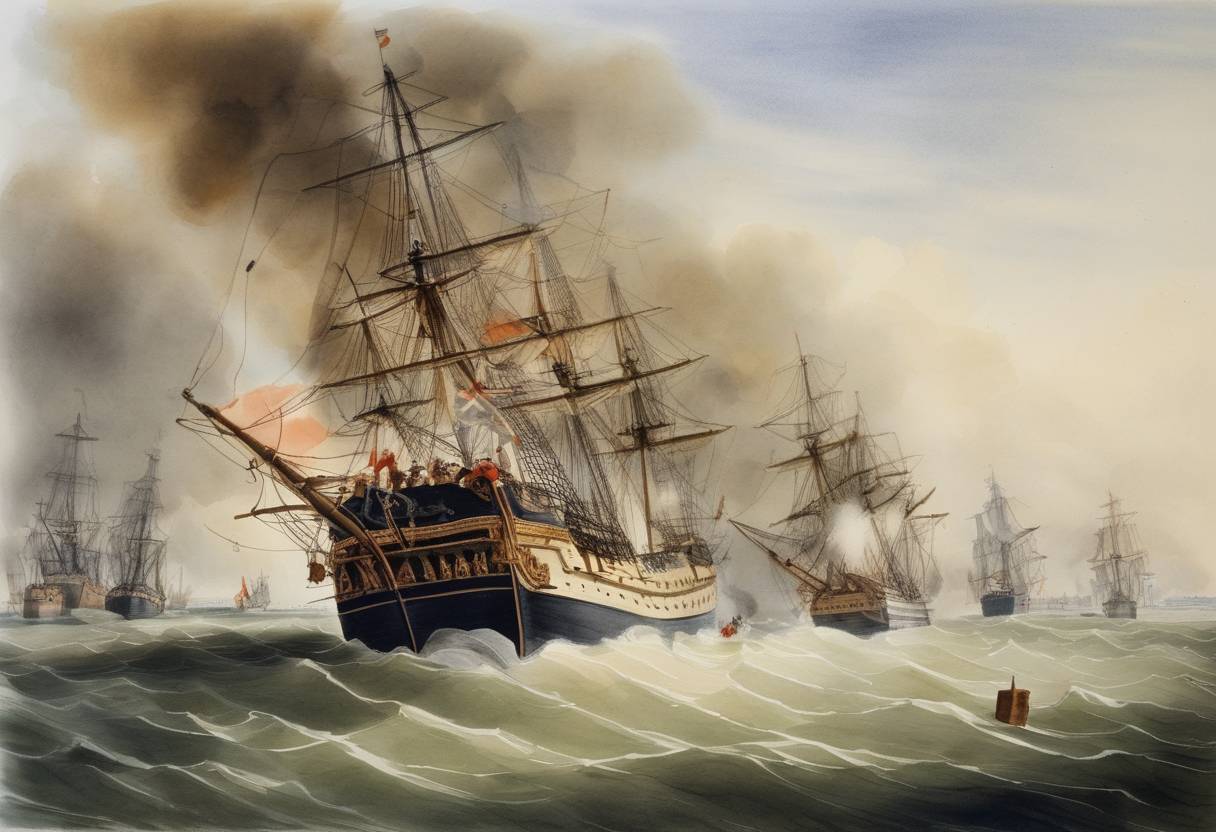
Battle of Camperdown: October 11, 1797
On October 11, 1797, the British Royal Navy secured a significant victory over the Dutch fleet at the Battle of Camperdown, a critical engagement during the French Revolutionary Wars. This battle reinforced British naval superiority and was instrumental in curbing French influence via their Dutch allies.
Context and Background
Following the French Revolution, a series of coalition wars pitted Revolutionary France against multiple European powers, including Britain. The Netherlands, under the influence of France, posed a threat to British dominance in the North Sea.
The Dutch fleet under Vice-Admiral Jan de Winter sought to challenge British control of the waters and potentially support French naval operations. For Britain, maintaining this control was essential to protect trade routes and national security.
The Forces
British Fleet: Commanded by Admiral Adam Duncan, the British fleet consisted of 16 ships of the line. Duncan’s leadership was noted for decisiveness and resilience, factors that would prove crucial in the battle.
Dutch Fleet: The Dutch fleet was composed of 11 ships of the line. Vice-Admiral Jan de Winter was tasked with the challenging mission of breaking the British blockade to assert Dutch naval power and assist French campaigns.
The Battle
The battle commenced off the coast of Camperdown, near the North Sea. Duncan’s strategic plan involved splitting the British fleet into two sections to overpower and disrupt the formation of the Dutch fleet, which was sailing in a line of battle. The British ships aggressively closed in, facilitating a decisive and chaotic close-quarters engagement.
Key Moments
The aggressive maneuvering of the British fleet quickly disrupted the Dutch line, leading to intense fighting. The British ships effectively utilized their superior gunnery and seamanship.
The Dutch flagship, Vrijheid, was surrounded and subjected to heavy fire, eventually surrendering, which marked a turning point in the battle.
Duncan’s bold tactics and the superior discipline of his fleet resulted in overwhelming the Dutch forces, capturing eleven Dutch ships and breaking their naval influence.
Aftermath and Significance
The British victory at Camperdown had substantial strategic implications:
British Naval Dominance: The battle reinforced British control over the North Sea, preventing Dutch support to French operations and maintaining crucial maritime trade routes.
Impact on the Dutch Navy: The defeat diminished the Dutch navy’s ability to project power and align effectively with France thereafter.
Morale and Warfare: The victory boosted British morale following near mutinous conditions in the fleet earlier in 1797, and it emphasized the importance of naval power in the Revolutionary Wars.
Overall, the Battle of Camperdown exemplified effective naval strategy and leadership and was instrumental in sustaining British maritime dominance during a turbulent period in European history.