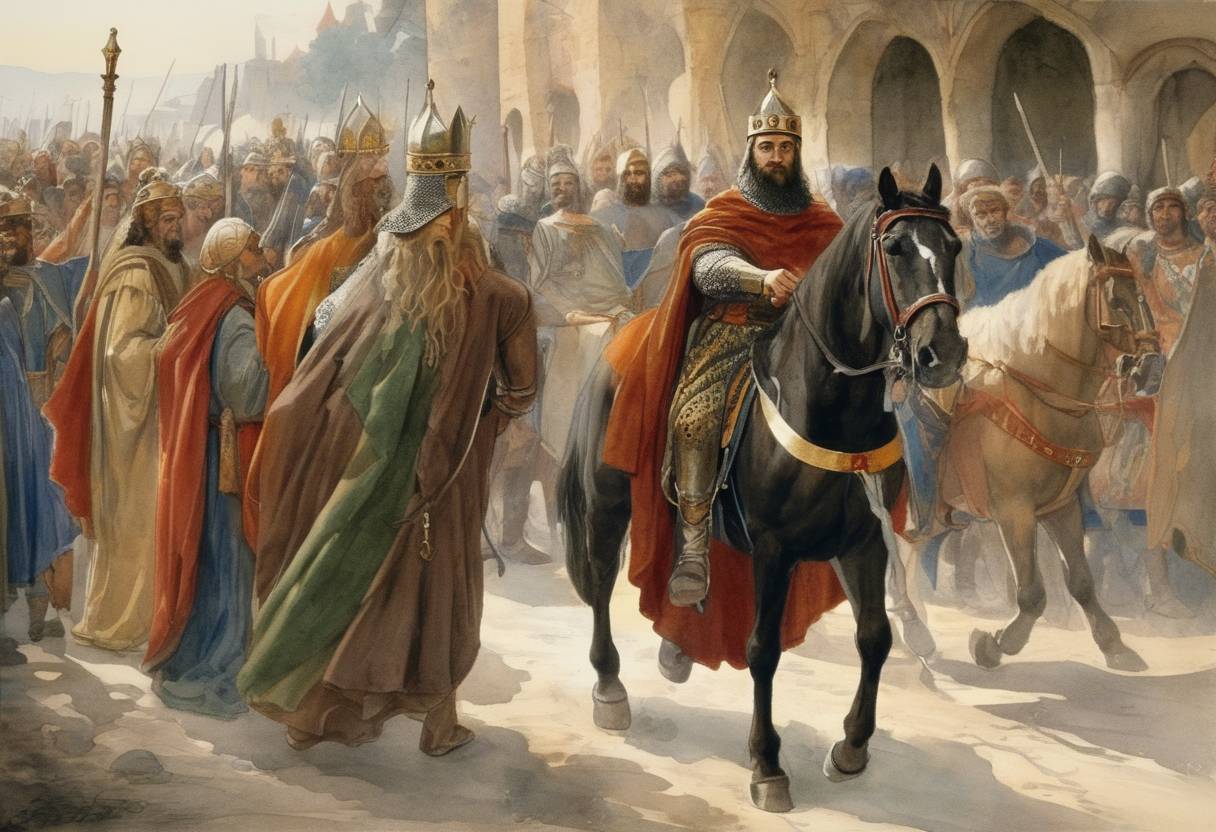
Death of Carloman I and Its Historical Significance
On December 4, 771, Carloman I, who was co-ruler of the Frankish Kingdom alongside his brother Charlemagne, passed away. His death had significant implications for the Frankish Kingdom and the broader political landscape of medieval Europe.
Background
Carloman I was born in 751, the second son of Pepin the Short and Bertrada of Laon. Upon their father’s death in 768, Carloman and his elder brother, Charlemagne, inherited the Frankish Kingdom, which was divided between them. Carloman ruled over the eastern part, including Burgundy, Provence, and territories to the south, while Charlemagne took control of the western territories.
Co-Rulership and Tensions
The co-rule tenure of Charlemagne and Carloman I was marked by underlying tensions, partly due to divergent political strategies and potentially the influences of their advisors, including their mother, Bertrada. Efforts for cooperation were often strained, with the brothers exhibiting mutual suspicion. A significant event highlighting this tension occurred when Carloman refused to provide support to Charlemagne during a campaign against the rebellious Aquitainians.
Death and Aftermath
Following Carloman’s sudden death from unknown causes in 771, Charlemagne became the sole ruler of the entire Frankish Kingdom. This unification under a single ruler significantly bolstered the power of the Frankish state.
Key Implications
Political Stability and Expansion: With the elimination of internal division, Charlemagne could focus more on external conquests and consolidation of power. This laid the groundwork for what would become the Carolingian Empire.
Influence Over Europe: Charlemagne’s subsequent reign saw an expansion that would dominate much of Western and Central Europe, enhancing the Frankish Kingdom’s influence and leading to the Carolingian Renaissance—a revival of art, culture, and learning based on classical models.
Dynastic Impacts: Carloman’s widow, Gerberga, fled to the court of the Lombards after his death, taking their children with her. This flight set the stage for further conflict between the Lombards and Charlemagne, eventually leading to his conquest of their kingdom.
The passing of Carloman I and the consequent rise of Charlemagne as the sole ruler would have longstanding effects, not just on Frankish territories but on European history as a whole. Charlemagne’s reign marked the genesis of the Holy Roman Empire, a political entity that would shape the continent for centuries.