Martha Place: First Woman Executed by Electric Chair
1899 · Ossining, United States
Martha Place became the first woman to be executed in the electric chair at Sing Sing Correctional Facility in New York for the murder of her stepdaughter.
January 2, 1890
The first electric chair is set up at Auburn Prison in New York.
Auburn, United States | Auburn Prison
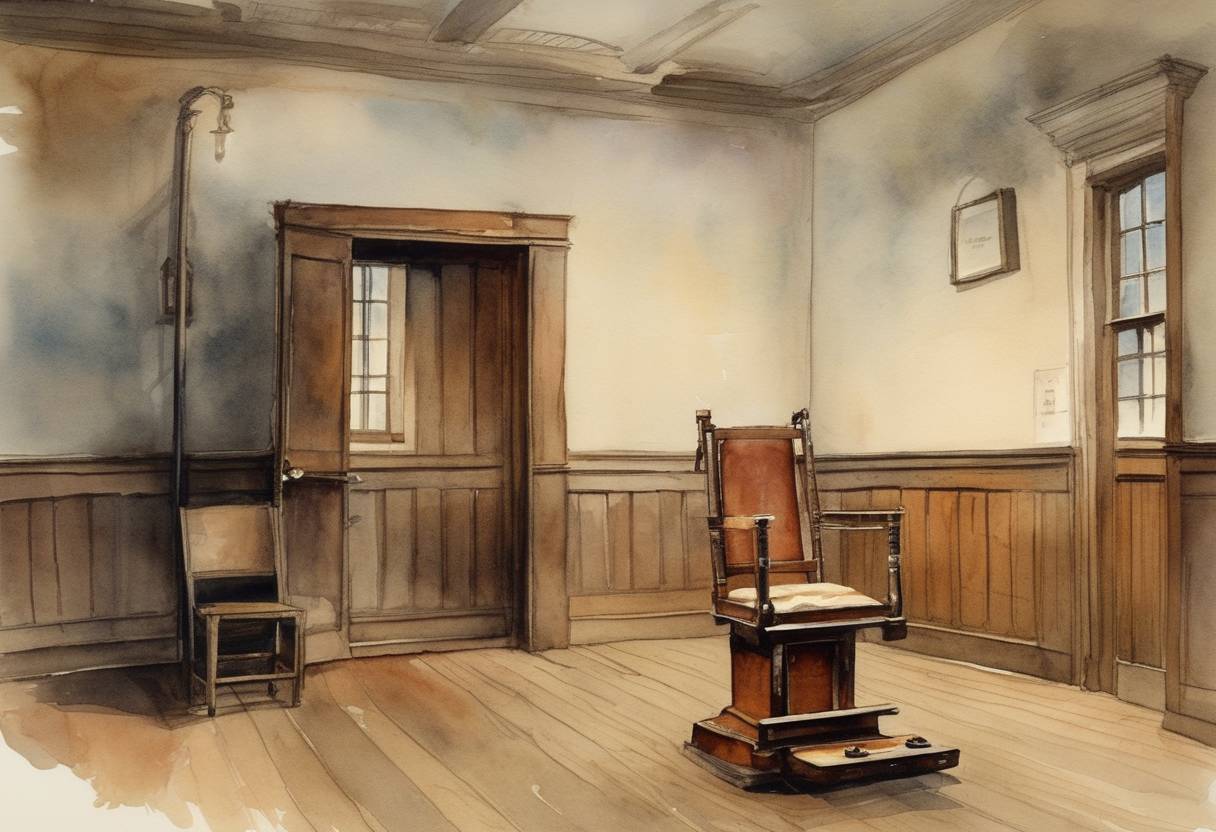
On January 2, 1890, Auburn Prison in New York became the site for the installation of the world’s first electric chair. This event marked a pivotal moment in the history of capital punishment and the use of electricity in penal systems.
In the late 19th century, there was growing debate about the most humane method of execution. Traditional methods such as hanging were increasingly viewed as inhumane and prone to mishaps. The electric chair was proposed as a more humane alternative, promising a quicker and less painful death.
The development of the electric chair was heavily influenced by the so-called “War of Currents,” a period marked by intense competition between Thomas Edison’s direct current (DC) systems and George Westinghouse’s alternating current (AC) systems. Edison’s advocacy for the use of AC electricity in the electric chair aimed to demonstrate its dangers compared to DC, which he endorsed.
Auburn Prison was selected as the site for the first electric chair due to New York State’s decision to replace hanging with electrocution as the state’s official method of execution. The decision followed the 1888 New York legislation that endorsed electrocution as the primary method of executing capital offenders, based on the recommendation of a commission that reviewed humane methods of execution.
Harold P. Brown, an electrical engineer and Edison supporter, was pivotal in the design and construction of the chair. Brown conducted several experiments on animals to test the effectiveness and method of execution by electricity, leading to the design implemented at Auburn Prison.
The electric chair’s introduction was part of a broader reform movement aimed at moral and procedural improvements in the penal system. However, it also sparked ethical and moral debates about the nature of capital punishment and the state’s role in administering such penalties.
In August 1890, the first execution by electric chair was carried out at Auburn Prison, when William Kemmler was executed. This event underscored both the perceived need for and the controversy surrounding the electric chair as a method of execution.
The installation of the electric chair at Auburn Prison set a precedent that saw its adoption by several other states in the following decades, becoming a dominant method of execution in the United States until the adoption of lethal injection in the late 20th century. The use of the electric chair continues to be a topic of legal and ethical discussion.
The historical significance of installing the electric chair lies not only in its immediate impact on execution methods but also in the broader implications for technological progress, ethical considerations, and the evolution of capital punishment practices.
Source: www.britannica.com