1331 · Płowce, Poland
The Battle of Płowce, part of the Polish-Teutonic Wars, was fought between the Kingdom of Poland and the Teutonic Order, ending with a Polish victory.
July 28, 1330
Battle of Velbazhd: A significant medieval battle between the Kingdom of Serbia and the Bulgarian Empire, resulting in a decisive Serbian victory that solidified Serbian power in the Balkans.
Velbazhd, Bulgaria | Kingdom of Serbia
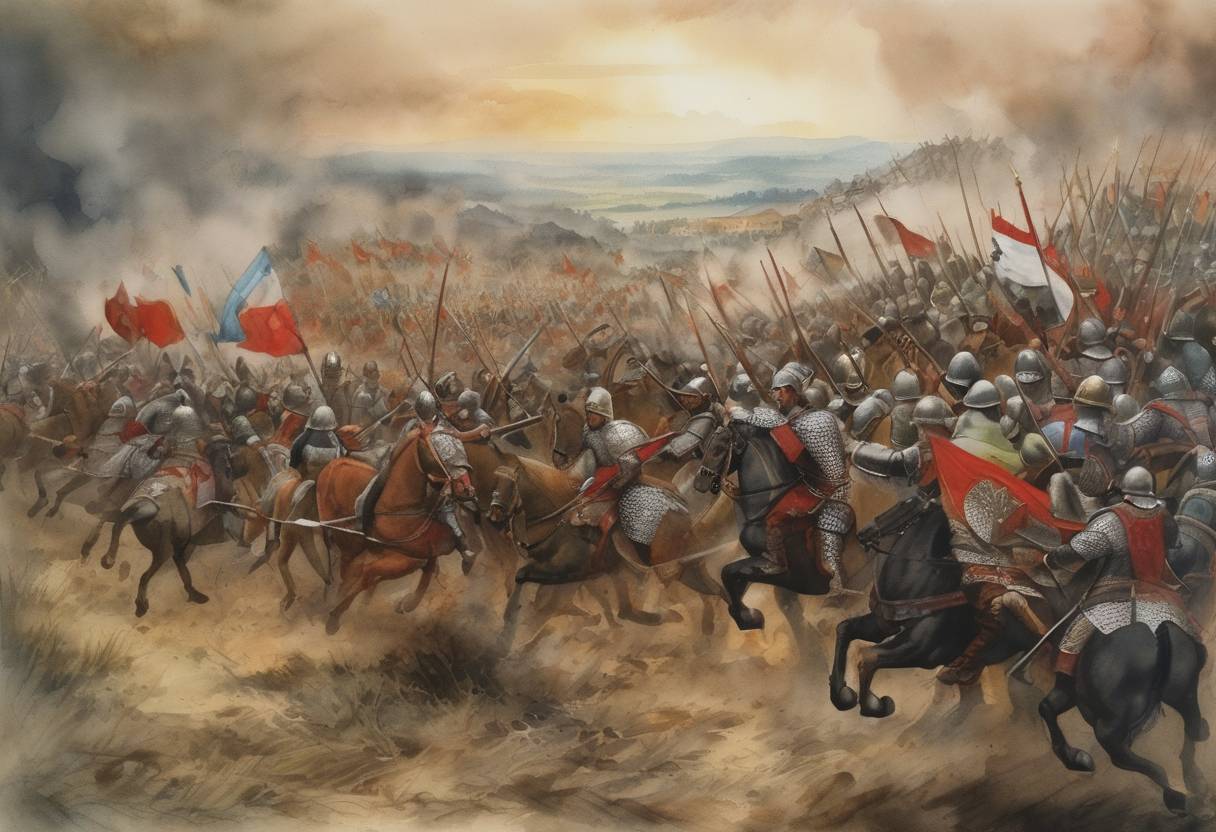
The Battle of Velbazhd, fought on July 28, 1330, was a crucial military engagement in the medieval Balkans involving the Kingdom of Serbia and the Bulgarian Empire. The battle took place near the town of Velbazhd, present-day Kyustendil in western Bulgaria, and it marked a decisive Serbian victory under King Stefan Dečanski.
In the early 14th century, the Balkans were a contested region with several powers vying for dominance. The Kingdom of Serbia, under the leadership of Stefan Dečanski, was rapidly expanding its influence. Meanwhile, the Bulgarian Empire, ruled by Tsar Michael Shishman, aimed to reassert its authority in the region, seeking to curb Serbian expansion and possibly restore its former dominance.
Tensions between Serbia and Bulgaria escalated due to territorial disputes, particularly over Macedonian regions. In 1330, these tensions led to open conflict as both realms mobilized their forces. The Bulgarians aimed to launch a pre-emptive strike while seeking alliances to isolate Serbia. However, the speedy movement and strategic positioning of the Serbian forces set the stage for a confrontation near Velbazhd.
The Serbian army employed effective tactics and superior battlefield strategy. On July 28, King Stefan Dečanski’s forces launched a sudden and devastating assault on the Bulgarian camp. The Bulgarians, taken by surprise and in a compromised position, were swiftly overrun. During the battle, Tsar Michael Shishman was severely wounded and later died, sealing the fate of the Bulgarian forces.
The decisive Serbian victory at Velbazhd had significant implications for the power dynamics in the Balkans:
Serbian Ascendancy: The triumph solidified the Kingdom of Serbia as a dominant power in the region and paved the way for further expansion under Stefan Dečanski’s son, Stefan Dušan, who would later become the Emperor of the Serbs and Greeks.
Bulgarian Decline: The defeat marked the beginning of a decline in Bulgarian influence. The empire struggled with internal fragmentation and external pressures, weakening its position significantly.
Regional Stability Shift: The power balance shifted in favor of the Serbians, allowing them greater leverage in regional politics and influencing the subsequent history of the Balkans.
In summary, the Battle of Velbazhd was more than just a military victory; it was a transformative event that reshaped the political landscape of Southeastern Europe during the 14th century.
Source: en.wikipedia.org