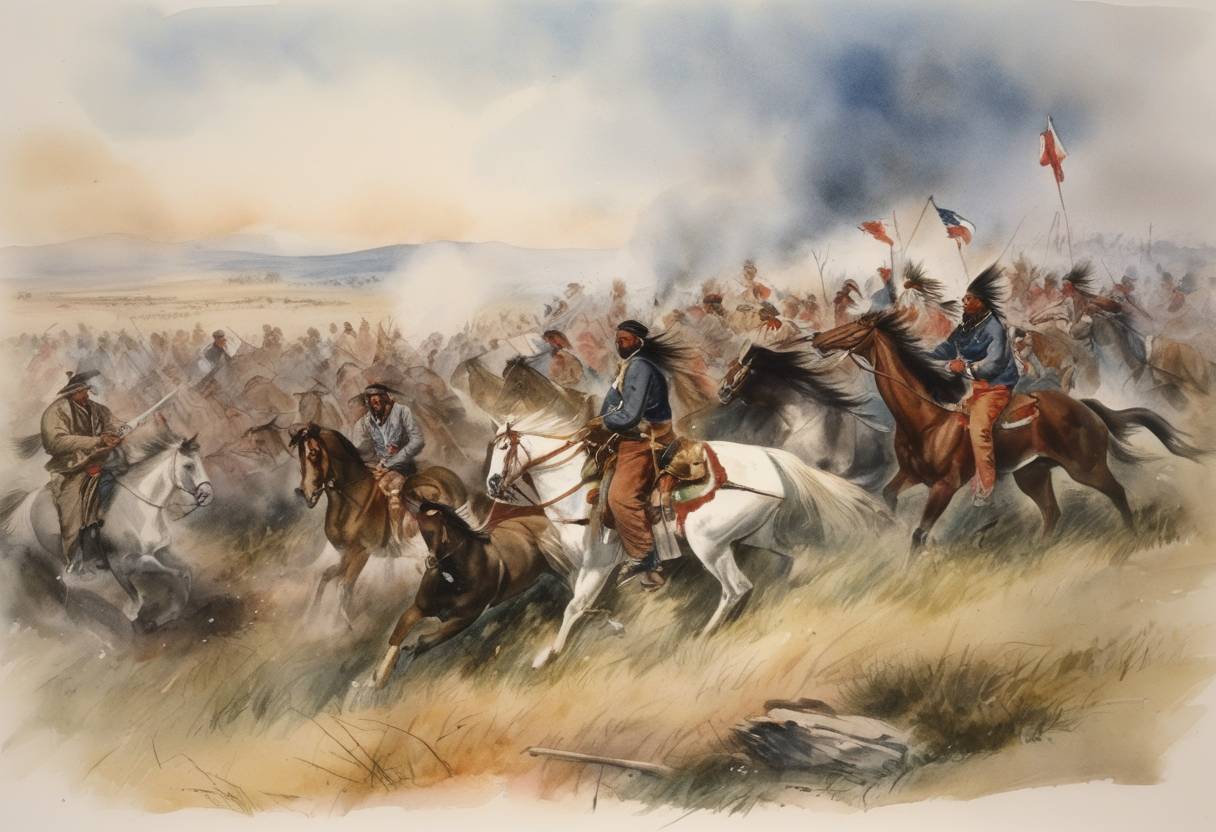
The Battle of the Rosebud: June 17, 1876
Context and Background
The Battle of the Rosebud took place on June 17, 1876, in the Montana Territory, part of the wider Great Sioux War of 1876. The conflict arose from tensions between the United States government and Native American tribes over land rights and sovereignty, especially following the discovery of gold in the Black Hills, which were sacred to the Sioux.
Forces Involved
The United States Army contingent was led by General George Crook. His force included around 1,300 soldiers, composed of cavalry and infantry, along with a contingent of Crow and Shoshone scouts. On the opposing side, the Native American coalition was primarily comprised of Lakota Sioux and Northern Cheyenne warriors, with leadership by the notable war leader Crazy Horse. Their numbers were estimated to be between 1,000 to 1,500 warriors.
The Battle
The confrontation began as General Crook’s forces marched northward with the objective of linking up with General George A. Custer’s Seventh Cavalry. As Crook’s forces moved through the Rosebud Valley, they unexpectedly encountered the Native American coalition.
The battle was marked by fierce and chaotic engagements, with both sides maneuvering for advantageous positions across the rugged terrain. Crazy Horse and his forces effectively used ambush tactics, exploiting their knowledge of the land. The battle lasted for several hours and was characterized by intense and close-quarters combat.
Outcome and Aftermath
Ultimately, the Native American forces successfully halted Crook’s advance. The inability of Crook’s forces to continue north allowed Crazy Horse and his warriors to further consolidate and prepare for the subsequent confrontation with Custer’s forces at the Battle of the Little Bighorn.
The Battle of the Rosebud was a strategic victory for the Lakota Sioux and Northern Cheyenne. It delayed Crook long enough to prevent him from supporting Custer, contributing to the monumental defeat of the Seventh Cavalry at Little Bighorn eight days later, sometimes referred to as “Custer’s Last Stand.”
Historical Significance
The victory at the Rosebud reinforced Native American resistance to U.S. military campaigns aimed at their subjugation and land acquisition. It demonstrated the strategic acumen of leaders like Crazy Horse and underscored the challenging nature of United States expansionism in the face of determined and well-organized indigenous resistance.
The battle remains a significant event in the broader narrative of United States and Native American history, symbolizing native resilience in the face of immense pressure and encroachment on their lands and way of life.