The United Irishmen's Rebellion and the Easter Rising: Clarification on Historical Context
1800 · Ireland, Ireland
The United Irishmen's Rebellion: The Irish Republican Army attempt to launch a diversionary attack during the Easter Rising.
August 22, 1798
French troops land at Killala Bay as part of an ill-fated attempt to support the Irish Rebellion of 1798.
Killala, Ireland | French Republic
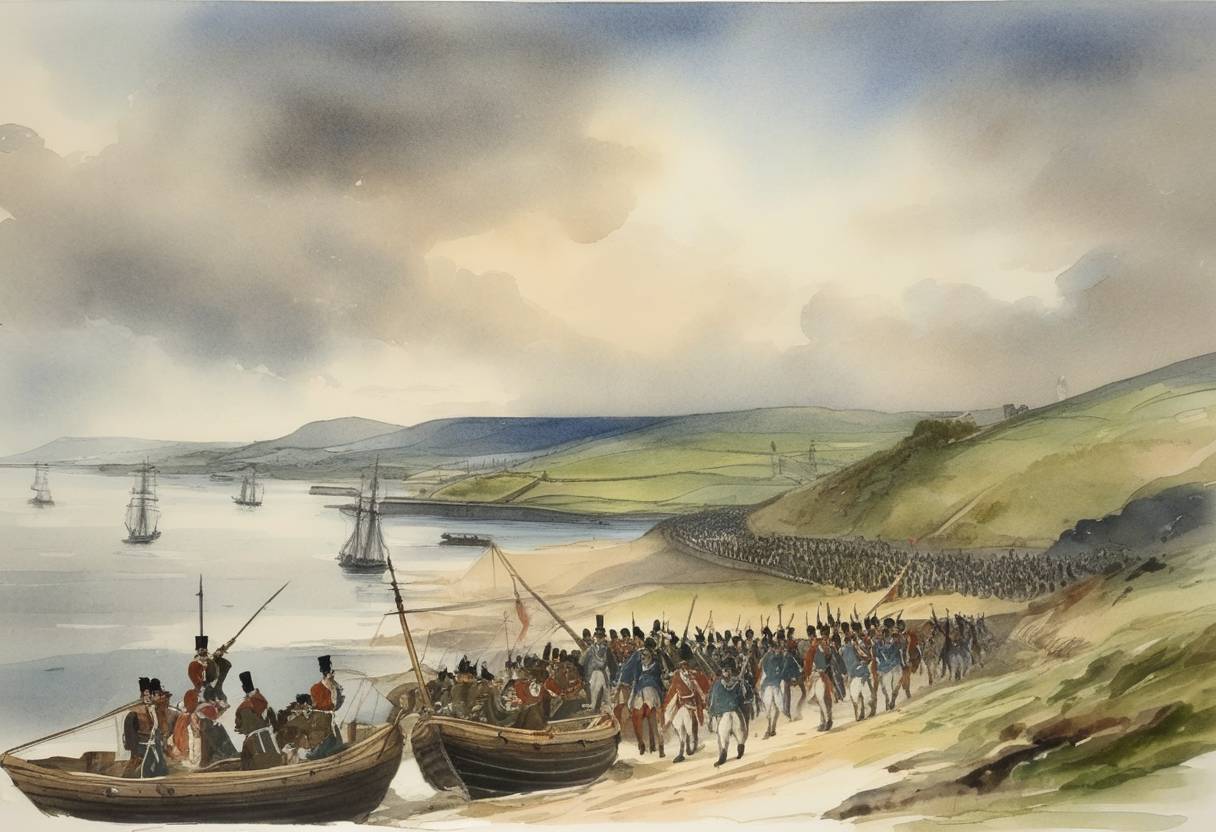
On August 22, 1798, a contingent of French troops landed at Killala Bay in County Mayo, Ireland, as part of a bold but ultimately doomed effort to support the Irish Rebellion of 1798. This expedition was one of several attempts by the French to weaken British power by inciting and supporting uprisings within the British Isles.
The Irish Rebellion of 1798 was fueled by widespread discontent among the Irish, who were primarily seeking independence from British rule and inspired by revolutionary movements in America and France. The Society of United Irishmen, a revolutionary group advocating for Irish republicanism and unity across religious lines, played a key role in organizing the rebellion. France, which had been in conflict with Britain since the French Revolution, saw an opportunity to destabilize its adversary by aiding the rebels.
The force that arrived at Killala Bay was relatively small, consisting of about 1,100 soldiers led by General Jean Joseph Amable Humbert. They were part of a larger strategy planned by the French to launch multiple invasions into Ireland. The landing at Killala was the only successful expedition, as other planned invasions failed due to various logistical challenges and adverse weather conditions.
Upon their arrival, the French troops were welcomed by local Irish rebels, and they quickly moved to capture the town of Ballina on August 23. This incited hope among the local population, and a number of Irishmen joined the French ranks, swelling their numbers modestly. However, misunderstandings, a lack of coordination, and the limited size and support for the French force ultimately made sustained success challenging.
The most significant engagement following the landing at Killala was the Battle of Castlebar on August 27, 1798. The French and their Irish allies managed to decisively defeat a larger British force, an event known colloquially as the “Castlebar Races” given the rapid British retreat. However, despite this victory, the French-Irish force was isolated from potential reinforcements and severely outmatched by subsequent British military responses.
Following initial victories, the French and Irish forces were gradually worn down by numerically superior British troops. The campaign culminated in the Battle of Ballinamuck on September 8, where the French forces were decisively defeated. General Humbert and his troops were captured, while many Irish insurgents were killed or later executed.
The failure of the French expedition to secure Irish independence and the subsequent suppression of the rebellion had significant repercussions. The harsh aftermath discouraged further revolutionary activity in Ireland for many years. Additionally, the Act of Union in 1801, which merged the Irish and British parliaments, was partly a political response to prevent further rebellions. The 1798 rebellion and the support it received from France highlighted the persistent struggles in Ireland for self-determination, a theme that persisted well into the 20th century.
Source: www.britannica.com