1214 · Alarcos, Spain
Alfonso VIII of Castile and the forces of the Almohad Caliphate clash in the Battle of Alarcos. This battle establishes Almohad dominance in southern Iberia for a period.
July 16, 1212
The Battle of Las Navas de Tolosa took place, marking a significant turning point in the Reconquista.
Near Las Navas de Tolosa, Present-day Spain | Joint Christian forces
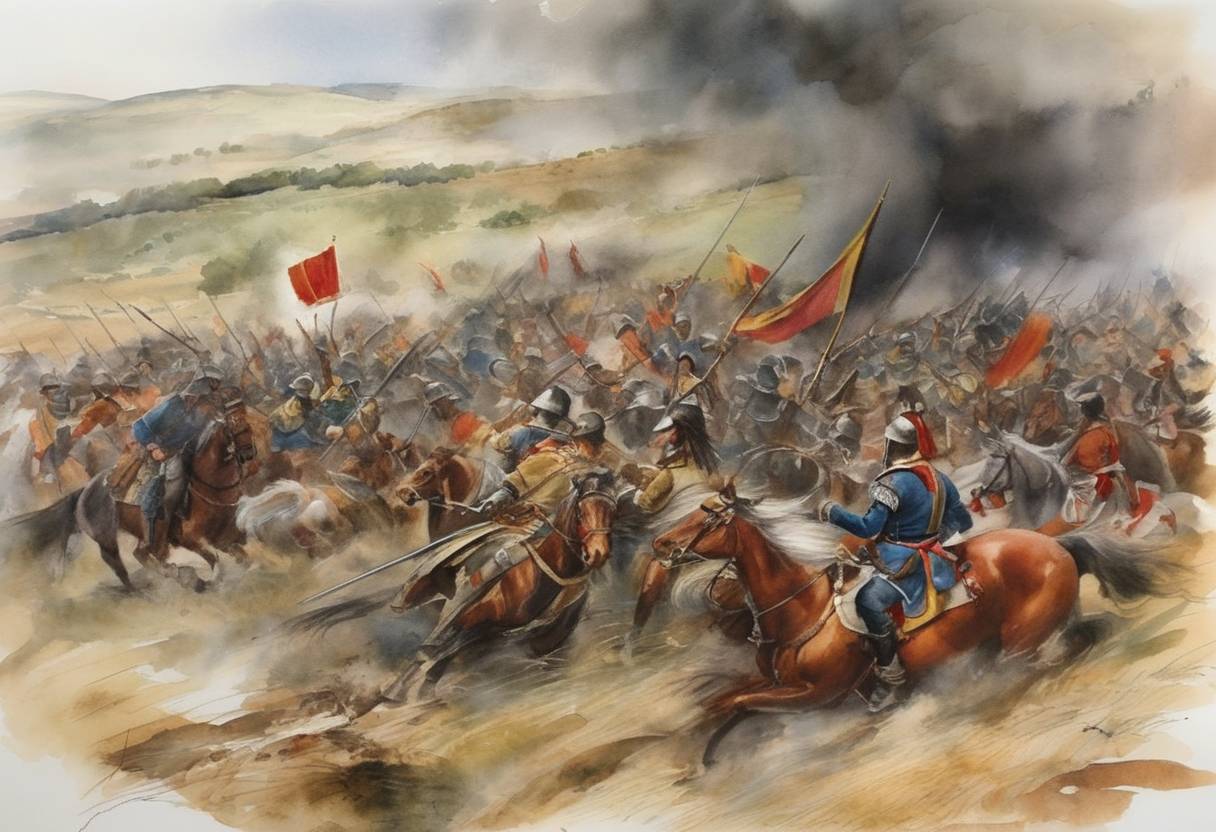
The Battle of Las Navas de Tolosa, fought on July 16, 1212, was a pivotal engagement during the lengthy campaign known as the Reconquista, wherein the Christian kingdoms of the Iberian Peninsula sought to reclaim territory controlled by Muslim rulers since the early 8th century. This battle was part of a larger effort to reduce the influence of the Almohad Caliphate, a North African Berber Muslim dynasty that had established significant control over Al-Andalus, or Muslim Spain.
The Crusade Invitation: Pope Innocent III declared a crusade against the Almohads, encouraging European knights to join the effort. The call was particularly answered by Spanish Christian realms such as Castile, Aragon, and Navarre, as well as military orders like the Knights Templar and the Knights Hospitaller.
Pre-battle Coalition: King Alfonso VIII of Castile spearheaded the creation of a coalition against the Almohads, successfully drawing support from King Peter II of Aragon and King Sancho VII of Navarre. Despite various political tensions among the Christian states, this unprecedented unity was partly rallied by religious fervor and promises of indulgences.
Location and Forces: The battlefield at Las Navas de Tolosa, in the region of Andalusia, was chosen after the Almohad forces, led by Caliph Muhammad al-Nasir, advanced into Christian territories. The Christian forces reportedly numbered around 10,000 to 15,000 men, while the Almohad army was much larger, possibly exceeding 20,000 troops.
Strategic Maneuvers: Initially, the Almohads held a strong defensive position in the pass, which was difficult for the Christians to penetrate. However, a strategic maneuver known as Alboacén, facilitated by the treacherous guidance through the Despeñaperros Mountains by local shepherds, allowed Christians to flank the Muslim army.
Decisive Moments: The battle was marked by the bold charge led by Sancho VII of Navarre, who broke through the Almohad lines. Key to their victory was overwhelming the caliph’s elite guard, known as “The Black Guard,” and reaching al-Nasir’s tent, causing his forces to collapse in disarray.
Christian Advance: The overwhelming victory significantly weakened the Almohad presence in Iberia, hastening the decline of Muslim rule. The victory allowed Christian forces to gain substantial territorial advances in subsequent campaigns.
Symbolic Impact: The battle has profound symbolic significance as it represented a unifying triumph for the Christian forces in Spain, bolstering morale and boosting the ongoing Reconquista efforts which would continue until the fall of Granada in 1492.
Cultural Legacy: Las Navas de Tolosa became emblematic of the struggle between Christian and Muslim powers, often celebrated in medieval lore and heraldry. It symbolized Christian solidarity in the face of a common enemy, despite occasional internal conflicts.
The Battle of Las Navas de Tolosa thus stands as a crucial turning point in the Iberian Peninsula’s history, drastically altering the political landscape of the region in favor of the Christian kingdoms. Its repercussions continued to resonate through the concluding centuries of the Reconquista.
Source: en.wikipedia.org