Discovery of Liquid Water on Mars - September 27, 2015
2015 · Washington, D.C., United States
NASA announced that liquid water was found on Mars, a significant discovery in the search for extraterrestrial life.
July 31, 2008
NASA confirms that its Phoenix Mars Lander has discovered water ice on Mars, a pivotal finding in the quest to determine the potential for life on the planet.
Pasadena, United States | NASA
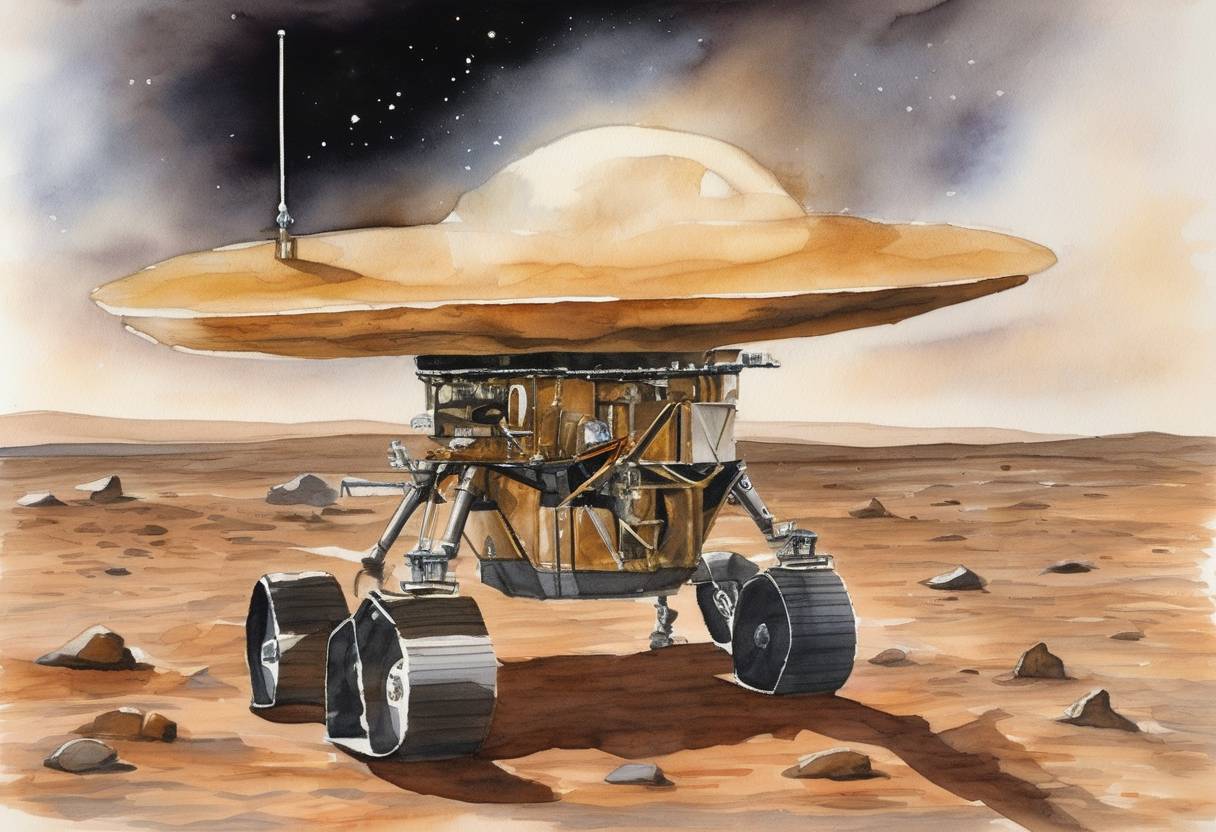
On July 31, 2008, NASA announced a significant milestone in space exploration with the confirmation that the Phoenix Mars Lander had discovered water ice on Mars. This finding represented a pivotal development in the search for potential life on the Red Planet and was a key moment in the study of its geochemistry and climate history.
The Phoenix Mars Lander was part of NASA’s Mars Scout Program aimed at understanding the Martian arctic’s water history and potential habitability. Launched on August 4, 2007, the spacecraft successfully landed in the planet’s northern polar region on May 25, 2008. The primary goals of the mission included studying the history of water in all its phases, examining the interactions between the soil and atmosphere, and assessing the habitability potential of the near-surface environment.
Using its robotic arm, the Phoenix Mars Lander dug into the Martian surface, revealing a bright material just beneath the soil. This material was later confirmed to be water ice through the use of the lander’s onboard instruments, including its TEGA (Thermal and Evolved-Gas Analyzer) and MECA (Microscopy, Electrochemistry, and Conductivity Analyzer). The instruments were able to heat the samples which, in turn, confirmed that the volatile substance was indeed water ice. The discovery of water ice was further validated by its observable sublimation as the material disappeared when exposed to the spacecraft’s environment.
The confirmation of water ice on Mars was monumental for several reasons:
This discovery by the Phoenix Mars Lander rejuvenated interest and investment in Mars exploration by confirming that water, a fundamental component for life as we know it, exists on the planet. It spurred more advanced missions like the Mars Science Laboratory and the Mars Exploration Rovers, which aimed to further investigate Mars’ geological history and habitability. The findings marked an essential step in understanding our neighboring planet and exploring the possibility of life beyond Earth.
Source: www.nasa.gov