Samuel Morse Patents His Telegraph System
1840 · Washington D.C., United States
Samuel Morse patents his telegraph system, a pivotal moment in the history of communication technology.
January 6, 1838
Samuel Morse and Alfred Vail demonstrated the telegraph system for the first time.
Morristown, United States | Morse and Vail
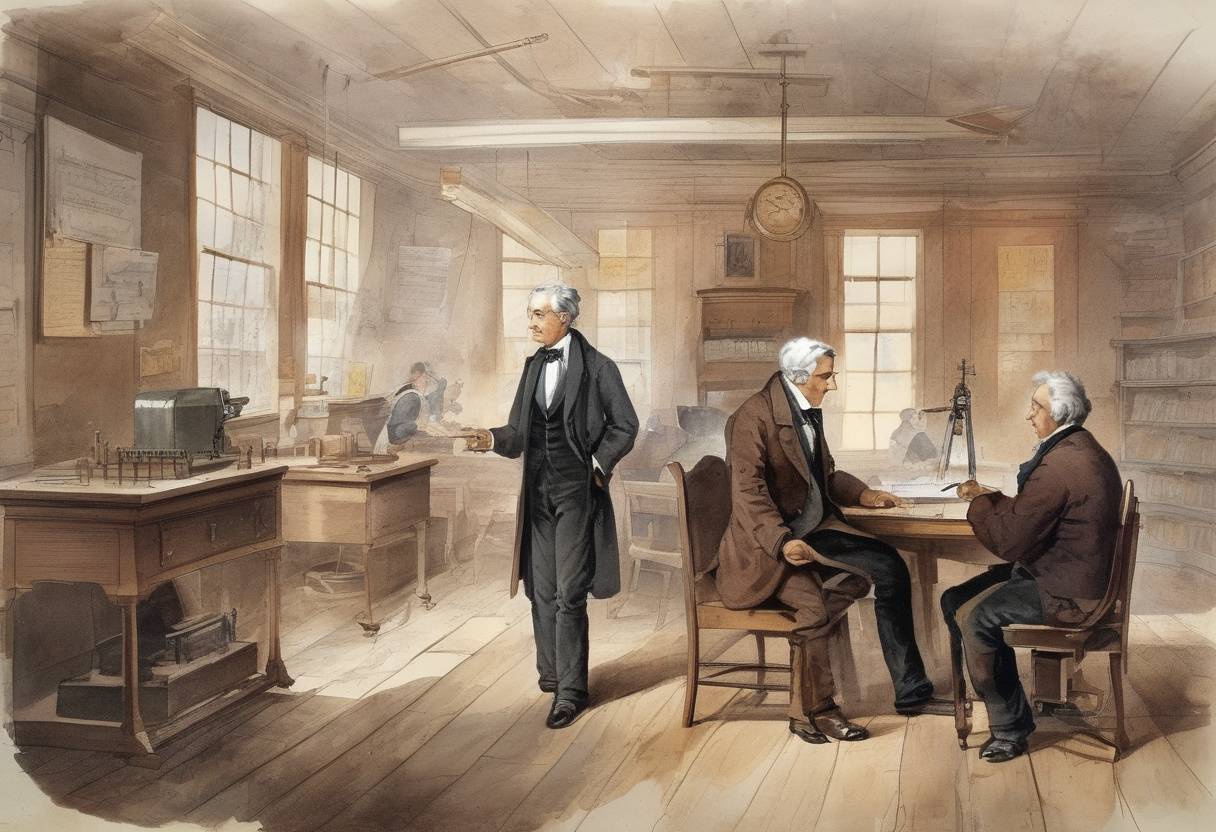
On January 6, 1838, Samuel Morse and Alfred Vail conducted the first public demonstration of their revolutionary telegraph system. This event marked a significant milestone in the history of communication, showcasing a technology that would eventually transform how information was transmitted over long distances.
Samuel Morse: An American painter and inventor, Morse was initially interested in the idea of a telegraph after hearing about European experiments with electrical telegraphy. He began working on his version of the telegraph in the early 1830s.
Alfred Vail: A skilled machinist and inventor, Vail joined Morse in 1837. He contributed significantly to the development of the telegraph, including improvements in the design and the creation of a more efficient code system.
Location: The demonstration took place at the Speedwell Ironworks in Morristown, New Jersey, which was owned by Vail’s family. This site was chosen due to its facilities and Vail’s access to resources.
Technology: The telegraph system used an electrical circuit to send signals over a wire. Morse and Vail’s system included a transmitter and a receiver, with the latter using an electromagnet to mark a paper tape with dots and dashes, which would later become known as Morse code.
Morse Code: Although not fully developed at the time of the demonstration, Morse code was a system of encoding letters and numbers using sequences of dots and dashes. This code was crucial for the telegraph’s success, allowing complex messages to be sent quickly and accurately.
Communication Revolution: The successful demonstration of the telegraph paved the way for the rapid expansion of telegraph networks. By the mid-19th century, telegraph lines spanned continents, drastically reducing the time it took to send messages.
Economic and Social Impact: The telegraph had profound effects on commerce, journalism, and personal communication. It enabled faster business transactions, real-time news reporting, and more immediate personal correspondence.
Legacy: The telegraph laid the groundwork for future innovations in communication technology, including the telephone and the internet. Morse and Vail’s work demonstrated the potential of electrical communication, influencing countless subsequent developments.
In summary, the demonstration on January 6, 1838, was a pivotal moment in technological history, showcasing the potential of the telegraph and setting the stage for a new era of communication. Samuel Morse and Alfred Vail’s collaboration and innovations were instrumental in bringing this transformative technology to life.
Source: en.wikipedia.org