The Guadalcanal Campaign: Battle of the Tenaru
1942 · Guadalcanal, Solomon Islands
The Guadalcanal Campaign, a significant battle in the Pacific Theater of World War II, begins as the Battle of the Tenaru takes place.
August 7, 1942
The Battle of Guadalcanal began during World War II, marking the first major offensive by Allied forces against the Empire of Japan.
Guadalcanal, Solomon Islands | Allied Forces
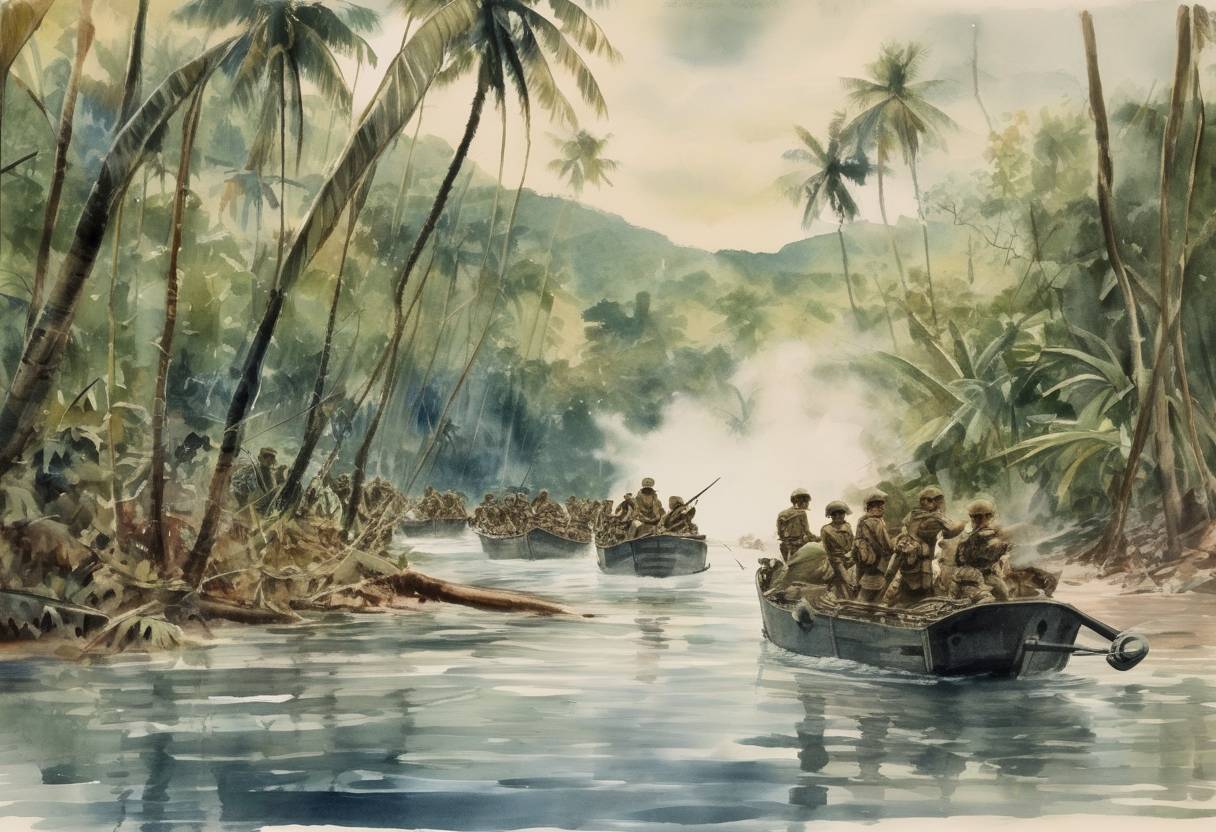
The Battle of Guadalcanal, which commenced on August 7, 1942, marked a pivotal moment in the Pacific Theater of World War II. It was the first major offensive by Allied forces against the Empire of Japan and a significant turning point in the war.
Strategic Importance: Guadalcanal, part of the Solomon Islands, held strategic significance due to its location. The Japanese had begun constructing an airfield on the island, which threatened Allied supply and communication routes between the United States, Australia, and New Zealand.
Allied Strategy: The Allies, primarily the United States, aimed to halt Japanese expansion and establish a base to support further operations in the Pacific. The operation was part of a broader strategy to regain control of the Pacific islands and eventually advance towards Japan.
Initial Landings: On August 7, 1942, U.S. Marines landed on Guadalcanal, Tulagi, and Florida Islands. The landings were part of Operation Watchtower, the codename for the Guadalcanal Campaign. The initial landings were met with little resistance, allowing the Allies to secure the airfield, later named Henderson Field.
Japanese Response: The Japanese quickly recognized the threat posed by the Allied occupation of Guadalcanal. They launched several counterattacks, both naval and ground, to retake the island. The ensuing battles were characterized by fierce combat, including the Battle of Savo Island and the Battle of Edson’s Ridge.
Naval Engagements: The waters around Guadalcanal became the site of numerous naval battles, as both sides sought to control the sea lanes. The naval engagements were crucial in determining the flow of reinforcements and supplies to the island.
Prolonged Campaign: The battle for Guadalcanal continued until February 1943, with both sides suffering heavy casualties. The Japanese eventually evacuated their remaining forces, marking a strategic victory for the Allies.
Turning Point: The successful defense and eventual control of Guadalcanal marked a turning point in the Pacific War. It halted Japanese expansion and shifted the momentum in favor of the Allies, paving the way for further offensives in the Pacific.
Legacy: The Battle of Guadalcanal demonstrated the importance of air and naval power in modern warfare and underscored the significance of joint operations among Allied forces. It also highlighted the harsh conditions and challenges of jungle warfare.
The Battle of Guadalcanal remains a testament to the strategic and tactical shifts that defined World War II in the Pacific, illustrating the resilience and determination of Allied forces in the face of formidable opposition.
Source: en.wikipedia.org