May 18, 1980

Mount St. Helens erupts in Washington state, United States, in one of the most significant volcanic events in U.S. history, causing widespread devastation and loss of life.


Skamania County, United States | United States Geological Survey
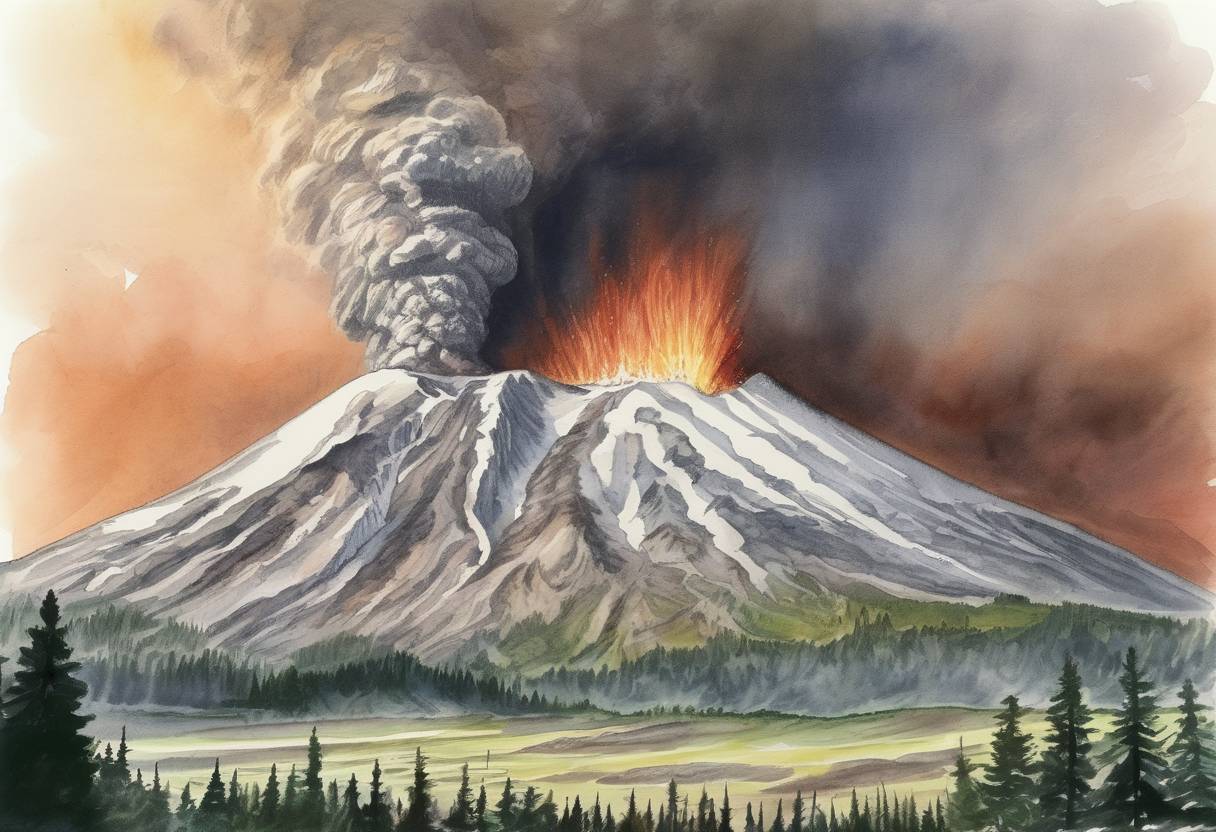
Watercolor painting based depiction of Mount St. Helens erupts in Washington state, United States, in one of the most significant volcanic events in U.S. history, causing widespread devastation and loss of life. (1980)

Mount St. Helens Eruption: May 18, 1980

On May 18, 1980, Mount St. Helens, located in Washington state, erupted in one of the most significant volcanic events in United States history. This catastrophic eruption resulted in widespread devastation and loss of life, marking a pivotal moment in the study of volcanology and emergency management.

Background

Mount St. Helens is part of the Cascade Range, a volcanic arc in the Pacific Northwest. Prior to 1980, the volcano had been dormant since its last significant eruption in 1857. However, in March 1980, a series of earthquakes and steam-venting episodes signaled a reawakening. These precursors included:

  • March 20, 1980: A magnitude 4.2 earthquake, the first sign of volcanic activity.
  • March 27, 1980: The volcano began to emit steam and ash, forming a new crater and a growing bulge on its north flank.

The Eruption

The catastrophic eruption occurred at 8:32 a.m. on May 18, 1980. The sequence of events unfolded as follows:

  1. Earthquake Trigger: A magnitude 5.1 earthquake struck beneath the volcano, triggering the collapse of the north face.
  2. Landslide: The largest landslide in recorded history swept down the mountain, removing the bulging north flank.
  3. Lateral Blast: The sudden release of pressure caused a lateral blast, sending a superheated mix of volcanic gases, ash, and debris at speeds up to 670 mph (1,080 km/h).
  4. Plinian Eruption: A column of volcanic ash rose over 15 miles (24 km) into the atmosphere, spreading ash across 11 U.S. states and parts of Canada.

Impact

The eruption had devastating consequences:

  • Loss of Life: 57 people were killed, including volcanologist David A. Johnston, who was monitoring the volcano.
  • Destruction: The eruption destroyed 230 square miles (600 square km) of forest, obliterating everything in its path.
  • Economic Damage: The estimated economic damage exceeded $1 billion, affecting timber, transportation, and agriculture.
  • Environmental Impact: The eruption drastically altered the landscape, creating a new crater and depositing ash and debris over a vast area.

Aftermath and Significance

The Mount St. Helens eruption had significant implications:

  • Volcanology: It provided valuable data on volcanic processes and hazards, leading to advancements in monitoring and prediction.
  • Emergency Management: The event underscored the importance of disaster preparedness and response, influencing policies and practices.
  • Ecological Recovery: The eruption zone became a natural laboratory for studying ecological succession and recovery.

In the years following the eruption, Mount St. Helens has remained an active volcano, with periodic eruptions and ongoing scientific study. The event serves as a powerful reminder of the dynamic nature of Earth’s geology and the need for vigilance in monitoring volcanic activity.