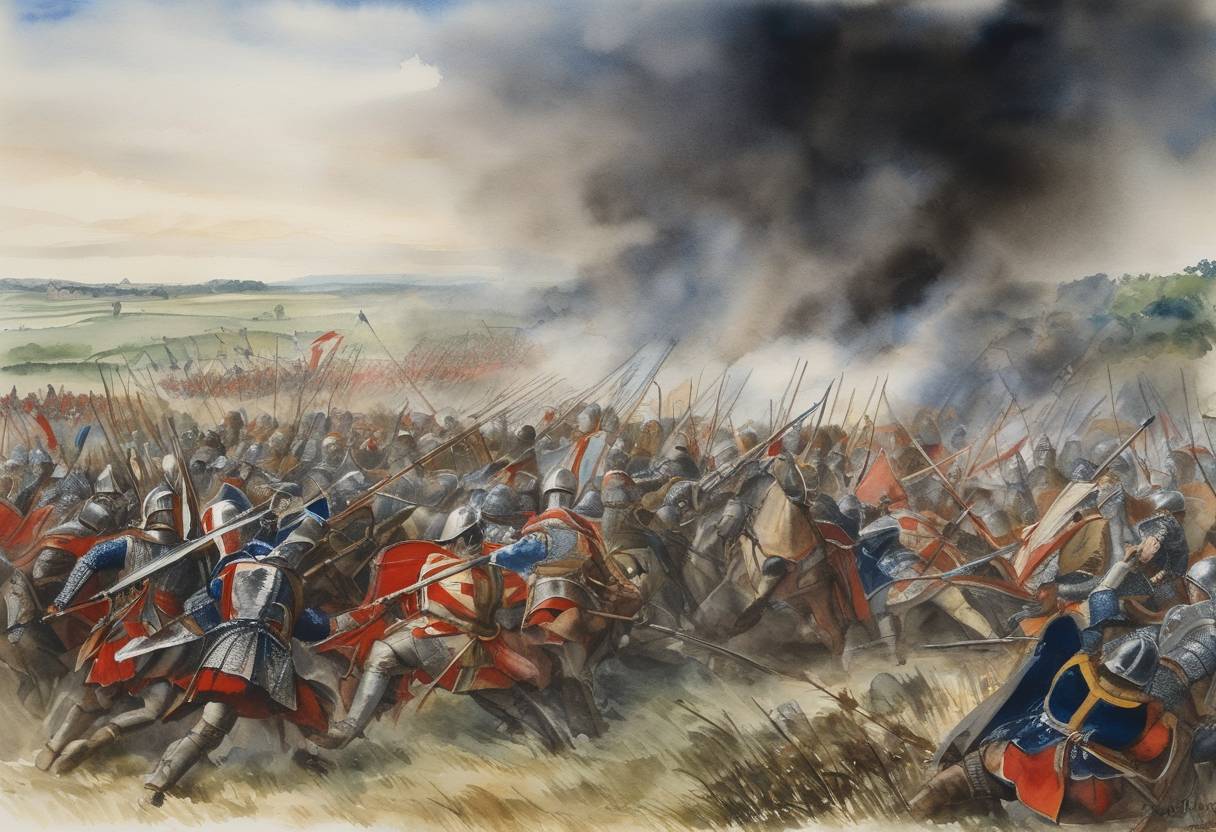
Battle of Poitiers - September 19, 1356
The Battle of Poitiers is one of the notable engagements during the Hundred Years’ War, a protracted conflict between the Kingdom of England and the Kingdom of France. It took place on September 19, 1356. On this day, English forces led by Edward, the Black Prince, achieved a significant victory over a French army commanded by King John II of France.
Context and Prelude
The background to the Battle of Poitiers involves the ongoing tensions and claims to the French throne that had been made by the English monarchy. After decisive English victories at the battles of Crécy in 1346 and the capture of Calais in 1347, the two sides entered a temporary truce. However, tensions resumed, and the English sought to conduct strategic raids, known as chevauchées, into French territories to weaken their adversary.
The Combatants
Edward, the Black Prince, was the eldest son of King Edward III of England and was already an experienced military leader by the time of Poitiers. The English forces, though outnumbered, utilized superior tactics, including defensive positions and the effective use of longbowmen. In contrast, the French forces, commanded by King John II, were much larger but struggled with issues of unity and cohesiveness among their troops.
The Battle
The battle took place near the city of Poitiers, in the region of Poitou. The English forces utilized terrain and positioning to their advantage, taking a defensive stance in a location flanked by natural obstacles, which helped negate the numerical superiority of the French.
During the battle, the English longbowmen played a crucial role in disrupting the French cavalry and infantry advances, similar to what had been effective at the earlier Battle of Crécy. The French army launched several assaults, but each was repelled by the disciplined English forces.
Capture of King John II
A pivotal moment in the battle occurred when King John II was captured by the English forces. Alongside him, many other French nobles were taken prisoner. The capture of the French king was a significant blow to France, severely weakening its political and military standing.
Aftermath and Significance
Following the battle, Edward, the Black Prince, treated his noble captives, including King John II, with notable chivalry. The capture of the king led to a crisis in France, resulting in political instability and contributing to social unrest, including uprisings known as the Jacquerie.
The immediate consequences of the English victory at Poitiers were profound. It eventually led to the Treaty of Brétigny in 1360, under which France agreed to a large ransom for the release of King John II, along with concessions of territory to England. The treaty, however, only provided a temporary peace, as the Hundred Years’ War resumed thereafter.
The Battle of Poitiers stands as a testament to the tactical ingenuity of the English under the Black Prince, marking one of the pivotal successes for England during the Hundred Years’ War and altering the course of medieval European history.