1644 · Chester, England
The Battle of Rowton Heath takes place during the English Civil War, resulting in a victory for the Parliamentarians over the Royalists.
October 8, 1645
The Battle of Winceby occurred, a decisive engagement of the First English Civil War, leading to a victory for the Parliamentarians and opening the way for their control over Lincolnshire.
Winceby, England | Parliamentarian Army
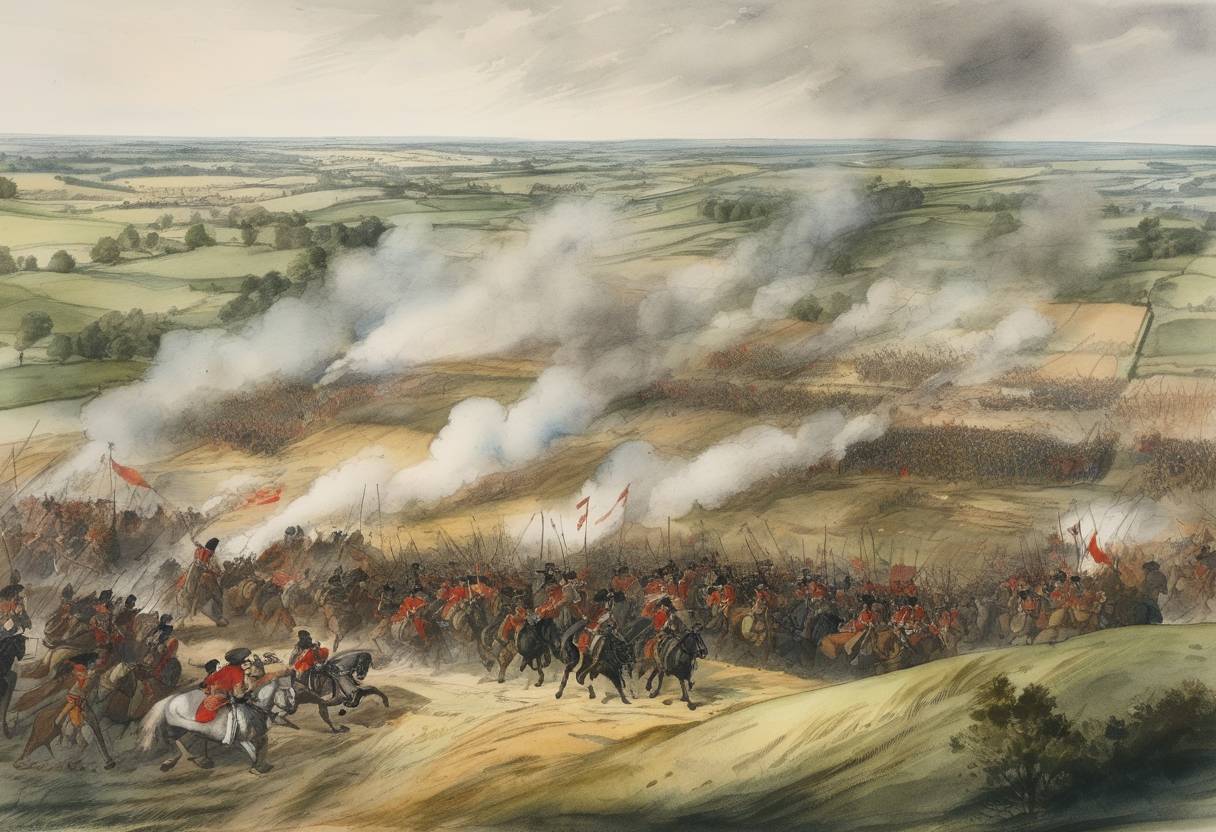
The Battle of Winceby was a pivotal confrontation during the First English Civil War that took place on October 11, 1643. Contrary to some accounts marking it as occurring in 1645, the battle occurred two years earlier. This engagement was significant in securing Parliamentary control over Lincolnshire and was instrumental in shaping the course of the conflict between the Royalists and the Parliamentarians.
The First English Civil War, spanning from 1642 to 1646, was characterized by a clash of ideologies between the Royalists, loyal to King Charles I, and the Parliamentarians, who sought to emphasize the power of Parliament. Prior to the Battle of Winceby, the Parliamentarians, led by the Earl of Manchester and Oliver Cromwell, aimed to relieve the besieged city of Hull and secure the eastern counties of England, which held strategic importance.
On the morning of October 11, 1643, the battle commenced near the village of Winceby in Lincolnshire. The conflict was relatively short, lasting less than two hours. The Parliamentarian forces, despite being somewhat outnumbered, executed a surprise cavalry attack against the Royalists led by Sir William Widdrington and Sir John Henderson, both commanders for the King’s forces.
Oliver Cromwell, commanding the cavalry, played a crucial role in the engagement. His charge was described as decisive, breaking the Royalist ranks and causing significant disarray. The Parliamentarian commanders, utilizing effective tactics and leveraging their cavalry’s strength, overwhelmed the Royalists, resulting in a substantial victory.
The victory at Winceby was a significant strategic success for the Parliamentarians. It facilitated their control over Lincolnshire and diminished the King’s presence in the region. The outcome also bolstered the reputation of Oliver Cromwell and his cavalry, known as the Ironsides, who would continue to play a vital role in subsequent battles.
The victory helped strengthen the Parliamentarian position in the eastern counties and contributed to the broader campaign against Royalist forces throughout the war. The battle exemplified the evolving military strategies and the growing competence of the Parliamentarian forces, setting the stage for future successes and the eventual defeat of Royalist forces in the First English Civil War.
Source: en.wikipedia.org