Richard Nixon's Resignation: August 9, 1974
1974 · Washington, D.C., United States
Richard Nixon became the first U.S. president to resign from office, following the Watergate scandal.
October 10, 1973
The Vice President of the United States, Spiro Agnew, resigns after being charged with tax evasion following investigations of political corruption throughout his career. This resignation marks the first time a U.S. Vice President leaves office due to criminal charges.
Washington, D.C., United States | U.S. Department of Justice
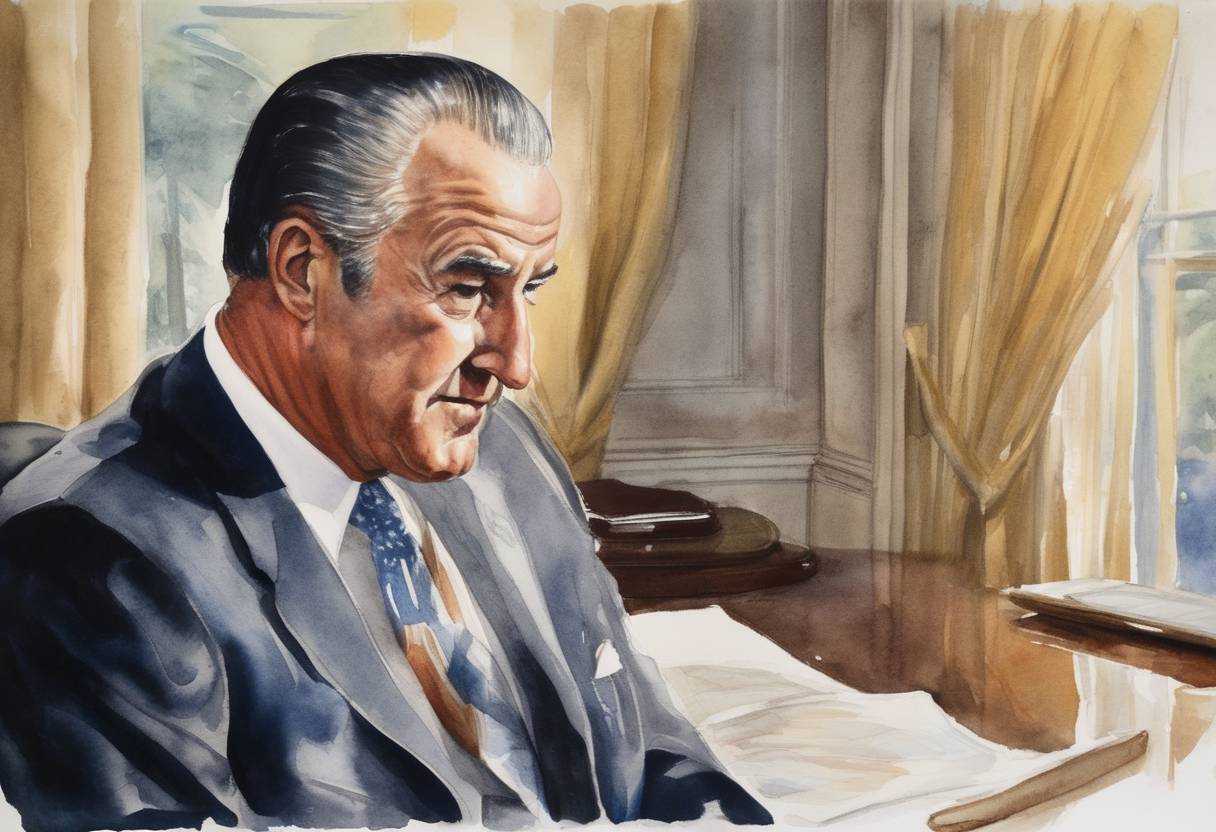
On October 10, 1973, Spiro T. Agnew, the Vice President of the United States, resigned from office amid charges of tax evasion. Agnew’s resignation marked an unprecedented moment in American political history, as it was the first time a sitting U.S. Vice President left office due to criminal charges.
Spiro Agnew, a former governor of Maryland, was elected as Vice President in 1968 and re-elected in 1972 on a ticket with President Richard Nixon. He was known for his strong rhetoric against political opponents, often criticizing them vehemently from the public stage.
The events leading to Agnew’s resignation began with a federal investigation into political corruption in Maryland. The investigation expanded to encompass Agnew’s activities, uncovering evidence that while serving as Baltimore County Executive, Governor of Maryland, and later as Vice President, Agnew had accepted bribes and engaged in other corrupt practices. The probe ultimately led to charges of tax evasion against him, as he had failed to report these illicit payments on his tax returns.
Facing mounting legal pressure and in a bid to avoid prolonged legal battles that could further embarrass the Nixon Administration, Agnew accepted a plea bargain. On October 10, 1973, he submitted his resignation and appeared before a federal court in Baltimore. There, he pled no contest to a single felony charge of tax evasion for a sum of \(13,551 in 1967 and was fined \)10,000.
Agnew’s departure paved the way for the implementation of the 25th Amendment, specifically its provision for filling a vacancy in the vice presidency. Following Agnew’s resignation, President Nixon nominated Gerald Ford, then the House Minority Leader, as Vice President. Ford was confirmed by Congress and sworn in on December 6, 1973.
This sequence of events accentuated the political turmoil of the Nixon presidency, which just months later would be further engulfed by the Watergate scandal. Agnew’s resignation illustrated vulnerabilities in the U.S. political system regarding corruption and accountability at the highest levels of government. It also underscored the importance of the 25th Amendment in providing mechanisms to maintain governmental continuity in times of crisis.
Source: www.history.com