The Entry of the Sixth Coalition into Paris - March 30, 1814
1814 · Paris, France
The forces of the Sixth Coalition entered Paris after defeating Napoleon's army, leading to his abdication and the restoration of the Bourbon monarchy.
February 18, 1814
The Battle of Montereau was fought between Napoleonic forces and a coalition led by Austria during the War of the Sixth Coalition.
Montereau, France | Napoleonic Army
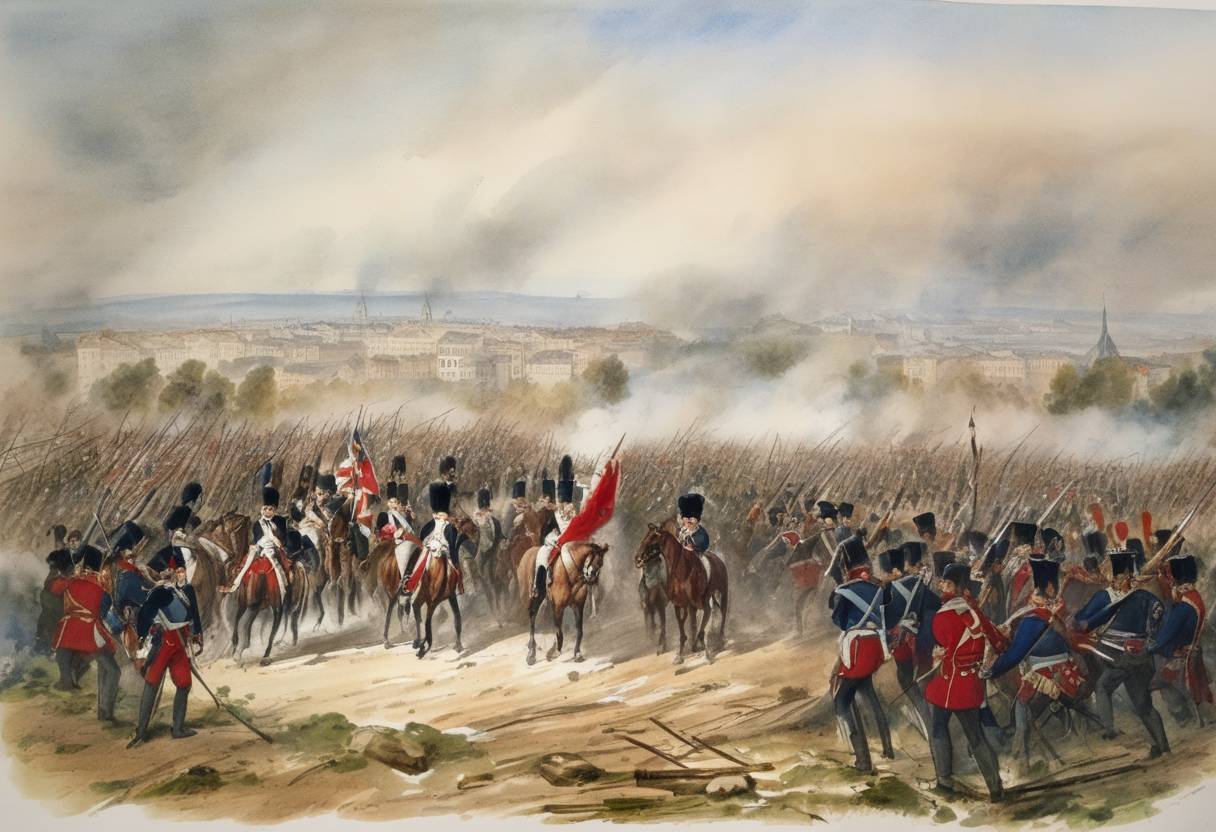
The Battle of Montereau was a significant conflict that took place on February 18, 1814, during the War of the Sixth Coalition, part of the Napoleonic Wars. This battle was crucial in Napoleon Bonaparte’s campaign to recapture the momentum against the Coalition forces invading France.
In 1813, the Sixth Coalition was formed by several European powers, including Great Britain, Russia, Prussia, Austria, Sweden, Spain, and Portugal, with the intent to defeat Napoleon. Following his defeat in the Russian campaign of 1812 and the significant loss at the Battle of Leipzig in 1813, Napoleon retreated to France. By early 1814, the Allied forces were advancing into French territory from multiple directions, creating a desperate situation for French defenses.
As the Coalition forces penetrated deeper into France, Napoleon launched a series of counter-offensives to disrupt their advance. The battle near Montereau was part of the larger Six Days’ Campaign, an endeavor by Napoleon to defeat the maneuvering Austrian Army under the command of Field Marshal Karl Philipp, Prince of Schwarzenberg.
On February 18, French forces, led by Napoleon, engaged the Austro-Württemberg troops in and around the town of Montereau. Napoleon’s strategy capitalized on rapid movements and surprise attacks. His forces included seasoned veterans and newly conscripted troops, who were motivated by Napoleon’s charismatic leadership.
Despite being outnumbered, Napoleon decisively commanded his forces, effectively using artillery and the positioning of his troops to gain strategic advantage. The French first attacked the Coalition defenses around the Seine River and then secured the bridges, pivotal for the Coalition’s retreat operations.
The victory at Montereau was a morale booster for the French and allowed Napoleon to delay the Coalition’s advance toward Paris. It confirmed Napoleon’s tactical brilliance, as he outmaneuvered larger enemy forces through a coordinated offensive. However, despite this temporary success, the overwhelming numbers of the Coalition and the depleted French resources meant that sustaining these victories grew increasingly difficult.
The Battle of Montereau contributed to the temporary halt of the Coalition forces, but it was insufficient to stem the eventual tide. By late March 1814, the Allied forces entered Paris, and Napoleon abdicated shortly thereafter, marking a temporary end to his rule. This battle stands as a testament to Napoleon’s tactical adeptness and the determination of a beleaguered French army in the face of a formidable alliance.
In the context of the War of the Sixth Coalition, Montereau demonstrated both the possibilities and limits of Napoleonic warfare in a changing European landscape fraught with alliances against the previously dominant French Empire.
Source: en.wikipedia.org