The Battle of Copenhagen: April 2, 1801
1801 · Copenhagen, Denmark
The Battle of Copenhagen takes place during the War of the Second Coalition, where a British fleet under Admiral Sir Hyde Parker defeats a Danish-Norwegian fleet.
February 5, 1807
A British naval force began bombarding Copenhagen, leading to the Second Battle of Copenhagen.
Copenhagen, Denmark | Royal Navy
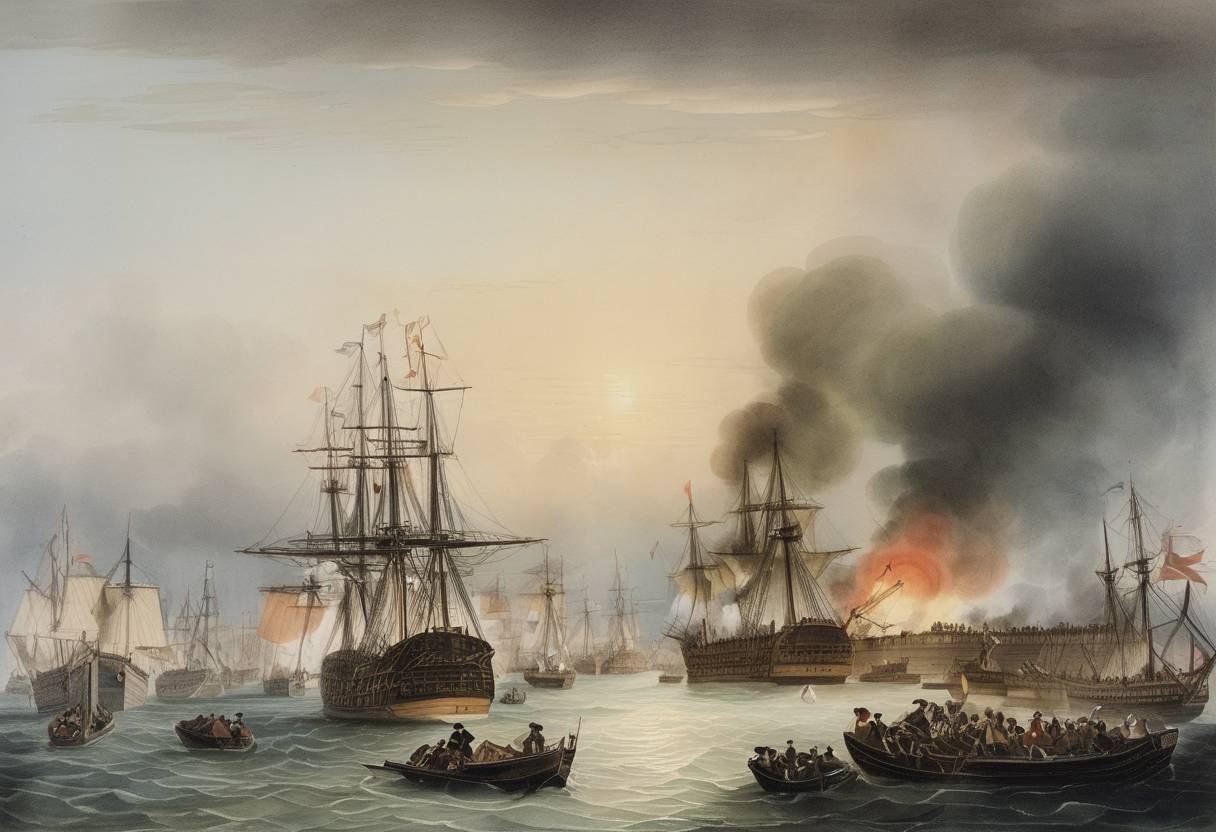
The Second Battle of Copenhagen was a pivotal military campaign during the Napoleonic Wars, involving a British naval assault on the Danish capital, Copenhagen. The battle, which commenced on February 5, 1807, was part of British efforts to prevent Napoleon from commandeering the substantial Danish-Norwegian fleet. This event occurred within the broader strategic efforts of the United Kingdom to maintain naval supremacy and ensure the Continental powers could not coalesce against it effectively.
The background to the bombardment involves Denmark-Norway’s neutral stance during the Napoleonic Wars, coupled with the tensions between major European powers. Britain, wary of Napoleon’s influence and his pursuit of naval dominance, sought to secure the Danish-Norwegian fleet. There was concern that Napoleon might force Denmark-Norway to join his coalition, thus significantly enhancing French naval capabilities.
British intelligence suggested that Napoleon planned to capture these ships, and therefore Britain opted for a pre-emptive strike to either compel Danish cooperation or confiscate the fleet by force.
On February 5, 1807, a British naval force began its campaign against Copenhagen with a bombardment aimed at coercing Denmark into surrendering its fleet or face the consequences. This offensive marked the beginning of an operation that would escalate into a full-scale siege and bombardment later known more specifically for major actions occurring in September 1807.
The bombardment and subsequent siege of Copenhagen resulted in significant destruction and civilian casualties, compelling Denmark-Norway to eventually surrender its fleet. The conclusion of the conflict saw Britain seize upwards of 70 ships, thus neutralizing the Danish-Norwegian naval threat and preventing its potential alliance with France.
The Second Battle of Copenhagen underscores the lengths to which Britain would go to protect its maritime supremacy. It also reflects the broader strategic dynamics of the Napoleonic Wars, where alliances and neutral nations were often thrust into conflict perceptions. The battle reinforced Britain’s naval dominance but also contributed to the deterioration of its relations with Denmark-Norway, leading to long-standing enmity.
The event is a stark example of pre-emptive military strategy and its immediate geopolitical ramifications during one of history’s most turbulent periods.
Source: en.wikipedia.org