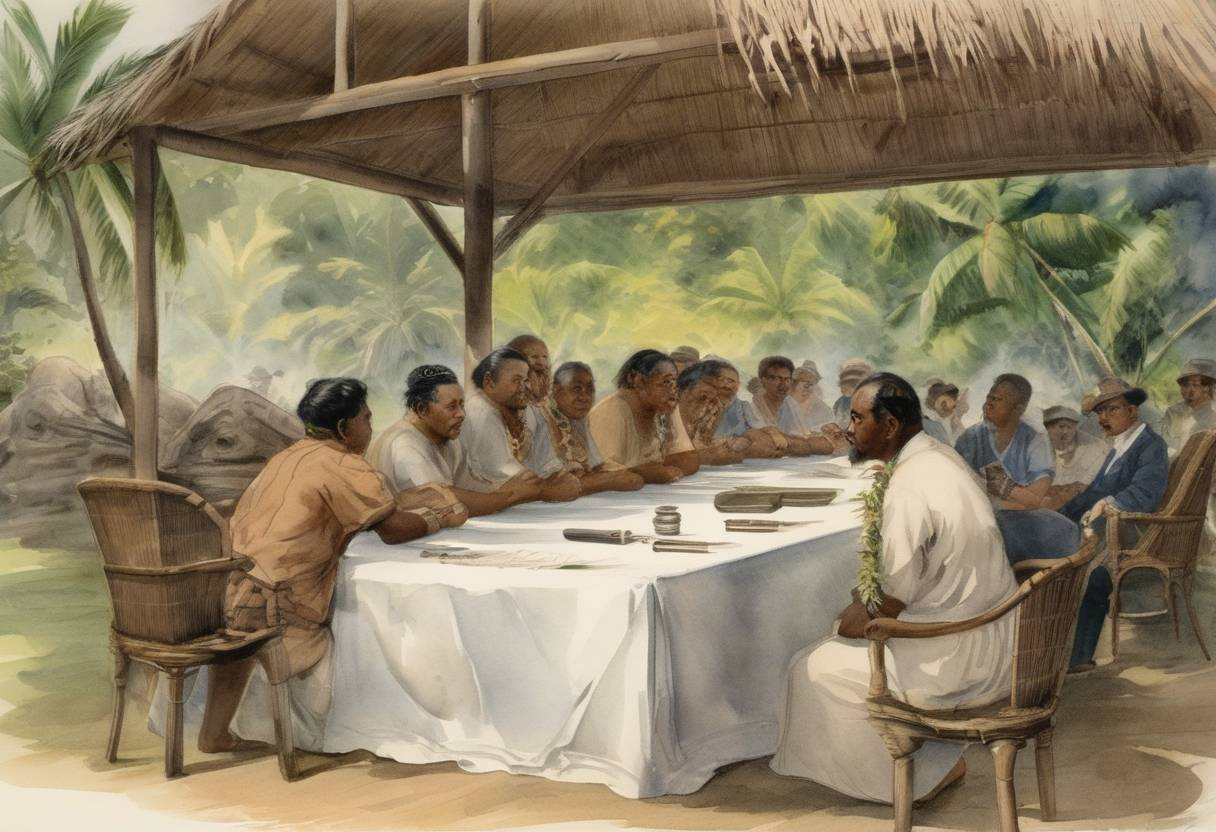
Peace Treaty Signed in Samoa - August 13, 1899
On August 13, 1899, a significant peace treaty was signed in Samoa, putting a temporary halt to the Second Samoan Civil War. This agreement emerged from the complex interplay of local Samoan factions and the intervention of colonial powers, namely Germany, the United States, and the United Kingdom.
Background
The Second Samoan Civil War, which lasted from 1898 to 1899, was largely an extension of the First Samoan Civil War. The conflict was characterized by rivalry between two local leaders, Mata’afa Iosefo and Malietoa Tanumafili I, for the throne. This struggle for power led to increased external involvement as imperial nations sought to expand their influence and protect their strategic interests in the Pacific.
Colonial Involvement
- Germany: Attempted to extend its colonial footprint in the Pacific, backing Mata’afa Iosefo.
- United States: Supported Malietoa Tanumafili I, primarily interested in protecting its commercial and military interests in the region.
- United Kingdom: Although initially neutral, it eventually sided with the United States to check German expansion.
Events Leading to the Treaty
By 1899, the escalating tensions had resulted in numerous battles, causing significant destruction. The colonial powers recognized the unsustainable nature of the conflict, which jeopardized their interests and led to continued instability.
Diplomatic negotiations gradually gained momentum, leading up to the fateful date of August 13, 1899. On this date, a provisional agreement was reached, bringing a fragile peace and setting the stage for further discussions to definitively resolve the conflict.
Implications and Aftermath
Temporary Peace: The treaty succeeded in pausing active hostilities but did not address the underlying political and cultural disagreements among the Samoan factions and their colonial backers.
Fate of Samoa: Subsequent negotiations culminated in the Tripartite Convention of 1899, which formalized the partition of the Samoan Islands. Eastern Samoa became a territory of the United States (known today as American Samoa), while the western islands (now independent Samoa) were eventually placed under German control.
Impact on Local Governance: The agreement diluted local Samoan authority, as external powers took on more significant roles in guiding the political future of the islands.
The treaty signed on August 13, 1899, thus marked an important diplomatic turning point in the history of Samoa, illustrating both the complexities of colonial geopolitics and the local struggles for sovereignty.