The Death of Captain James Cook
1779 · Kealakekua Bay, Hawaii
British explorer Captain James Cook was killed by Native Hawaiians during his third exploratory voyage in the Pacific, at Kealakekua Bay on the Big Island of Hawaii.
July 12, 1776
Captain James Cook began his third voyage around the world. This journey, which ultimately led to his tragic demise, was primarily aimed at discovering the Northwest Passage and further emphasized the importance of exploration in the age of European global voyages.
Plymouth, England | Royal Navy
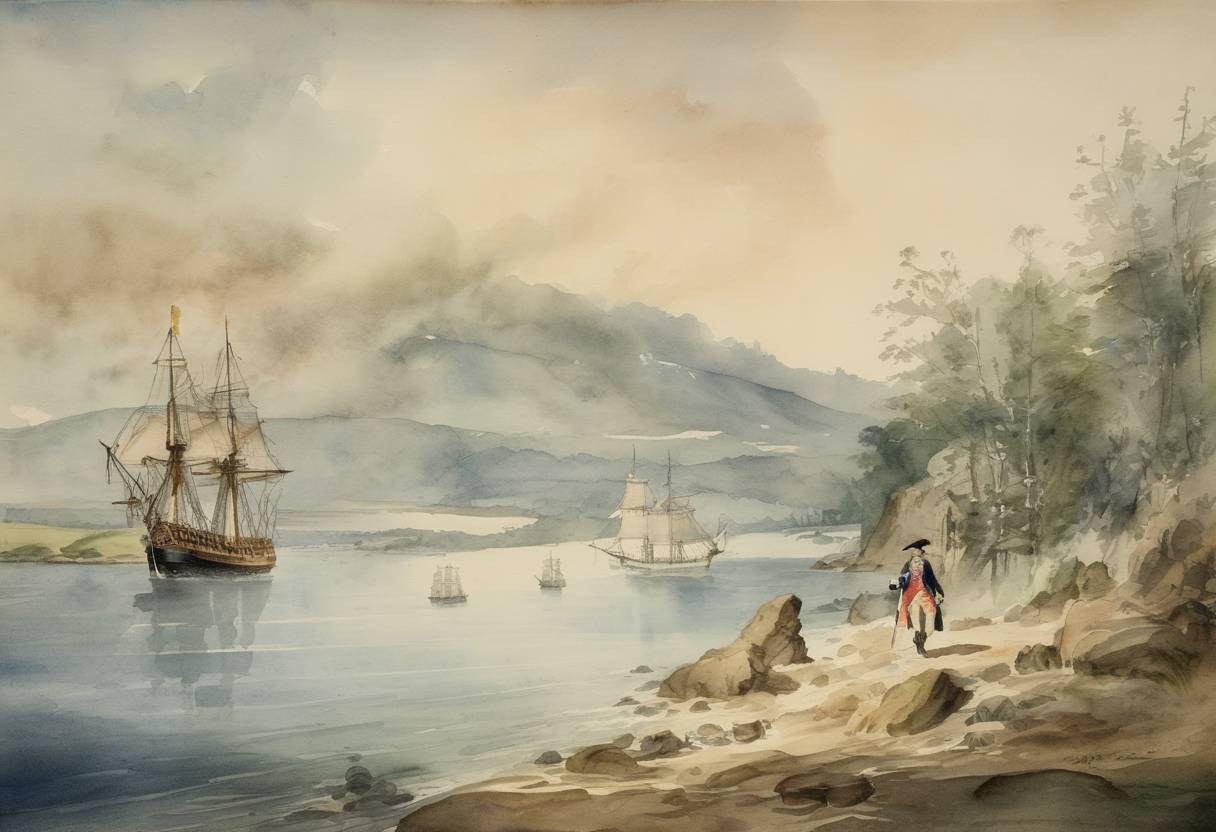
On July 12, 1776, Captain James Cook embarked on his third and final voyage from Plymouth, England. The primary objective of this expedition was to discover the elusive Northwest Passage, a theoretical maritime route that promised a direct connection between the Atlantic and Pacific Oceans through the Arctic, potentially transforming global trade routes.
By the 18th century, European powers were fervently expanding their global reach. Britain, in particular, sought to enhance its naval dominance and economic potential through exploration. Cook’s prior voyages had already yielded significant discoveries, mapping vast portions of the Pacific and enhancing European understanding of the region’s geography.
The third voyage commenced with two ships, the HMS Resolution and the HMS Discovery. The expedition was tasked with further exploration of the Pacific, especially around the North American continent’s west coast. King George III and the British Admiralty hoped that by finding the Northwest Passage, Cook’s mission would secure Britain’s preeminence in maritime exploration and global trade.
Cook’s reputation as a skilled navigator and cartographer was firmly established from his previous voyages. His successful circumnavigation and mapping of New Zealand, along with his detailed observations of the central Pacific islands, set a high standard for exploratory missions. His second voyage (1772-1775) disproved the existence of a massive southern continent, a hypothesis held by geographers of his time.
The success and outcomes of his earlier endeavors solidified the decision to appoint him for the ambitious task of finding the Northwest Passage.
Captain Cook’s third voyage played a vital role in expanding European knowledge of the far reaches of the Pacific, Alaska, and the Bering Strait. Although the expedition did not discover the Northwest Passage, it significantly advanced geographical and scientific knowledge, contributing valuable information about the indigenous peoples and ecosystems encountered.
The voyage tragically resulted in Cook’s death on February 14, 1779, during a confrontation with Hawaiian islanders in Kealakekua Bay. Cook’s demise marked the end of an era in exploration, yet his expeditions underscored the age of discovery’s transformative impact on world history.
Cook’s voyages laid the groundwork for the continued exploration of the Pacific and Arctic regions, reinforcing the importance of understanding global geography during a period of intense maritime competition among European powers. This journey marked a pivotal moment in the history of exploration, influencing subsequent missions and fostering a deeper comprehension of the world’s oceans and continents.
Source: en.wikipedia.org