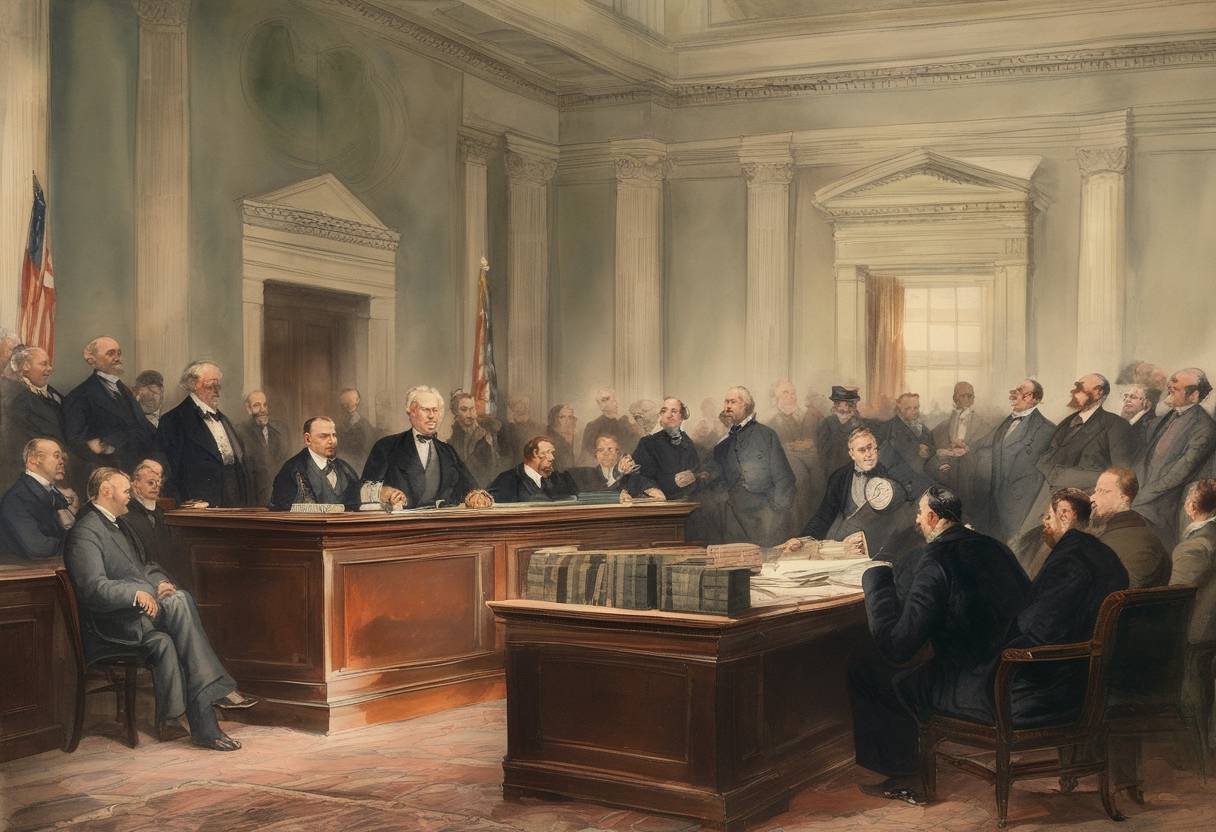
The Sherman Antitrust Act of 1890
On July 2, 1890, the United States Congress passed the Sherman Antitrust Act, a landmark statute in the realm of U.S. economic policy and antitrust law. Named after Senator John Sherman of Ohio, who was a key advocate for antitrust legislation, the act was designed to combat anti-competitive practices, reduce monopolistic control, and preserve economic competition in the marketplace.
Background
During the late 19th century, the United States experienced rapid industrialization and the growth of large corporations, often referred to as “trusts.” These conglomerates, by consolidating control over entire industries, were able to dictate terms, control prices, limit production, and stifle competition. This monopolistic behavior prompted public outcry and calls for legislative action to safeguard free competition.
Provisions of the Act
The Sherman Antitrust Act comprised several sections, with the most critical being:
- Section 1: Outlawed “every contract, combination, or conspiracy in restraint of trade or commerce among the several States, or with foreign nations.”
- Section 2: Made it illegal to “monopolize, or attempt to monopolize, or combine or conspire with any other person or persons, to monopolize any part of the trade or commerce among the several States, or with foreign nations.”
The Act empowered the federal government to investigate and pursue legal action against organizations and individuals suspected of violating its provisions.
Impact and Significance
The Sherman Antitrust Act marked a significant shift in U.S. regulatory policy, establishing a precedent for the federal government’s role in maintaining competitive markets. Although the initial enforcement of the Act was sporadic and sometimes ineffective due to vague language and judicial interpretations, it laid the groundwork for future antitrust legislation.
Over time, the Act’s significance grew as courts began interpreting its provisions more broadly. Landmark cases, such as the breakup of the Standard Oil Company in 1911, demonstrated its potential to rein in monopolistic enterprises.
Aftermath
The Sherman Antitrust Act inspired subsequent antitrust policies and laws, including the Federal Trade Commission Act and the Clayton Antitrust Act, which addressed issues like price discrimination and mergers that substantially reduced competition. These laws collectively formed the basis of modern antitrust enforcement in the United States.
In conclusion, the passage of the Sherman Antitrust Act on July 2, 1890, represented a pivotal moment in American economic history, shaping the competitive landscape and influencing antitrust regulations both domestically and globally.