Liberation of Elba - October 28, 1943
1943 · Elba, Italy
The Italian island of Elba was liberated by Allied Forces from German occupation during World War II.
May 13, 1943
German and Italian forces in North Africa officially surrendered to the Allies, marking the end of the North African Campaign of World War II.
Tunis, Tunisia | Allied Forces
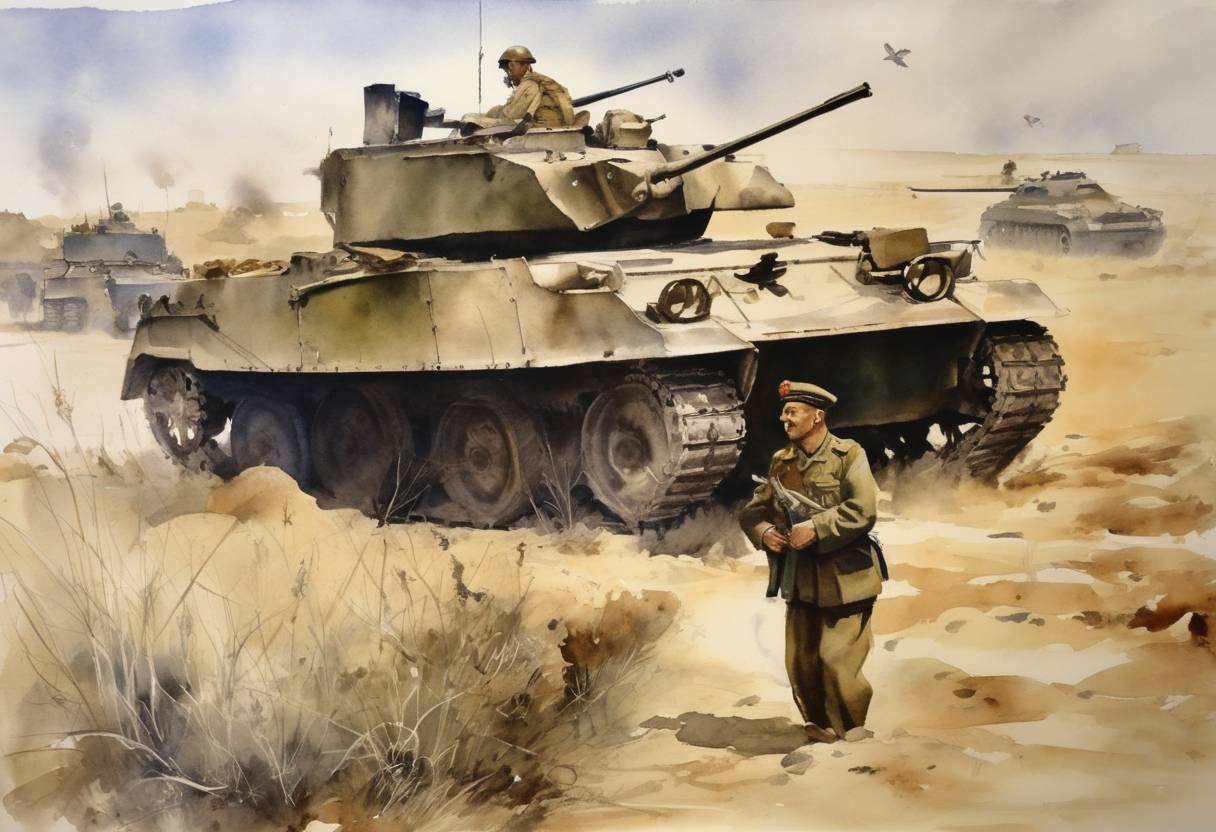
On May 13, 1943, the Allied forces achieved a significant victory with the official surrender of Axis troops in North Africa. This decisive event marked the end of the North African Campaign during World War II and was a crucial turning point in the conflict.
The North African Campaign had been ongoing since June 1940, primarily involving forces from the British Commonwealth fighting against Axis powers composed mainly of German and Italian troops. The campaign’s strategic importance stemmed from the control of the Suez Canal and North African territories, crucial for supply routes and resources.
Operation Torch: In November 1942, the Allies launched Operation Torch, a major amphibious assault in North Africa aimed at weakening Axis hold by landing in French North Africa (Morocco and Algeria). It marked the first significant involvement of American forces in the European Theater of World War II.
Battle of El Alamein: Prior to Operation Torch, in October-November 1942, the British Eighth Army, commanded by General Bernard Montgomery, successfully defeated the German Afrika Korps, led by Field Marshal Erwin Rommel, at the Battle of El Alamein. This victory was pivotal in turning the tide against the Axis powers in North Africa.
By early May 1943, Axis forces in North Africa had been financially weakened. Allied forces, advancing from both the eastern and western fronts, effectively trapped the remaining German and Italian troops in Tunisia.
Completion of the Tunisian Campaign: The surrender on May 13 followed intense fighting in the Tunisian Campaign, culminating in the encirclement and capture of Axis troops around Cape Bon, Tunisia.
Official Surrender: Over 275,000 Axis soldiers were taken as prisoners of war, marking the largest mass surrender by Axis forces in World War II up to that date. This included the surrender of German commanders Jürgen von Arnim and Hunold von Hammerstein-Equord, and the Italian General Giovanni Messe.
Impact on the Axis Powers: The loss of North Africa deprived the Axis of a crucial foothold in the Mediterranean. It also boosted Allied morale and showcased the effectiveness of joint operations among the United States, the United Kingdom, and their Allied partners.
Subsequent Operations: The successful conclusion of the North African Campaign set the stage for the Allied invasion of Sicily in July 1943, part of a broader strategy to move into continental Europe, leading eventually to the Italian Campaign and beyond.
Strategic Shift: The defeat in North Africa forced the German military to divert resources to reinforce other fronts, weakening their defensive positions across occupied Europe.
The surrender on May 13, 1943, was a testament to the strategic coordination and military prowess of the Allied forces and a critical step toward the eventual Allied victory in Europe.
Source: www.history.com