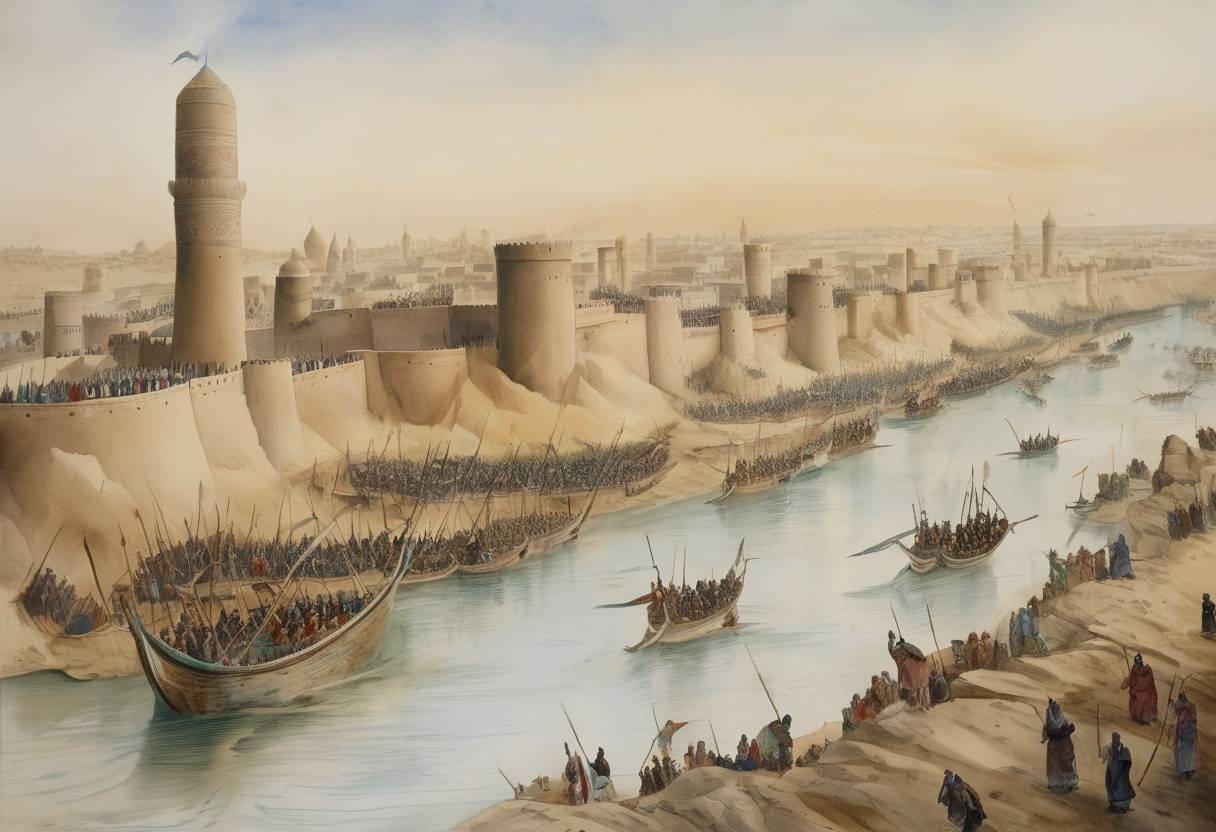
Siege of Baghdad Begins - January 30, 1258
On January 30, 1258, the Mongol siege of Baghdad commenced, marking the beginning of a pivotal and devastating event in Islamic and world history. The siege was orchestrated by Hulagu Khan, a grandson of Genghis Khan, who led a vast Mongol army to the gates of Baghdad, then one of the most prominent centers of culture and knowledge in the Islamic world.
Context
The Abbasid Caliphate, which ruled from Baghdad, had experienced a significant decline by the 13th century. Political fragmentation, economic difficulties, and reduced military prowess had left the once-mighty caliphate vulnerable. Meanwhile, the Mongol Empire had expanded rapidly under the leadership of Genghis Khan and his successors, reaching from China in the east to Eastern Europe in the west.
Events Leading Up to the Siege
- Mongol Expansion: By mid-13th century, Mongol incursions into the Islamic world were intensifying. Hulagu Khan was tasked by the Great Khan Möngke with extending Mongol dominance into Persia, the Levant, and Egypt.
- Hulagu’s Campaign: Before reaching Baghdad, Hulagu subjugated Persia and destroyed the Hashshashin (Assassins) stronghold at Alamut in 1256.
- Ultimatum: Hulagu sent a letter to Al-Musta’sim, the Abbasid caliph, demanding surrender. The caliph, overconfident in his city’s historic defenses and perhaps underestimating the Mongol threat, refused.
The Siege
- Beginning of the Siege: On January 30, 1258, Hulagu’s forces began the siege by encircling the city and systematically attacking its defenses.
- Mongol Strategy: The Mongols employed a combination of skilled archers and experienced siege engineers, utilizing catapults and other siege weapons to breach Baghdad’s mighty walls.
- Capitulation and Destruction: After over a week of intense fighting, Baghdad fell on February 10, 1258. The Mongols entered the city, whereupon a week of looting, destruction, and mass slaughter ensued.
Consequences
- End of the Abbasid Caliphate: The fall of Baghdad marked the end of the Abbasid rulers as political powers. Al-Musta’sim was captured and executed.
- Cultural Loss: The destruction of Baghdad resulted in the loss of countless manuscripts, books, and cultural artifacts, as the House of Wisdom and other libraries were destroyed.
- Islamic World: The fall of Baghdad sent shockwaves through the Islamic world, symbolizing a major power shift.
- Mongols Advance: Following Baghdad’s conquest, Hulagu’s forces continued campaigns in Syria and towards Egypt, although their expansion was halted at the Battle of Ain Jalut in 1260 by the Mamluks.
The siege and subsequent fall of Baghdad epitomized the destructive force of the Mongol expansions and had lasting impacts on the Islamic world and beyond, reshaping the power dynamics and cultural landscapes of the medieval era.