The First Battle of Panipat (April 21, 1526)
1526 · Panipat, India
The First Battle of Panipat takes place, marking the beginning of the Mughal Empire in India. Babur's forces defeat Ibrahim Lodi's much larger army.
March 17, 1526
The Battle of Khanwa was fought near the village of Khanwa, India, between the forces of Babur, the first Mughal Emperor, and a Rajput confederation led by Rana Sanga of Mewar.
Khanwa, India | Mughal Empire
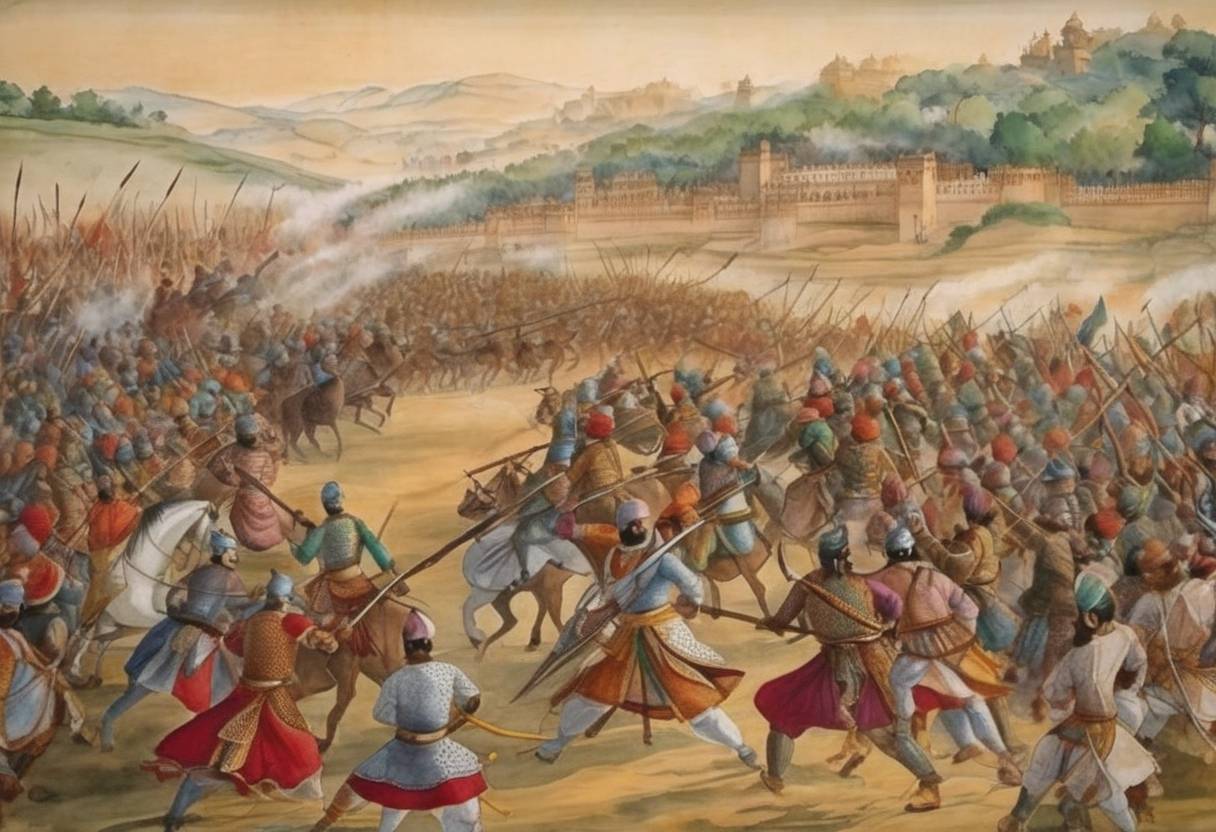
The Battle of Khanwa was a significant conflict that took place on March 17, 1527, near the village of Khanwa, located in present-day Rajasthan, India. This battle was a decisive engagement between the forces of Babur, the founder of the Mughal Empire, and a Rajput confederation led by Rana Sanga of Mewar.
Following his victory at the First Battle of Panipat in April 1526, where Babur defeated Ibrahim Lodi and established the Mughal Empire in India, his new reign faced challenges. Among these challenges was the formidable Rajput ruler, Rana Sanga, who opposed Babur’s expansion into India. Rana Sanga had united several Rajput clans and sought to reassert Rajput dominance in the region by challenging Babur’s authority.
Rana Sanga, known for his military acumen and valor, organized a large confederation of Rajput rulers and allies, including the rulers of the kingdoms of Marwar and Amber. This alliance assembled to confront Babur’s Mughal forces, aiming to halt further Mughal advance and restore Rajput power. Anticipating conflict, Babur prepared his troops and positioned himself strategically at Khanwa, where the two armies would face off.
The Battle of Khanwa began on March 17, 1527, with both sides engaging in intense combat. Babur’s forces, though potentially outnumbered by the large Rajput coalition, were seasoned and equipped with advanced warfare tactics, including the use of gunpowder and artillery. Babur employed the ‘Tulughma’ strategy, a battle formation that maximized the effectiveness of his army’s artillery and cavalry.
Rana Sanga fought valiantly, but the Rajput forces struggled against Babur’s disciplined troops and innovative tactics. The use of firearms and strategically placed artillery provided Babur with a critical advantage, which led to significant losses for the Rajput side.
The victory at Khanwa solidified Babur’s control over northern India and confirmed the Mughal Empire’s dominance in the region. This battle not only marked the decline of Rajput influence but also emphasized the effectiveness of modern warfare techniques over traditional forces. Babur’s victory laid the groundwork for future Mughal expansion and established the dynasty’s legacy in Indian history.
In the broader historical context, the Battle of Khanwa demonstrated the changing dynamics of power and warfare in the Indian subcontinent during the early 16th century, highlighting the introduction of new military technologies and strategies. Babur’s triumph at Khanwa would influence the future course of the Mughal Empire, ultimately shaping the political and cultural landscape of India.
Source: en.wikipedia.org