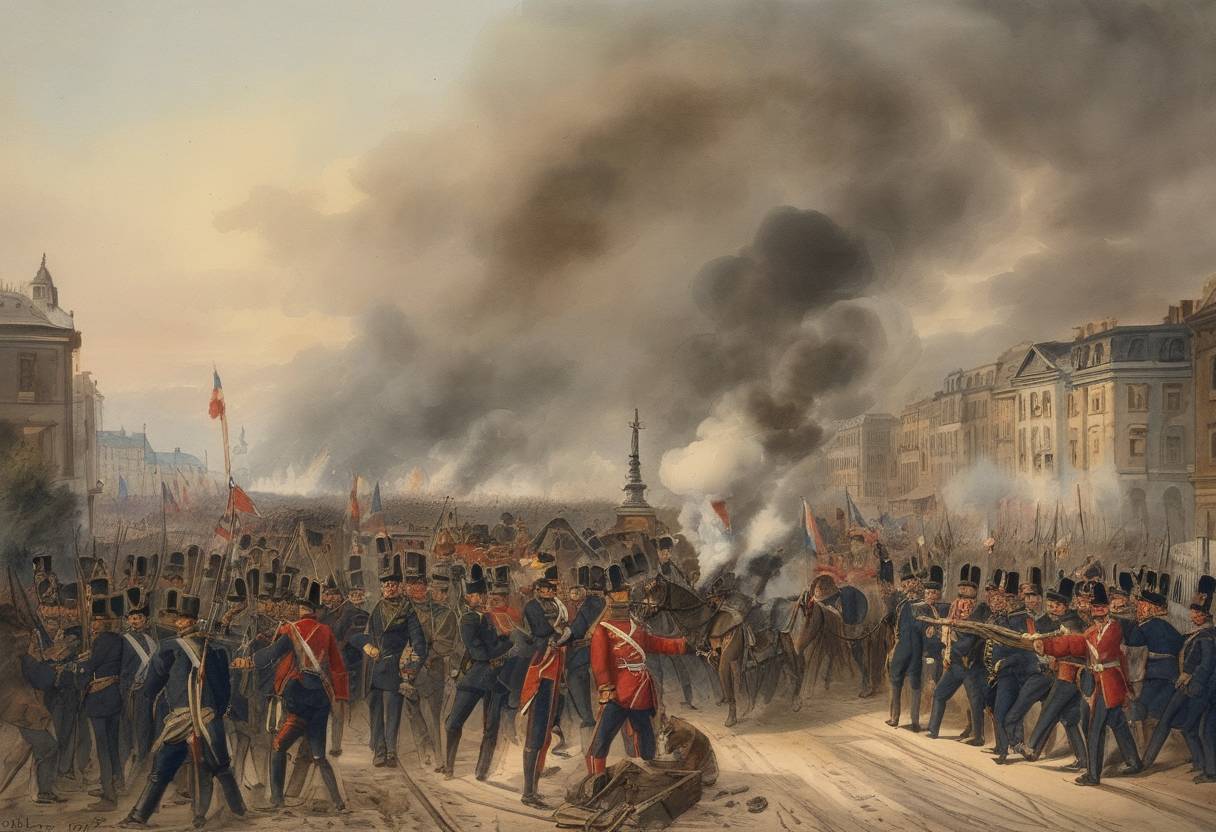
The Outbreak of the Franco-Prussian War: July 15, 1870
On July 15, 1870, the Franco-Prussian War officially began when France declared war on the Kingdom of Prussia. This conflict had far-reaching consequences for the power balance in Europe and led to the unification of Germany. The immediate cause of the war was rooted in diplomatic tensions exacerbated by the Ems Dispatch, a maneuver orchestrated by Prussian Chancellor Otto von Bismarck.
Background
The tensions between France and Prussia had been brewing for years, primarily due to the shifting alliances and territorial disputes in Europe. Prussia, under the leadership of Bismarck, had been growing in power and influence following its victorious wars against Denmark (1864) and Austria (1866). This rise was unsettling for France, which was then ruled by Emperor Napoleon III.
The situation escalated when a Spanish throne succession crisis presented an opportunity for Bismarck to provoke France. Prince Leopold of Hohenzollern-Sigmaringen, a relative of the Prussian King Wilhelm I, was considered for the Spanish throne. This potential elevation of a Prussian-affiliated monarch to the Spanish throne was unacceptable to France, given the possibility of encirclement by Hohenzollern rulers.
The Ems Dispatch
The war declaration was precipitated by an incident involving King Wilhelm I of Prussia and a French ambassador at the spa town of Bad Ems. A French diplomat approached Wilhelm, seeking assurance that the Hohenzollern candidacy would be permanently withdrawn. Wilhelm’s subsequent report of the conversation was deliberately edited by Bismarck, transforming a conciliatory note into a provocation that insulted French national honor.
The manipulated dispatch was published in newspapers and had the intended effect, inflaming public opinion in both France and Prussia. In France, the perceived insult to their envoy and the nation led to calls for war as a matter of national pride and honor.
War Declaration and Consequences
On July 15, 1870, France declared war on Prussia. The conflict was marked by swift Prussian victories, thanks to superior military organization, technology, and mobilization strategies. The war culminated in the decisive Battle of Sedan on September 1, 1870, where Emperor Napoleon III was captured, leading to his dethronement and the collapse of the Second French Empire.
The aftermath of the war significantly altered the European political landscape. The defeat of France and the subsequent Treaty of Frankfurt in 1871 resulted in the annexation of the Alsace-Lorraine region by Germany and the proclamation of the German Empire in the Hall of Mirrors at the Palace of Versailles. These outcomes sowed seeds of resentment and set the stage for further conflicts, including World War I.