Nikita Khrushchev Appointed General Secretary of the Communist Party
1953 · Moscow, Soviet Union
Nikita Khrushchev was appointed the General Secretary of the Communist Party of the Soviet Union.
May 7, 1960
Leonid Brezhnev becomes the President of the Presidium of the Supreme Soviet, the nominal head of state of the Soviet Union.
Moscow, Soviet Union | Communist Party of the Soviet Union
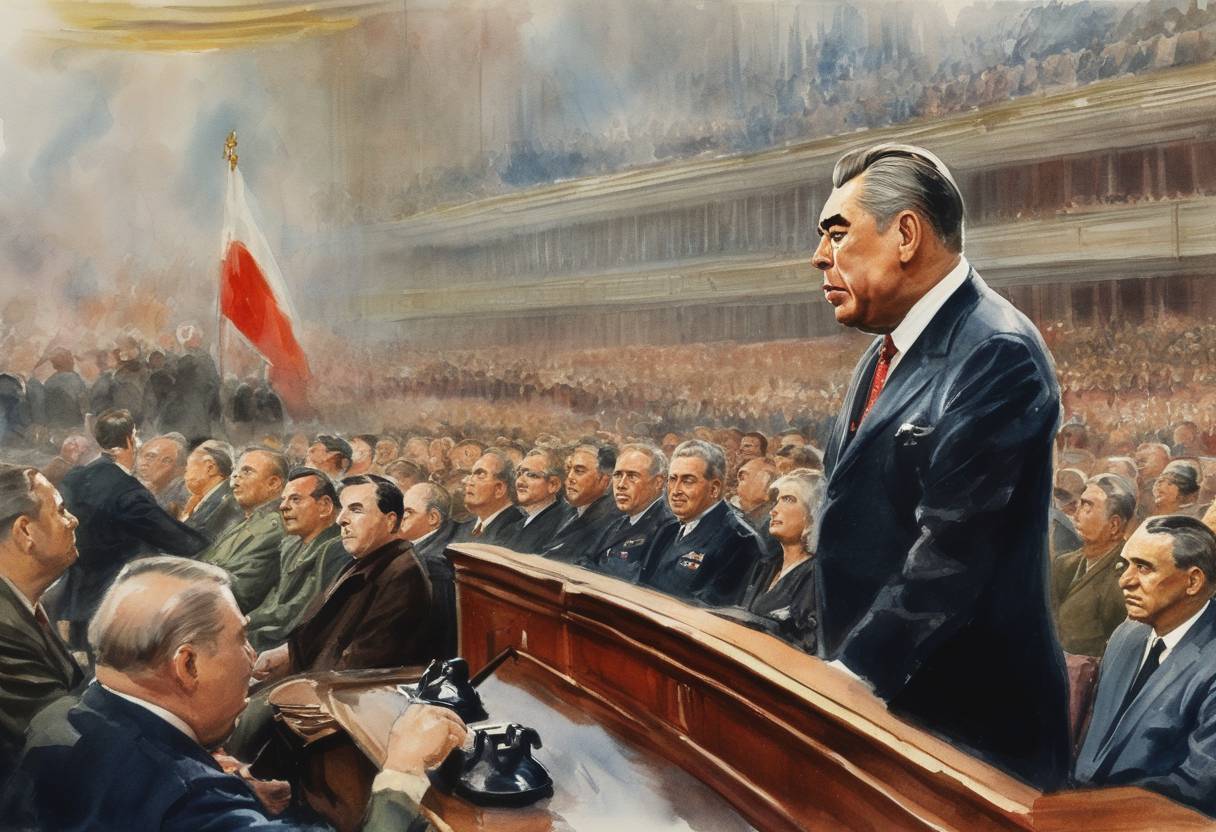
On May 7, 1960, Leonid Brezhnev was appointed as the President of the Presidium of the Supreme Soviet, effectively becoming the nominal head of state of the Soviet Union. This position marked a significant point in Brezhnev’s political career and the history of the Soviet Union, as it was a critical stepping stone toward his eventual leadership of the Soviet government.
Leonid Brezhnev was born in 1906 near Yekaterinoslav (now Dnipro, Ukraine). He joined the Communist Party in 1929, and after years of ascending through the ranks, Brezhnev became a key figure within the Soviet political structure. His career was characterized by his strong party loyalty and his capability to navigate the complex political landscape of the USSR.
Prior to his appointment as President of the Presidium, Brezhnev held significant roles within the Communist Party, including leadership positions in the Moldavian SSR and Kazakhstan, and he served as a Secretary of the Central Committee of the Communist Party.
Brezhnev’s appointment as President of the Presidium of the Supreme Soviet occurred in the context of internal shifts within the Soviet government. The position, although largely ceremonial, was indicative of Brezhnev’s rising influence in Soviet politics. In the context of the Cold War and the political maneuvering following Stalin’s death, this role put Brezhnev closer to the center of Soviet power.
After being appointed, Brezhnev succeeded Kliment Voroshilov, a long-serving military commander and political figure. Although the position did not confer executive power, serving as President of the Presidium allowed Brezhnev to build crucial alliances and enhance his political standing.
Brezhnev’s tenure as President of the Presidium was relatively short, as within four years he rose to become the General Secretary of the Communist Party in 1964, a position that indeed held substantial power as the leader of the Soviet Union. His time in this role is often remembered for the Brezhnev Doctrine and the stabilization policies following the period of de-Stalinization.
Overall, Brezhnev’s appointment as President of the Presidium marked the beginning of his ascent to the apex of Soviet leadership. His influence would later characterize a lengthy period in Soviet history often referred to as the “Brezhnev Era,” which lasted until his death in 1982. This period is noted for its stability in domestic affairs and a complex, often stagnant, relationship with Western powers during the Cold War.
Source: en.wikipedia.org