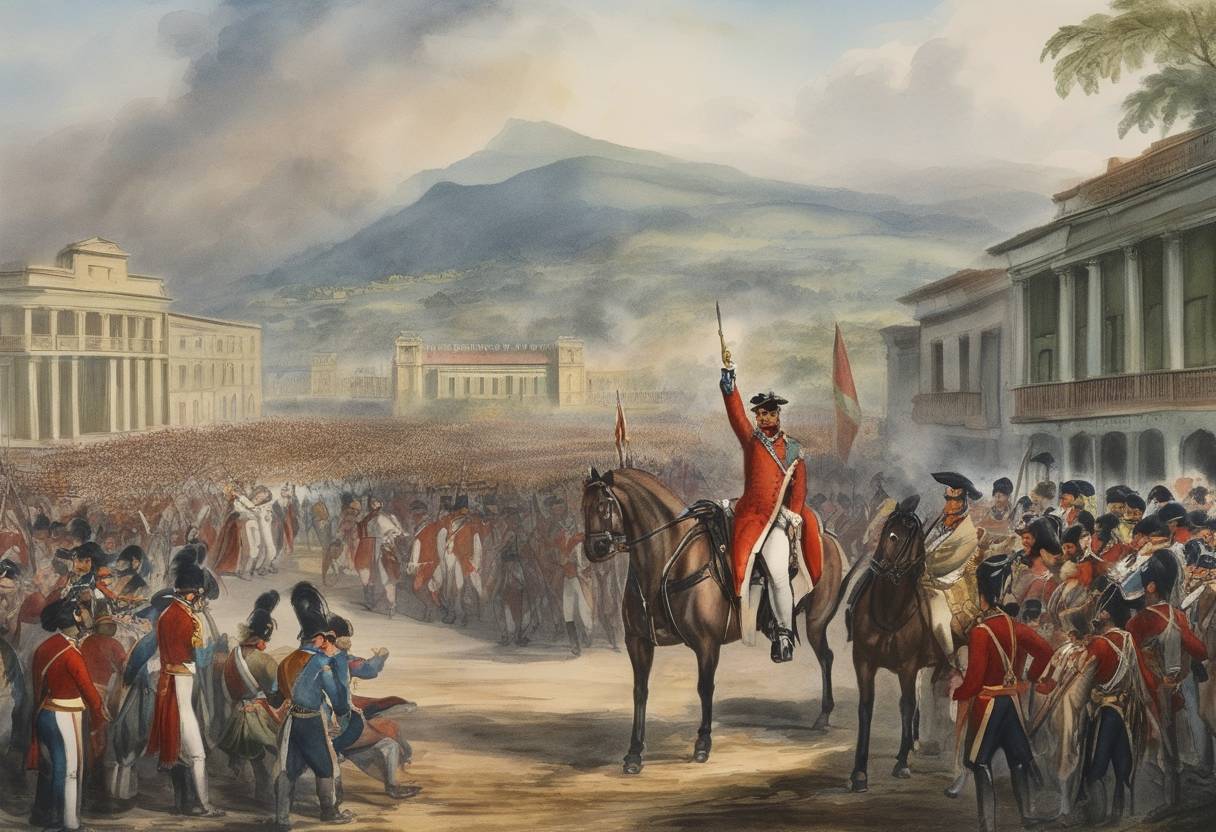
Simón Bolívar’s Triumphant Entry into Bogotá on August 7, 1819
On August 7, 1819, Simón Bolívar, the prominent leader of Latin America’s independence movement, made a triumphant entry into Bogotá following his victory over Spanish forces at the Battle of Boyacá. This moment marked a significant turning point in the Spanish American wars of independence.
Background
The Spanish American wars of independence, which spanned from 1808 to 1826, involved numerous battles and revolts against Spanish colonial rule across Latin America. Simón Bolívar emerged as a key figure in this struggle, dedicated to liberating regions under Spanish control. Before the events of 1819, Bolívar had focused his efforts on gaining control over territories like present-day Venezuela and New Granada (modern-day Colombia).
The Battle of Boyacá
The Battle of Boyacá, fought on August 7, 1819, was a decisive engagement that took place near the Boyacá Bridge in Colombia. Bolívar’s forces, which included a combination of local militias and regular troops, faced off against the Spanish royalist army led by Colonel José María Barreiro. Bolívar’s strategic acumen and the disciplined execution of his battle plan resulted in a resounding victory. The defeat of the Spanish forces effectively obliterated royalist power in the region and opened the path to Bogotá.
Entry into Bogotá
Following the victory at Boyacá, Bolívar and his troops entered Bogotá on the same day. His arrival was met with jubilant celebrations by the local population who viewed him as a liberating hero. This entry into the capital not only cemented Bolívar’s reputation as a military leader but also reinvigorated the independence movement across northern South America.
Significance and Consequences
The capture of Bogotá was a strategic and symbolic victory for Bolívar. It marked the beginning of the end for Spanish rule in the northern part of South America and led to the eventual establishment of Gran Colombia, a republic that included modern-day Colombia, Venezuela, Ecuador, and Panama.
Bolívar’s success at Boyacá and subsequent capture of Bogotá were instrumental in inspiring further uprisings and fostering unity among the independence movements in the region. His actions on August 7, 1819, set the stage for future campaigns to liberate South American territories from colonial domination, earning him the moniker “The Liberator.”
This event exemplified the broader shifts in colonial power in the Americas, contributing significantly to the decline of Spanish influence and the rise of independent nations throughout Latin America.