1836 · San Antonio, Republic of Texas
The Battle of the Alamo Mission in San Antonio began on October 25, 1836, marking the start of this pivotal conflict in Texas' fight for independence from Mexico.
October 7, 1835
The Texas Revolution's Battle of Gonzales took place, marking the start of the conflict leading to Texas independence from Mexico.
Gonzales, Mexico (at the time) | none
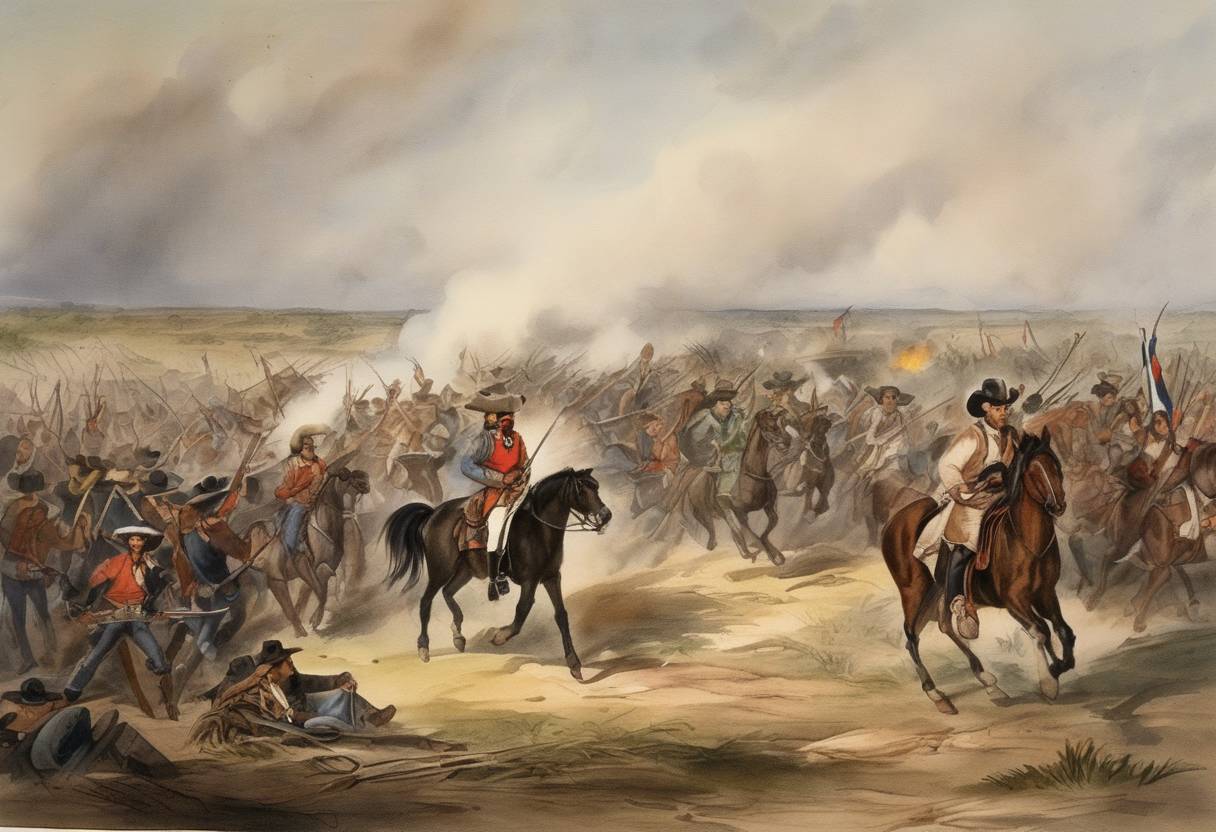
The Battle of Gonzales took place on October 2, 1835, marking the official beginning of the Texas Revolution. This skirmish is often referred to as the “Lexington of Texas” due to its role as the spark that ignited the broader conflict leading to Texas’ independence from Mexico.
In the early 1830s, tensions between the Mexican government and the settlers in Texas (then part of Mexico) began to increase. The Mexican government attempted to enforce more strict control over the region, leading to growing discontent among Texian settlers. One of the immediate precursors to the conflict at Gonzales was the Mexican government’s attempt to retrieve a small cannon it had previously given to the settlers for defense against native tribes.
In September 1835, Colonel Domingo de Ugartechea, the military commander in Texas, ordered the removal of the cannon from the Texians in Gonzales. The settlers refused to return the cannon and instead prepared to defend their rights to self-determination. On October 1, reinforcements from surrounding areas arrived, swelling the Texian ranks.
On the morning of October 2, 1835, Mexican forces, commanded by Francisco de Castañeda, engaged with the Texian militia near the town of Gonzales. The Texians flew a makeshift flag with the words “Come and Take It” emblazoned on it, defiantly daring the Mexican soldiers to seize the cannon. The skirmish was brief, resulting in the retreat of the Mexican forces after encountering resistance from the Texians.
The Battle of Gonzales was a pivotal event in Texas history. Although the conflict was minor with minimal casualties, it symbolized the willingness of Texians to take up arms for their independence. In the wake of Gonzales, unrest spread throughout Texas, leading to additional uprisings and mobilizations against Mexican rule. This eventually culminated in the Declaration of Texas Independence on March 2, 1836, and the subsequent creation of the Republic of Texas.
The Texas Revolution was part of the larger pattern of territorial and political disputes that characterized the early 19th century in North America. The battle set a precedent for other independence movements and highlighted the complex dynamics between colonists, indigenous peoples, and colonial powers.
Source: www.tshaonline.org