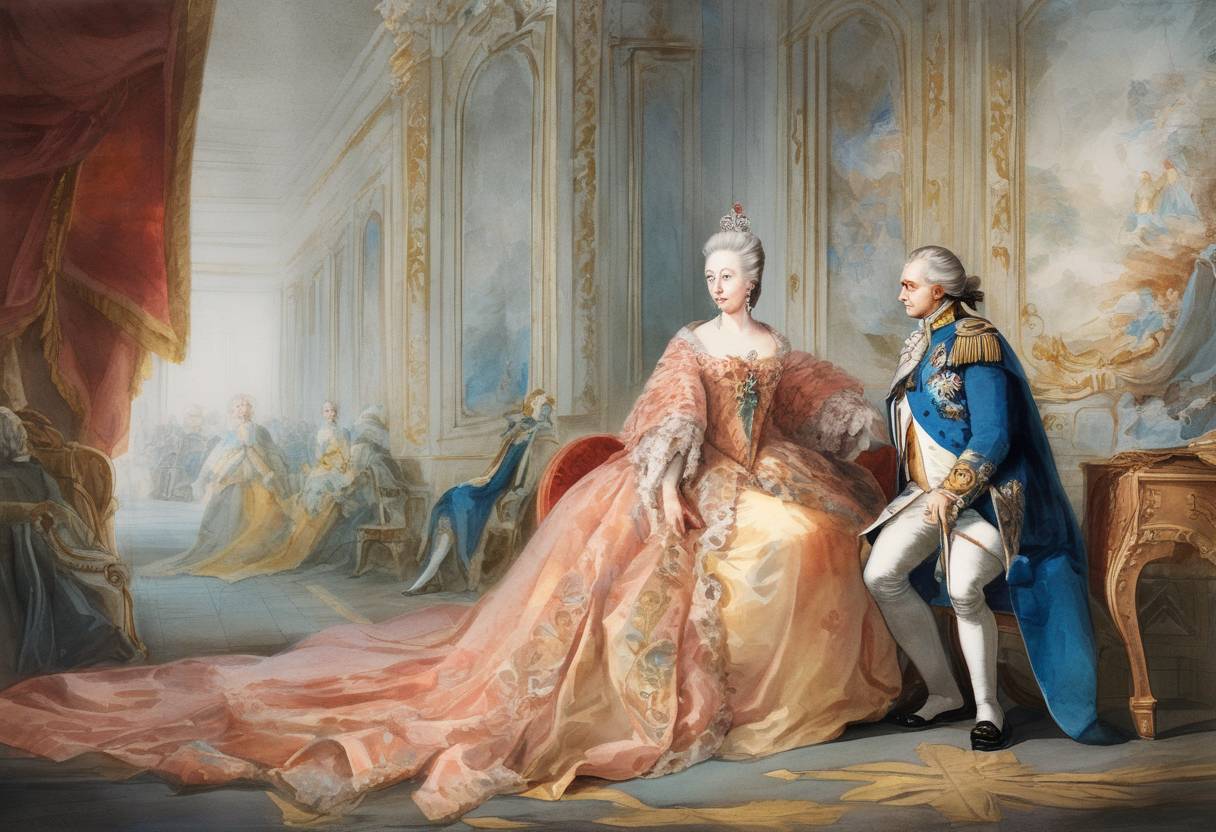
Catherine the Great Becomes Empress of Russia
On July 17, 1762, Catherine the Great ascended to the throne as Empress of Russia, following the assassination of her husband, Peter III. This event marked a significant turning point in Russian history, as Catherine would go on to become one of the country’s most renowned and influential rulers.
Context Leading Up to the Event
Background: Catherine, born Sophie Friederike Auguste von Anhalt-Zerbst in Stettin, Prussia (now Szczecin, Poland), married the future Emperor Peter III of Russia in 1745. The marriage was politically motivated, intended to strengthen alliances between Russia and Prussia.
Peter III’s Reign: Peter III ascended to the Russian throne in January 1762. His reign was short-lived and marked by unpopular policies, including his decision to withdraw Russia from the Seven Years’ War and his admiration for Prussian King Frederick the Great, which alienated many Russian nobles and military leaders.
Catherine’s Position: Despite her foreign origins, Catherine had ingratiated herself with the Russian nobility and military. She was seen as a more favorable ruler compared to her husband, who was perceived as erratic and disconnected from Russian interests.
The Coup and Assassination
The Coup: Discontent with Peter III’s rule led to a coup orchestrated by Catherine and her supporters, including key military figures and members of the Russian nobility. On July 9, 1762, Catherine was proclaimed Empress by the Imperial Guard in St. Petersburg.
Assassination of Peter III: Following the coup, Peter III was forced to abdicate and was subsequently arrested. On July 17, 1762, he was assassinated under mysterious circumstances, likely with the tacit approval of Catherine’s supporters, though the exact details remain unclear.
Catherine’s Reign and Legacy
Reforms and Policies: Catherine the Great’s reign, which lasted until her death in 1796, was marked by significant reforms in government, the expansion of the Russian Empire, and efforts to modernize Russian society along Western European lines. She is credited with fostering the arts, education, and the Enlightenment in Russia.
Expansion: Under her rule, Russia expanded its territory significantly, including the annexation of Crimea and parts of Poland, establishing Russia as a major European power.
Cultural Impact: Catherine’s patronage of the arts and her correspondence with prominent Enlightenment thinkers like Voltaire and Diderot helped cultivate a cultural renaissance in Russia.
Historical Significance
Catherine the Great’s rise to power and subsequent reign had profound implications for Russia and its place in the world. Her leadership style and policies helped shape the future of the Russian Empire, leaving a lasting legacy that continues to be studied and admired in historical discourse. Her reign is often seen as a period of revitalization and expansion, setting the stage for Russia’s emergence as a formidable European power.