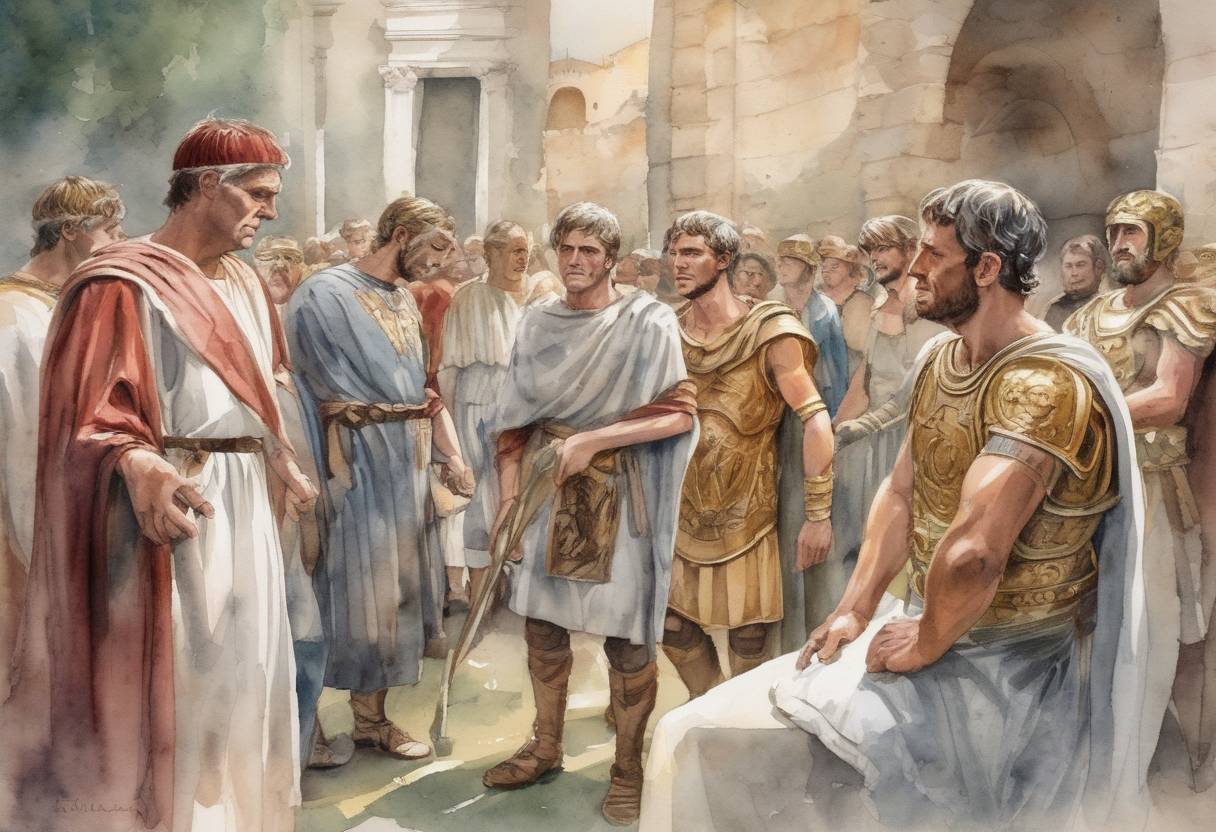
The Deposition of Romulus Augustulus: September 4, 476
On September 4, 476, a pivotal moment in history occurred: the deposition of Romulus Augustulus, traditionally recognized as the last Roman emperor of the Western Roman Empire. This event marked the end of ancient Rome’s imperial rule in the West and the beginning of a new era in European history.
Background
The Western Roman Empire had been in decline for several centuries due to a combination of internal strife, economic troubles, and external pressures from various barbarian groups. By the mid-5th century, the empire was a shadow of its former self, with its territories significantly reduced and its political structure weakened.
Romulus Augustulus, often referred to as the “little Augustus” due to his young age, was placed on the throne in 475 by his father, Orestes, a Roman general of Pannonian origin. Orestes had previously served under Attila the Hun and later became a key figure in the Roman military hierarchy. His decision to elevate his son to the position of emperor was largely a strategic move to consolidate his own power.
The Deposition
The actual power behind the throne was Orestes, as Romulus was merely a figurehead. However, Orestes’ refusal to grant land in Italy to his Germanic mercenaries led to unrest. The mercenaries, led by the chieftain Odoacer, revolted against Orestes. Odoacer, a leader of the Sciri, Heruli, and other Germanic tribes, capitalized on the discontent among the troops.
On September 4, 476, Odoacer captured the city of Ravenna, the Western Roman capital, and deposed Romulus Augustulus. Unlike many of his predecessors, Romulus was spared execution. Odoacer, recognizing the young emperor’s youth and insignificance, chose to exile him to the villa of Lucullus in Campania, where he lived out his days in relative obscurity.
Aftermath and Historical Significance
Odoacer declared himself the ruler of Italy, assuming the title of “King” rather than “Emperor.” He sent the imperial regalia to the Eastern Roman Emperor Zeno in Constantinople, symbolically acknowledging the end of the Western Roman Empire and the continuation of the Roman legacy in the East.
The deposition of Romulus Augustulus is traditionally marked as the end of the Western Roman Empire, although the Eastern Roman Empire, known as the Byzantine Empire, continued to thrive for nearly another thousand years. This event is often cited as a key milestone in the transition from antiquity to the Middle Ages in European history.
The fall of the Western Roman Empire had profound consequences for Europe, leading to the fragmentation of territories and the rise of various barbarian kingdoms. It set the stage for the development of medieval European culture and the eventual emergence of modern nation-states.
In summary, the deposition of Romulus Augustulus by Odoacer on September 4, 476, symbolizes the end of an era and the beginning of a new chapter in European history, marking the transition from the ancient world to the medieval period.