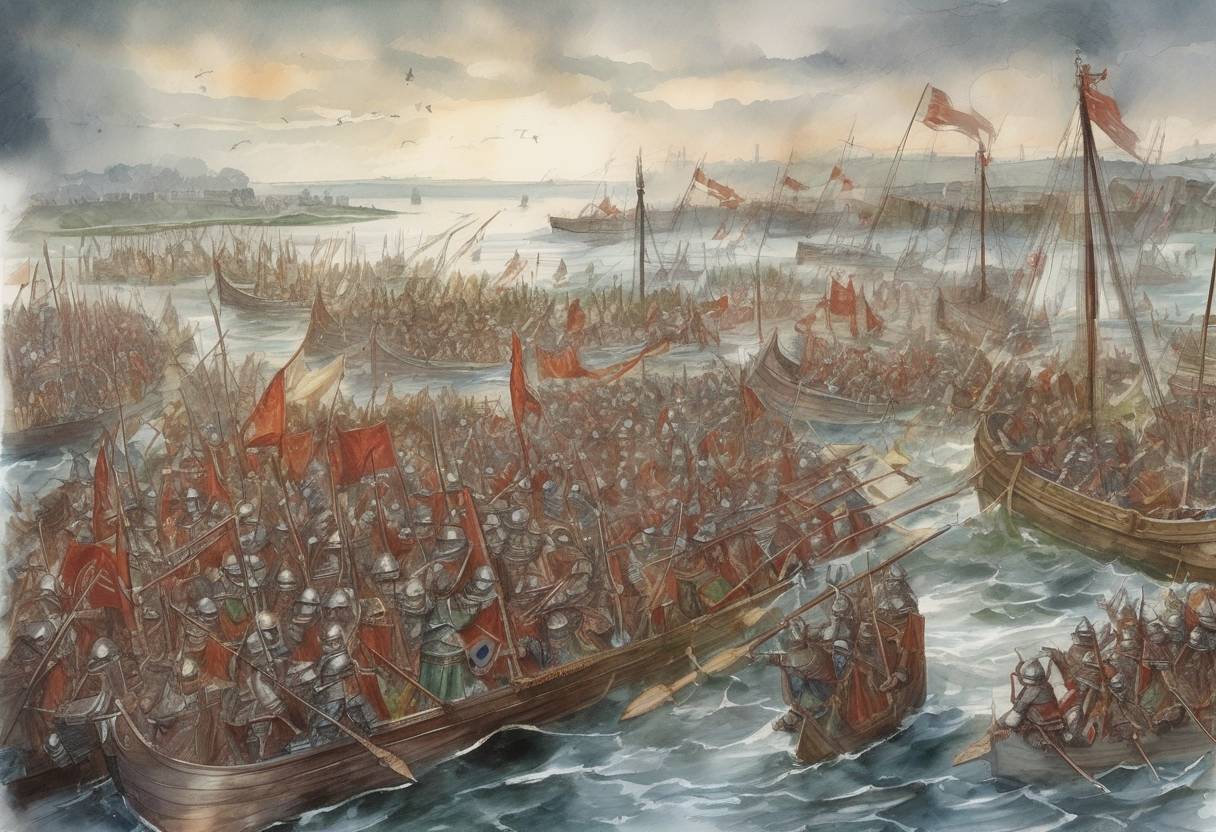
The Battle of Clontarf: April 23, 1014
The Battle of Clontarf, fought on April 23, 1014, is one of the most significant events in Irish history. It marked a decisive confrontation between the forces of the Irish High King Brian Boru and a coalition of Irish and Viking forces. This battle is often seen as a pivotal moment in the struggle for control over Ireland during the early medieval period.
Background
In the early 11th century, Ireland was a patchwork of rival kingdoms and territories, with Norse-Gaelic settlements established by Viking invaders along the coast. Brian Boru, who became High King of Ireland in 1002, sought to unify the island under his rule and diminish the influence of the Vikings, who had established significant power bases in cities like Dublin, Limerick, and Waterford.
The conflict leading to the Battle of Clontarf was rooted in Brian Boru’s efforts to consolidate power and the resistance he faced from both Irish rivals and Norse-Gaelic leaders. The immediate catalyst for the battle was a rebellion led by Máel Mórda mac Murchada, King of Leinster, who allied with Sigtrygg Silkbeard, the Norse King of Dublin, and other Viking forces from the Isle of Man and the Orkneys.
The Battle
The battle took place on the plains of Clontarf, near Dublin. Brian Boru’s forces, primarily composed of troops from Munster and southern Ireland, faced a coalition of Leinster men and Viking warriors. The battle was fierce and lasted from dawn until dusk.
Despite being heavily outnumbered, Brian Boru’s army managed to gain the upper hand. The tide turned in favor of Brian’s forces due to their strategic positioning and the effective use of their superior numbers in key engagements. The Viking and Leinster forces were eventually routed, suffering heavy casualties.
The Death of Brian Boru
Tragically, Brian Boru did not live to see the full fruits of his victory. As the battle drew to a close, he was killed in his tent by a group of retreating Viking warriors led by Brodir of the Isle of Man. Brian’s death, however, did not diminish the significance of the victory.
Aftermath and Significance
The Battle of Clontarf is often romanticized as a struggle between the Irish and the Vikings, symbolizing the end of Viking power in Ireland. While it did not completely eliminate Norse influence, it significantly weakened Viking control and marked a turning point in Irish history.
The battle also solidified Brian Boru’s legacy as a unifying figure in Ireland. His efforts to consolidate power and his victory at Clontarf are seen as pivotal in the eventual decline of Viking dominance in the region.
In the broader context of Irish history, the Battle of Clontarf is remembered as a defining moment that showcased the resilience and determination of the Irish people to maintain their sovereignty against foreign influence.