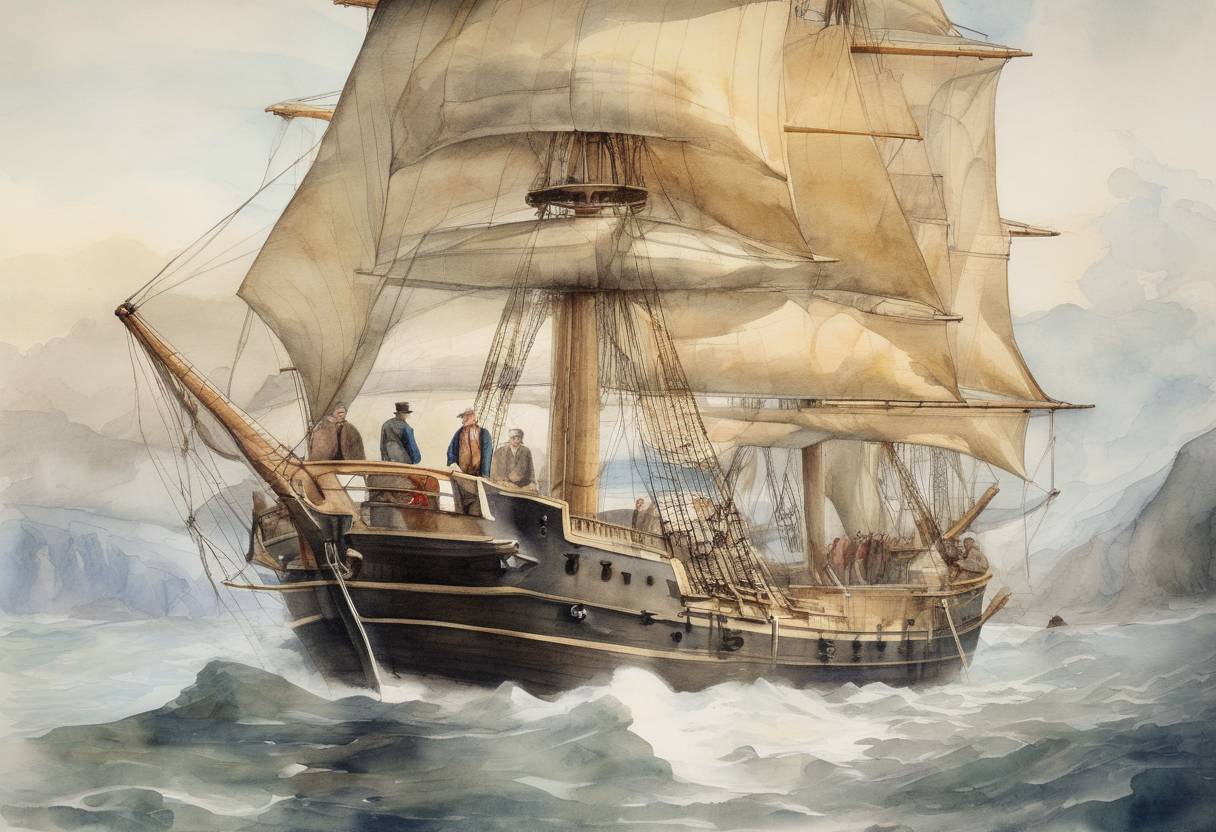
Charles Darwin’s Journey Aboard HMS Beagle
On December 27, 1831, Charles Darwin embarked on a pivotal journey aboard the HMS Beagle, a voyage that would lay the foundation for his groundbreaking work on the theory of evolution by natural selection. This expedition, which lasted nearly five years, profoundly influenced the scientific understanding of biological diversity and the processes that drive it.
Context and Background
The HMS Beagle was a Royal Navy ship tasked with a surveying mission to map the coastlines of South America. The voyage was led by Captain Robert FitzRoy, who sought a naturalist to accompany the crew and provide scientific observations. Charles Darwin, then a young graduate from the University of Cambridge, was recommended for the position by his mentor, John Stevens Henslow.
The Voyage
- Departure: The Beagle set sail from Plymouth, England, on December 27, 1831. Darwin, initially suffering from seasickness, quickly adapted to life at sea.
- South America: The Beagle’s primary mission was to chart the coasts of South America. Darwin spent considerable time on land, collecting specimens and making observations of the region’s geology, flora, and fauna.
- Galápagos Islands: One of the most significant stops was the Galápagos Islands. Here, Darwin observed variations in species, such as the famous finches, which would later inform his ideas on adaptation and natural selection.
- Australia and Other Regions: The journey also took Darwin to Australia, the Pacific Islands, and South Africa, providing him with a global perspective on biodiversity.
Key Observations and Impact
Darwin’s observations during the voyage challenged the prevailing scientific views of the time. He noted the diversity of life forms and their adaptations to different environments, leading him to question the fixity of species.
- Geological Observations: Darwin’s study of geological formations, such as the Andes Mountains and coral reefs, contributed to his understanding of Earth’s dynamic processes.
- Biological Diversity: The variations among species in different environments, particularly in isolated regions like the Galápagos, were crucial in shaping his thoughts on evolution.
Aftermath and Significance
Upon returning to England in October 1836, Darwin began to synthesize his findings. His extensive collection of specimens and detailed notes provided the empirical foundation for his later works.
- Publication of “On the Origin of Species”: In 1859, Darwin published “On the Origin of Species,” articulating his theory of evolution by natural selection. This work revolutionized biological sciences and altered the course of scientific thought.
- Legacy: Darwin’s voyage on the Beagle is considered one of the most significant scientific expeditions in history. It not only transformed Darwin’s life but also fundamentally changed our understanding of life on Earth.
The journey of the HMS Beagle remains a testament to the power of observation and inquiry, highlighting the importance of exploration in advancing human knowledge.