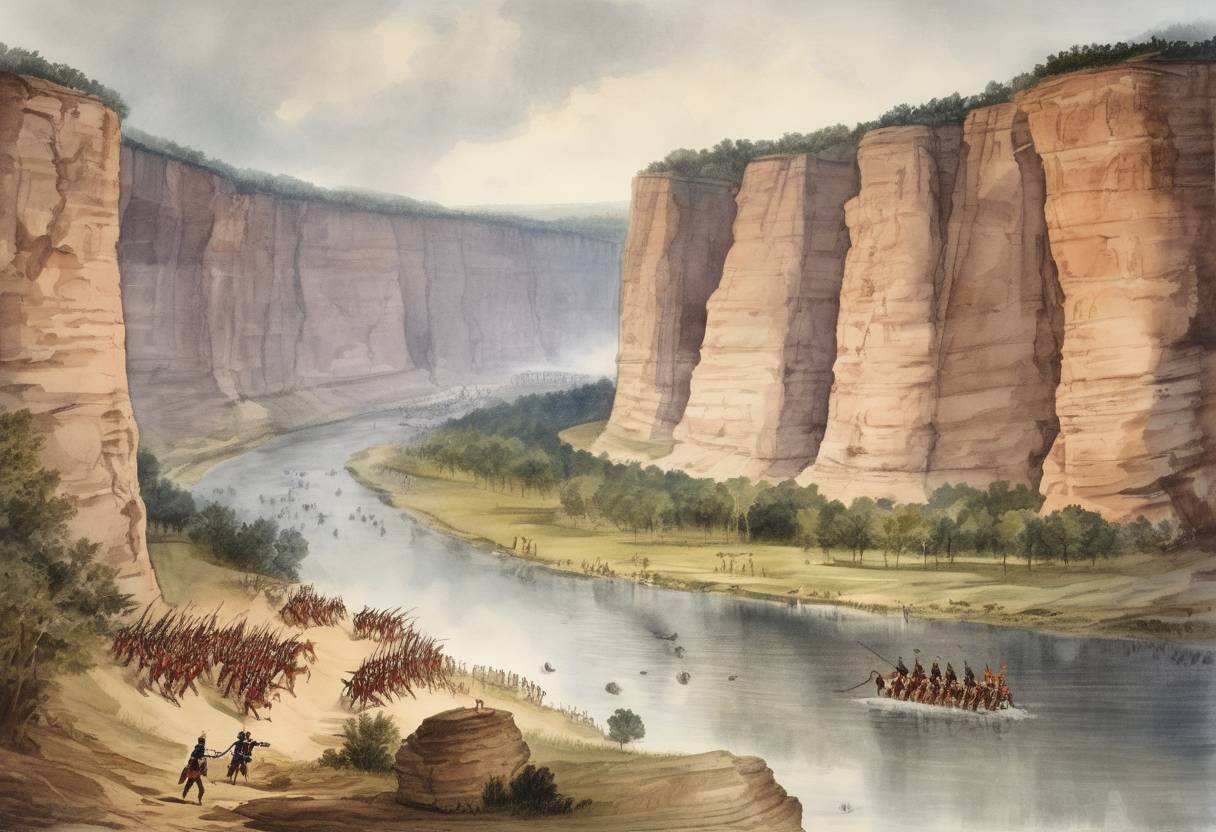
The Battle of Horseshoe Bend: March 27, 1814
The Battle of Horseshoe Bend was a pivotal conflict during the Creek War, part of the larger series of confrontations known as the War of 1812. This battle, which occurred on March 27, 1814, marked a decisive victory for Major General Andrew Jackson and his forces against the Red Stick faction of the Creek Indians.
Background
The Creek War (1813-1814) was a civil war within the Creek Nation between the Red Sticks, who sought to resist American expansion and preserve their traditional way of life, and other Creek factions who were more accommodating to American settlers. The conflict was exacerbated by the broader geopolitical tensions of the War of 1812, as the Red Sticks received some support from the British and Spanish.
Key Events Leading to the Battle
- Fort Mims Massacre (August 30, 1813): The Red Sticks attacked Fort Mims in Alabama, killing hundreds of settlers and militia. This event galvanized American efforts to subdue the Red Stick resistance.
- Andrew Jackson’s Campaign: In response, Andrew Jackson, a militia leader from Tennessee, was tasked with leading a campaign against the Red Sticks. His forces included militia from Tennessee, the 39th U.S. Infantry, and allied Native American tribes such as the Cherokee and Lower Creek.
The Battle
- Location: The battle took place at a bend in the Tallapoosa River, known as Horseshoe Bend, in present-day Alabama. The Red Sticks had fortified their position with a strong defensive barricade.
- Jackson’s Strategy: Jackson’s forces, numbering around 3,300 men, launched a two-pronged attack. While part of his force, including Cherokee allies, crossed the river to attack from the rear, Jackson led a frontal assault on the barricade.
- Outcome: The battle resulted in a crushing defeat for the Red Sticks. Approximately 800 of the 1,000 Red Stick warriors were killed, effectively ending their resistance.
Aftermath and Significance
- Treaty of Fort Jackson (August 9, 1814): Following the battle, the Creek Nation was forced to cede over 21 million acres of land to the United States, much of which was in present-day Alabama and Georgia.
- Impact on Andrew Jackson’s Career: The victory at Horseshoe Bend elevated Andrew Jackson’s national profile, setting the stage for his future role as a military leader in the Battle of New Orleans and eventually as the seventh President of the United States.
- Consequences for Native Americans: The defeat and subsequent land cessions significantly weakened the Creek Nation and contributed to the broader pattern of Native American displacement in the southeastern United States.
The Battle of Horseshoe Bend was a turning point in the Creek War, showcasing the military prowess of Andrew Jackson and leading to significant territorial gains for the United States at the expense of Native American lands and sovereignty.