NASA Launches Mariner 10: A Historic Mission
On November 3, 1973, NASA launched Mariner 10, a pioneering spacecraft that became the first to fly by two planets, Venus and Mercury. This mission marked a significant milestone in space exploration, providing humanity with unprecedented insights into our solar system’s innermost planets.
Background and Objectives
The Mariner program was a series of interplanetary missions conducted by NASA to explore neighboring planets. Mariner 10 was the last in this series and had the primary objective of conducting close-up studies of Venus and Mercury. The mission aimed to:
- Capture detailed images of the planets’ surfaces.
- Analyze the atmospheres and environments of Venus and Mercury.
- Investigate Mercury’s magnetic field and surface composition.
Key Events Leading to the Launch
Development and Planning: The Mariner 10 mission was developed in the early 1970s, building on the successes and lessons learned from previous Mariner missions. The spacecraft was equipped with a suite of scientific instruments, including television cameras, magnetometers, and plasma detectors.
Innovative Trajectory: Mariner 10 was the first spacecraft to use a gravity assist maneuver, a technique that involves using the gravitational pull of a planet (in this case, Venus) to alter its trajectory and speed, allowing it to reach Mercury.
The Launch
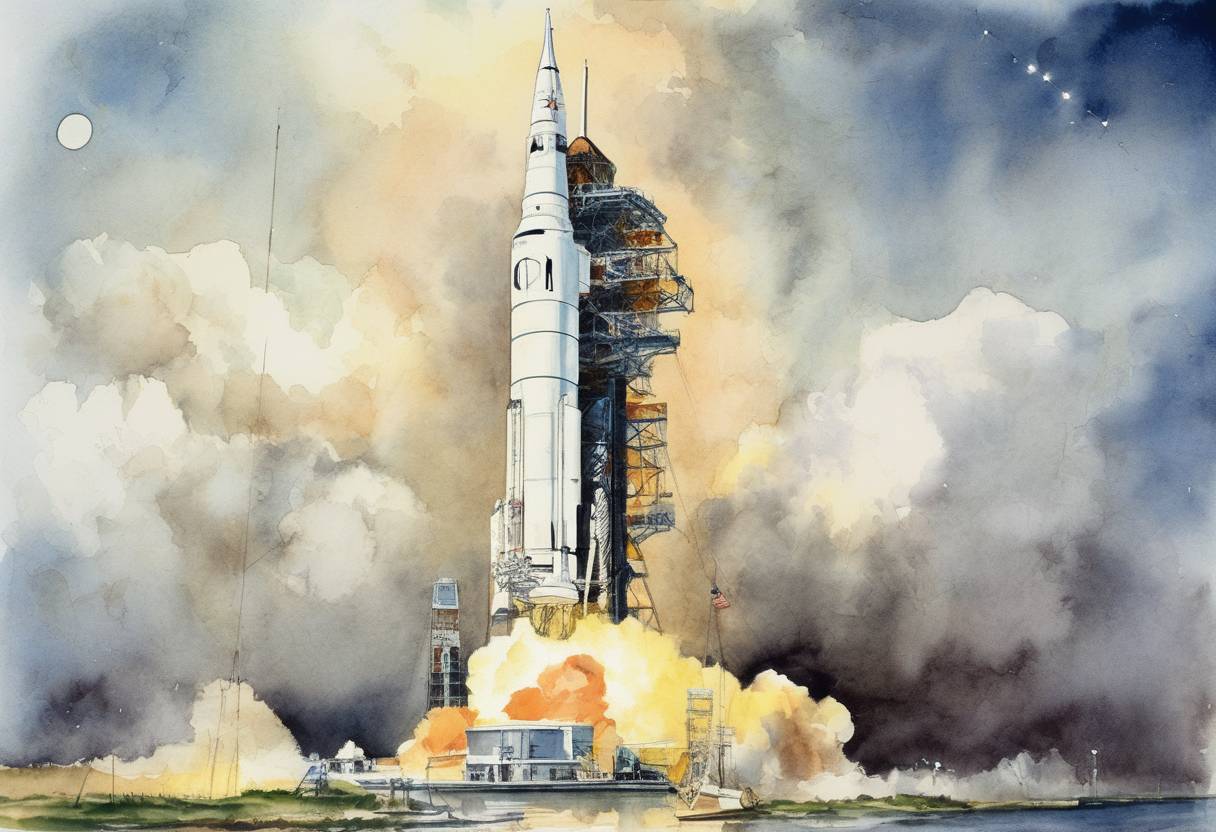
Date and Location: Mariner 10 was launched on November 3, 1973, from Cape Canaveral, Florida, aboard an Atlas-Centaur rocket.
Journey to Venus: The spacecraft’s trajectory took it on a path towards Venus, where it would perform a gravity assist maneuver to propel it towards Mercury.
Flybys and Discoveries
Venus Flyby: On February 5, 1974, Mariner 10 made its closest approach to Venus, capturing over 4,000 images of the planet. These images revealed details about Venus’s cloud-covered atmosphere and provided valuable data on its temperature and pressure.
Mercury Flybys: Mariner 10 made three flybys of Mercury:
- First Flyby: On March 29, 1974, it passed within 703 kilometers (437 miles) of Mercury, capturing the first close-up images of the planet’s surface, revealing a cratered and moon-like terrain.
- Second Flyby: On September 21, 1974, it provided additional data on Mercury’s magnetic field and surface features.
- Third Flyby: On March 16, 1975, it further refined measurements of Mercury’s environment and surface.
Aftermath and Significance
Scientific Contributions: Mariner 10’s mission significantly advanced our understanding of Mercury and Venus. It confirmed Mercury’s magnetic field and provided the first detailed maps of its surface, laying the groundwork for future missions.
Legacy: The mission demonstrated the effectiveness of gravity assist maneuvers, a technique that has since become a staple in interplanetary exploration. Mariner 10’s success paved the way for subsequent missions to Mercury, including NASA’s MESSENGER and the European Space Agency’s BepiColombo.
Mariner 10 remains a landmark achievement in space exploration, showcasing human ingenuity and the quest for knowledge beyond our planet.