Conrad II Crowned Holy Roman Emperor
1027 · Rome, Italy
Conrad II is crowned Holy Roman Emperor by Pope John XIX.
May 13, 0884
King Charles the Fat is crowned as the Holy Roman Emperor by Pope Adrian III, continuing the Carolingian dynasty's influence over the empire.
Rome, Italy | Holy Roman Empire
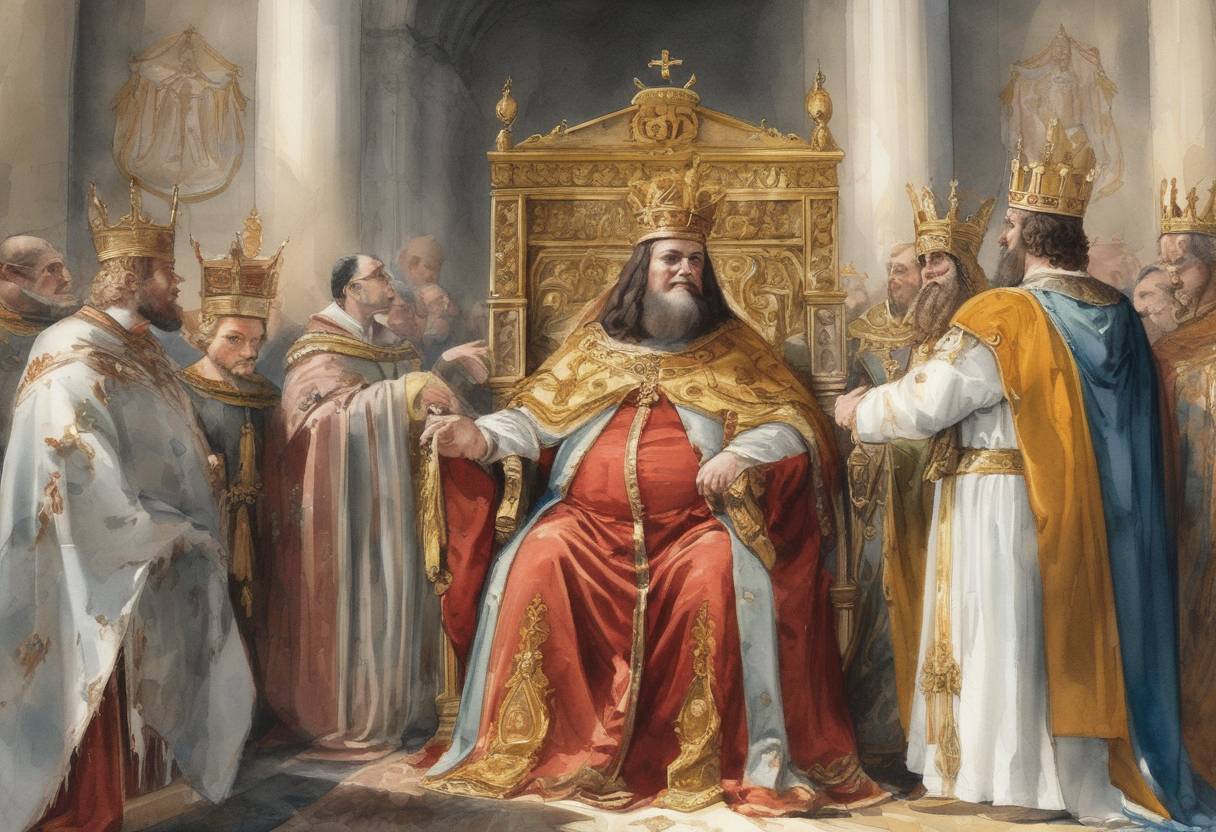
On May 13, 884, King Charles the Fat was crowned as the Holy Roman Emperor by Pope Adrian III. This event marked a significant moment in the history of the Carolingian dynasty, as it continued to exert its influence over the Holy Roman Empire during a period of political fragmentation and external threats.
Charles the Fat was born in 839, the youngest son of Louis the German, who was a grandson of Charlemagne. The Carolingian dynasty, founded by Charlemagne, had established a vast empire that encompassed much of Western and Central Europe. However, by the late 9th century, the empire had become fragmented due to internal divisions and external pressures, particularly from Viking invasions.
Charles initially ruled as King of Alemannia, a region in present-day southwestern Germany. Over time, he expanded his rule to include other territories, becoming King of Italy in 879 and King of East Francia in 882. His ascent to the imperial throne was part of a broader strategy to consolidate power and restore the unity of the Carolingian Empire.
The coronation of Charles the Fat as Holy Roman Emperor took place in Rome, a city that held significant religious and political importance. Pope Adrian III, who had been elected pope in 884, performed the coronation ceremony. This act symbolized the alliance between the papacy and the Carolingian rulers, a relationship that had been pivotal since the time of Charlemagne.
The title of Holy Roman Emperor was not merely ceremonial; it conferred upon Charles the responsibility to protect the Church and maintain the Christian order in Europe. The coronation also reinforced the idea of a unified Christian empire, despite the ongoing challenges of regionalism and external threats.
Charles the Fat’s reign as Holy Roman Emperor was marked by efforts to address the empire’s fragmentation. He attempted to negotiate peace with the Vikings and sought to unify the various Carolingian territories. However, his reign was plagued by internal dissent and a lack of effective control over the empire’s vast lands.
In 887, Charles was deposed by a coalition of nobles, leading to the further disintegration of the Carolingian Empire. His deposition marked the end of the Carolingian dynasty’s effective rule over the Holy Roman Empire, paving the way for the rise of regional powers and the eventual emergence of new dynasties.
Despite his short and troubled reign, Charles the Fat’s coronation as Holy Roman Emperor remains a significant event in the history of medieval Europe. It highlights the challenges of maintaining a unified empire in the face of internal and external pressures and underscores the enduring influence of the Carolingian legacy in shaping European history.
Source: en.wikipedia.org