The Coup Against Julius Nepos: August 28, 475
475 · Ravenna, Italy
The Western Roman Emperor Julius Nepos was forced to flee Ravenna after a coup led by the Roman general Orestes, who declared his own son, Romulus Augustulus, as emperor.
March 3, 0473
Gundobad, a prominent Roman general of the Western Roman Empire, proclaimed Glycerius as emperor in Ravenna.
Ravenna, Italy | Western Roman Empire
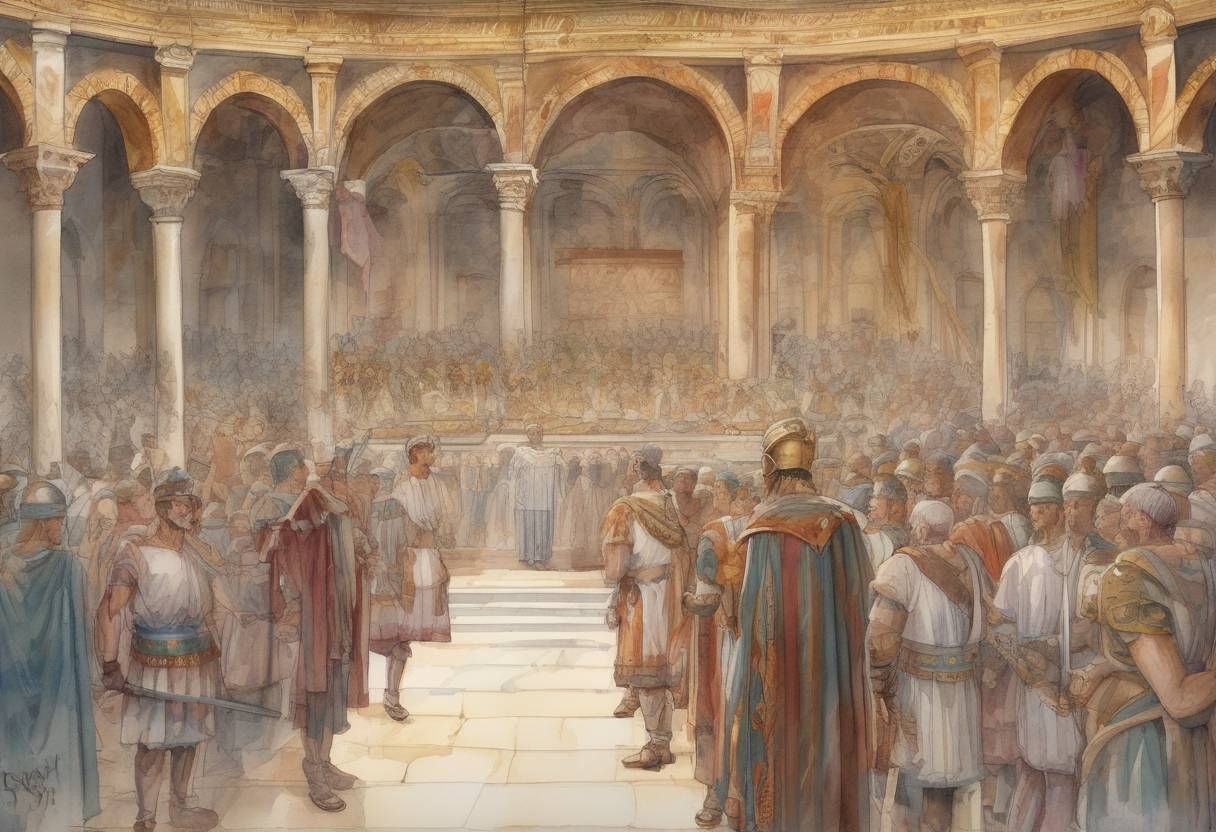
On March 3, 473, a significant event unfolded in the Western Roman Empire when Gundobad, a prominent Roman general, proclaimed Glycerius as emperor in Ravenna. This event is a noteworthy episode in the late Western Roman Empire’s history, characterized by political instability and the decline of central authority.
By the mid-5th century, the Western Roman Empire was in a state of severe decline. The empire faced continuous invasions by various barbarian groups, internal power struggles, and economic difficulties. The central authority was weakened, and the role of the Roman military and its generals became increasingly pivotal in the political arena.
Gundobad was a powerful military leader and a member of the Burgundian royal family. He was the nephew of Ricimer, a dominant figure in the Western Roman Empire who had effectively controlled the appointment and deposition of emperors. After Ricimer’s death in 472, Gundobad inherited his uncle’s influential position, becoming the magister militum (master of soldiers) and wielding significant power in the empire.
On March 3, 473, Gundobad proclaimed Glycerius as the new emperor in Ravenna, a city that had become the de facto capital of the Western Roman Empire. Glycerius was a relatively obscure figure before his elevation, serving as a comes domesticorum, a senior military position. His appointment was largely orchestrated by Gundobad, who sought a pliable figurehead to maintain his own influence over the empire.
The proclamation of Glycerius was a strategic move by Gundobad to stabilize the Western Roman Empire amidst ongoing threats and to secure his own power. At the time, the Eastern Roman Empire, under Emperor Leo I, had its own interests and candidates for the Western throne, leading to tensions between the two halves of the Roman world.
Glycerius’ reign was short-lived and largely ineffective in reversing the fortunes of the declining Western Roman Empire. He faced challenges from both internal factions and external threats, including the Visigoths and Ostrogoths. His rule ended in 474 when Julius Nepos, backed by the Eastern Roman Empire, invaded Italy and deposed him.
Gundobad’s influence continued after Glycerius’ deposition. He returned to his native Burgundy, where he later became king and played a significant role in the history of the Burgundian Kingdom. His actions during this period exemplify the complex interplay between Roman and barbarian powers in the late empire.
The proclamation of Glycerius highlights the fragmentation and vulnerability of the Western Roman Empire during its final decades. It underscores the shifting power dynamics where military leaders and barbarian influences increasingly dictated the political landscape. This period set the stage for the eventual fall of the Western Roman Empire in 476, marking the end of ancient Rome and the beginning of the Middle Ages in Europe.
In summary, the proclamation of Glycerius by Gundobad on March 3, 473, is a reflection of the turbulent and transitional era of the late Western Roman Empire, illustrating the decline of imperial authority and the rise of military and barbarian power.
Source: en.wikipedia.org