Discovery of the DNA Double Helix: April 25, 1953
1953 · Cambridge, United Kingdom
Francis Crick and James Watson published their paper on the structure of DNA in the journal Nature, marking a significant milestone in the field of genetics.
March 14, 2018
Renowned theoretical physicist Stephen Hawking passed away at the age of 76 in Cambridge, England. He was known for his work on black holes and his popular science books.
Cambridge, United Kingdom | University of Cambridge
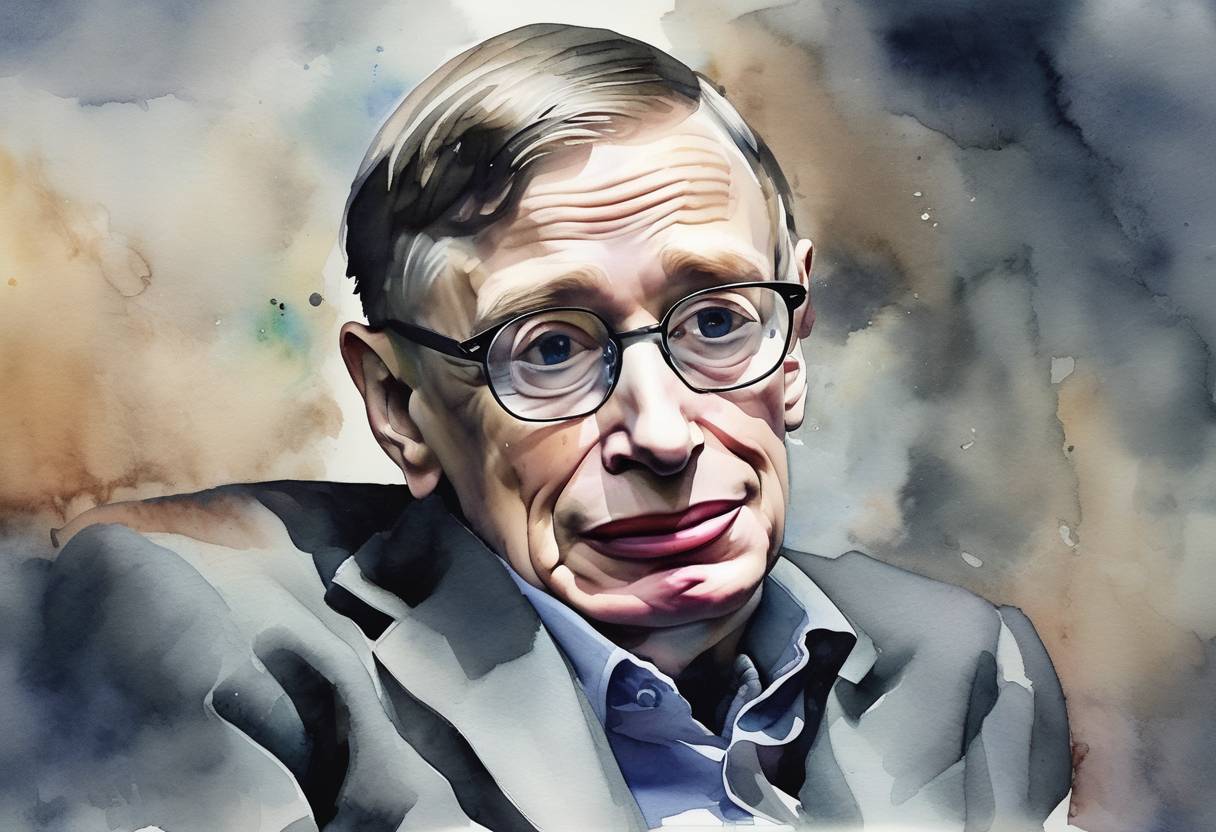
On March 14, 2018, the world bid farewell to one of the most brilliant minds of the 20th and 21st centuries, Stephen Hawking, who passed away at the age of 76 in Cambridge, England. Renowned for his groundbreaking work in theoretical physics, particularly in the study of black holes, Hawking’s contributions have left an indelible mark on both science and popular culture.
Stephen William Hawking was born on January 8, 1942, in Oxford, England. Despite being diagnosed with a rare form of motor neurone disease (ALS) at the age of 21, which gradually paralyzed him, Hawking pursued an illustrious academic career. He completed his Ph.D. at the University of Cambridge, where he later became the Lucasian Professor of Mathematics, a position once held by Sir Isaac Newton.
Hawking’s work primarily focused on the fundamental laws that govern the universe. He is best known for:
Hawking Radiation: In 1974, Hawking proposed that black holes emit radiation due to quantum effects near the event horizon, a theory that challenged the previously held notion that nothing could escape a black hole. This concept, known as Hawking radiation, has profound implications for the understanding of black holes and quantum mechanics.
Singularity Theorems: Collaborating with mathematician Roger Penrose, Hawking developed theorems regarding singularities in the framework of general relativity, suggesting that the universe began as a singularity.
Beyond his scientific achievements, Hawking was a prolific author and communicator of science to the general public. His 1988 book, A Brief History of Time, became an international bestseller, making complex concepts in cosmology accessible to millions. Hawking’s ability to explain intricate theories in an engaging manner helped bridge the gap between scientific communities and the public.
Hawking’s life and work have been celebrated in various forms of media, including the 2014 biographical film The Theory of Everything, which depicted his life and achievements.
Stephen Hawking’s passing on March 14, 2018, coincidentally on Pi Day and the birthday of Albert Einstein, was a poignant reminder of his contributions to our understanding of the universe. His legacy continues to inspire scientists and enthusiasts alike, encouraging a deeper exploration of the cosmos and the laws that govern it.
Hawking’s work not only advanced theoretical physics but also demonstrated the power of human resilience and curiosity, leaving a lasting impact on both science and society.
Source: www.bbc.com