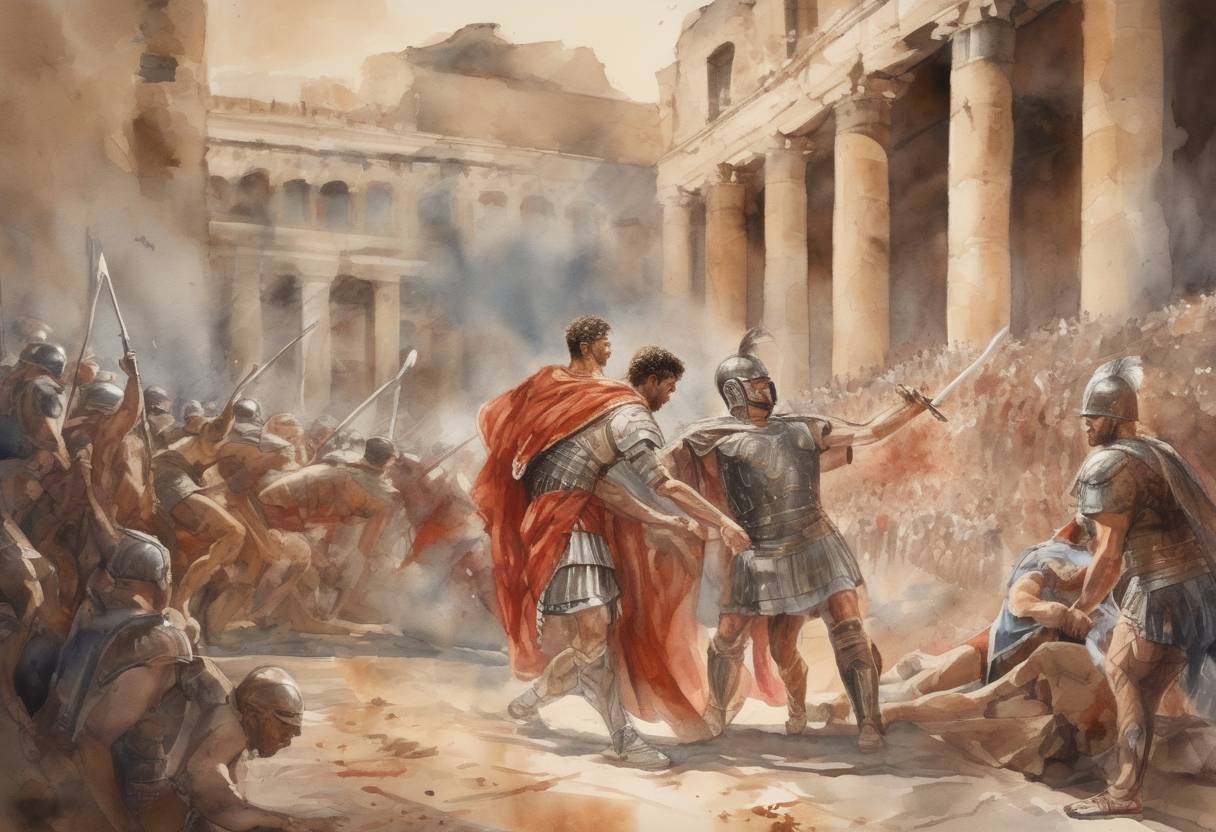
Certainly! Here’s a detailed account of the assassination of Roman Emperor Caracalla and the subsequent rise of Macrinus:
Assassination of Emperor Caracalla
Background
Caracalla, born Lucius Septimius Bassianus, was a Roman Emperor who reigned from 211 to 217 AD. He was the son of Emperor Septimius Severus and became co-emperor with his brother Geta after their father’s death. However, Caracalla’s reign was marked by violence and treachery, including the murder of his brother Geta in 211 AD, which he orchestrated to consolidate power.
Caracalla is perhaps best known for the Constitutio Antoniniana, an edict issued in 212 AD that granted Roman citizenship to all free men within the Roman Empire. Despite this, his rule was characterized by military campaigns and heavy taxation, which made him unpopular among many of his subjects.
The Assassination
On April 8, 217 AD, Caracalla was assassinated while traveling to Carrhae in modern-day Turkey. The assassination was carried out by a soldier named Justin Martialis. According to historical accounts, Caracalla had stopped to relieve himself when Martialis struck. The assassination was orchestrated by Marcus Opellius Macrinus, who was the Praetorian Prefect at the time—a high-ranking official responsible for the emperor’s personal security.
Macrinus had become aware of a prophecy suggesting that he would become emperor, and fearing for his own safety under Caracalla’s increasingly tyrannical rule, he decided to act preemptively. The assassination was part of a broader conspiracy to remove Caracalla from power.
Aftermath and Macrinus’ Ascension
Following Caracalla’s death, Macrinus quickly moved to secure his position as emperor. He was proclaimed emperor by the Roman army just three days after the assassination, on April 11, 217 AD. Macrinus became the first emperor who was not of senatorial rank and the first to rise from the equestrian class, marking a significant shift in the Roman political landscape.
Macrinus’ reign, however, was short-lived. He faced significant challenges, including military unrest and dissatisfaction among the Roman legions, particularly due to his attempts to reduce military expenditures. His rule lasted only until June 218 AD, when he was defeated by the forces of Elagabalus, a member of the Severan dynasty, who was proclaimed emperor by the troops in Syria.
Historical Significance
The assassination of Caracalla and the rise of Macrinus highlight the volatility of Roman imperial politics during this period. The transition of power through assassination and military support underscores the precarious nature of the emperor’s position, heavily reliant on the loyalty of the army. This event also illustrates the broader challenges faced by the Roman Empire in maintaining stability and continuity of leadership during the 3rd century AD, a time often referred to as the Crisis of the Third Century.
Caracalla’s death and Macrinus’ brief reign are pivotal moments that reflect the ongoing struggles within the Roman Empire, setting the stage for further political upheaval and the eventual rise of the Severan dynasty’s later members.