1760 · Panipat, India
Afghan leader Ahmad Shah Durrani defeats the Marathas in the Third Battle of Panipat.
February 24, 1711
The Battle of Karnal takes place in India, resulting in a decisive victory for Nader Shah of Persia over the Mughal Emperor Muhammad Shah.
Karnal, India | Persian Empire
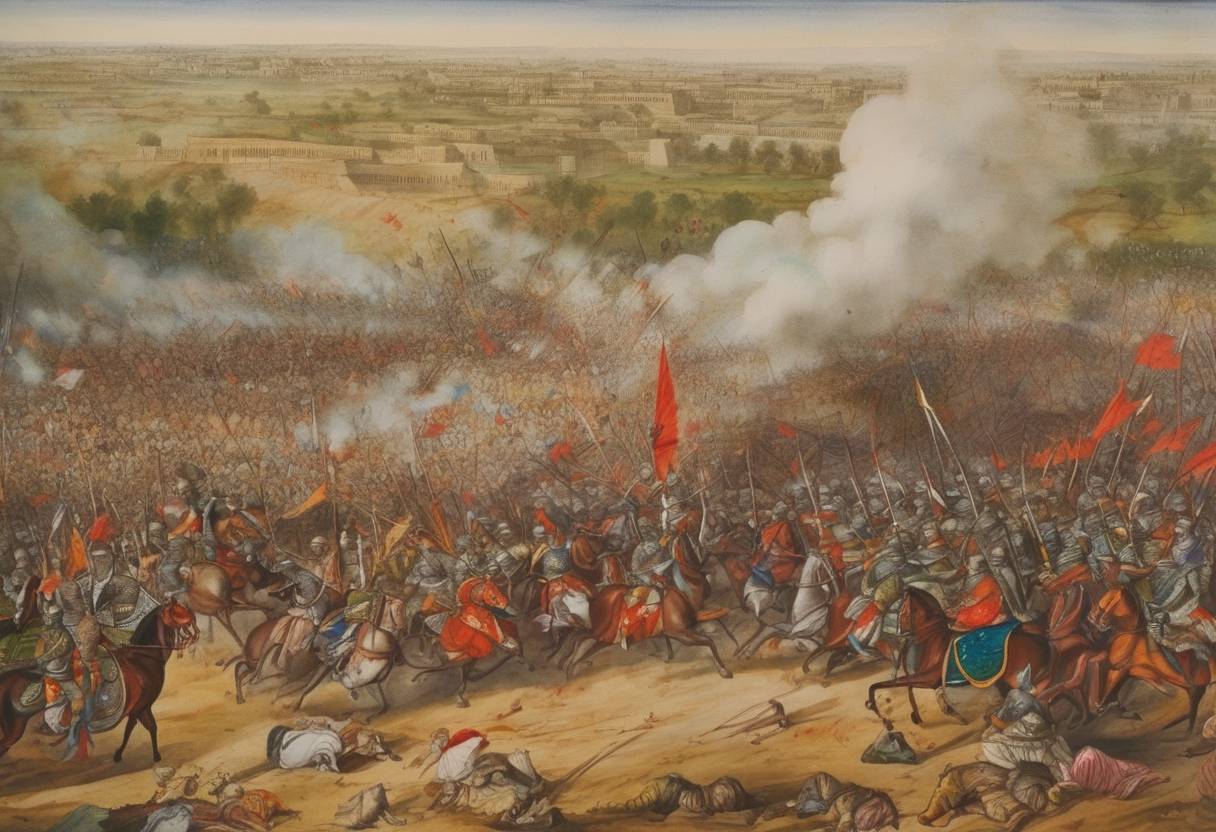
The Battle of Karnal occurred on February 24, 1739, a significant confrontation between the Persian forces under Nader Shah and the Mughal Empire led by Emperor Muhammad Shah. This battle is renowned for its swift and decisive outcome, marking a pivotal moment in the history of the declining Mughal Empire.
In the early 18th century, the once-mighty Mughal Empire was experiencing internal decline and fragmentation. Seeing an opportunity, Nader Shah, the ambitious ruler of Persia and founder of the Afsharid dynasty, orchestrated an invasion of India. He justified his invasion by citing the Mughal support for Afghan rebels who threatened Persia’s eastern territories.
With his seasoned and tactically proficient army, Nader Shah advanced through the Mughal-controlled regions, suffering minimal resistance. The Persians employed superior military tactics, including efficient use of cavalry and artillery, to secure their march toward Delhi.
The two armies met near Karnal, approximately 110 kilometers north of Delhi. Nader Shah’s forces numbered about 55,000, while the Mughal forces were significantly larger but poorly organized, with estimates ranging as high as 300,000, including a massive contingent of non-combatants.
The battle commenced on the morning of February 24, 1739. Nader Shah’s strategic acumen shone through as he quickly exploited the Mughal weaknesses. Utilizing feigned retreats and targeted cavalry attacks, the Persian army was able to shatter the Mughal lines.
One of the decisive moments was the Persian cavalry’s capture of Mughal artillery, which they then turned against its owners, causing havoc among the Mughal ranks. The inexperience of several Mughal commanders and lack of coordination further exacerbated their defeat.
Within a few hours, the Persian forces secured a comprehensive victory. The casualty figures reflected the disparity; the Mughal army suffered tens of thousands of losses, while Nader Shah’s forces incurred minimal casualties.
The fall of Karnal led directly to the occupation of Delhi by Nader Shah. The Mughal Emperor Muhammad Shah surrendered, and Delhi was subjected to a pillage that caused immense wealth to be transferred to Persia, including precious artifacts, jewels, and the famous Peacock Throne. This loot symbolized the futility of Mughal resistance against Nader Shah and the onset of their accelerated decline.
The victory at Karnal and the subsequent sacking of Delhi reverberated throughout the Indian subcontinent, weakening the Mughal Empire’s political and military stature. In the broader historical context, the battle exemplified the shifting power dynamics in 18th-century Asia and underscored the vulnerabilities of even the most formidable empires when faced with organized and determined adversaries.
Source: en.wikipedia.org