Election of Rodrigo de Borja as Pope Alexander VI
1492 · Rome, Papal States
Rodrigo de Borja is elected as Pope Alexander VI.
June 14, 1497
After the death of his predecessor, Pope Alexander VI issues a papal bull that excommunicates Girolamo Savonarola, an Italian Dominican friar and preacher active in Renaissance Florence, known for his prophecies of civic glory and calls for Christian renewal.
Rome, Papal States (present-day Italy) | Catholic Church
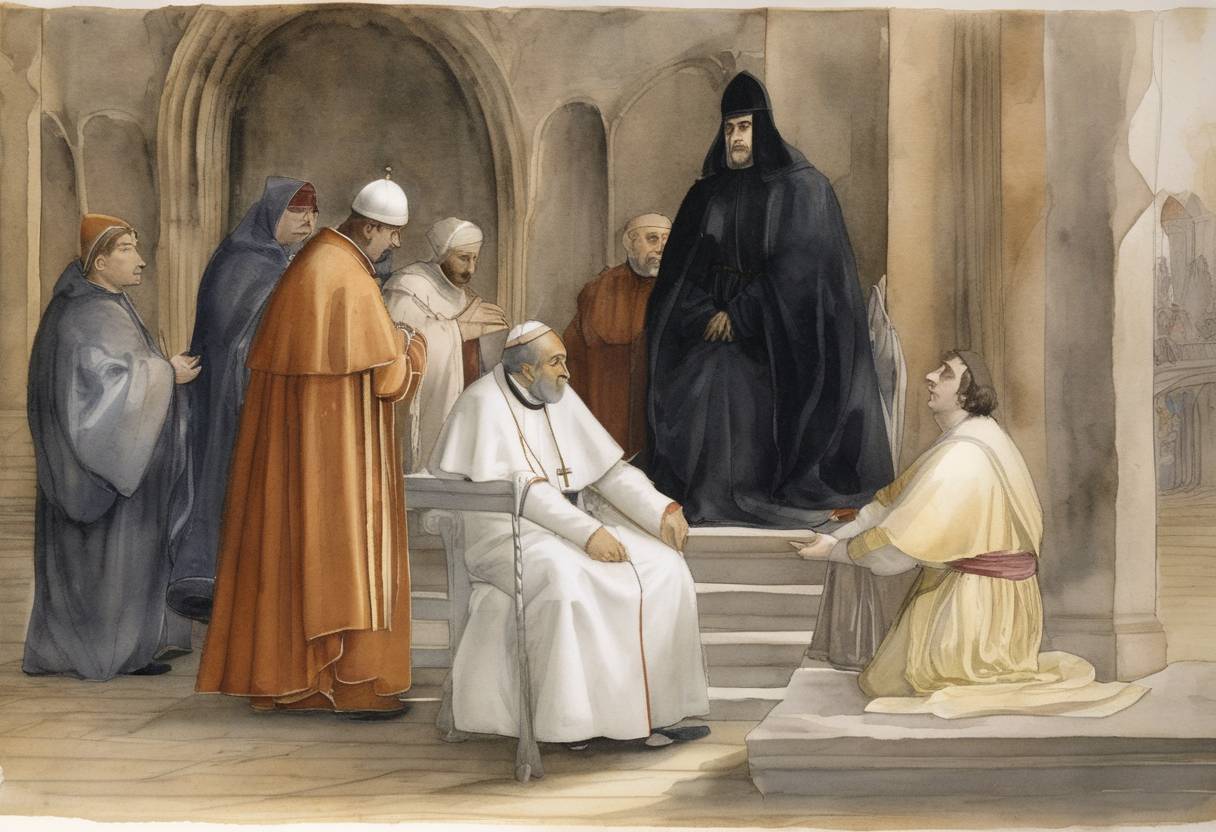
On June 14, 1497, Pope Alexander VI issued a papal bull that excommunicated Girolamo Savonarola, a prominent and controversial Dominican friar and preacher. Savonarola had gained significant influence in Florence, Italy, during the late 15th century, known for his fiery sermons and calls for moral and ecclesiastical reform. The excommunication underscored the intense conflict that existed between Savonarola and the papacy during this period.
Girolamo Savonarola rose to prominence in Florence amid a broader backdrop of political instability and widespread calls for reform within the Catholic Church. He became known for his vehement sermons that criticized the moral corruption of the clergy and the secular authorities of Florence. Savonarola’s vision for a renewed Christian society appealed to a wide audience, and he wielded significant influence over the city’s governance, establishing a theocratic rule in Florence in the mid-1490s.
Savonarola’s relationship with Pope Alexander VI, born Rodrigo Borgia, was fraught with tension. Alexander VI, whose papacy was frequently criticized for its corruption and nepotism, viewed Savonarola’s calls for reform and his potent influence in Florence as a direct threat to papal authority.
The conflict between Savonarola and the Vatican escalated significantly due to Savonarola’s public denunciations of the pope and his refusal to align with papal directives. In 1495, Savonarola defied the pope’s order to cease his preaching, insisting on his divine mission to reform the Church. His support for the French invasion of Italy, led by King Charles VIII, also antagonized Alexander VI, as it opposed the political interests of the papacy.
In response to these provocations, Pope Alexander VI attempted to suppress Savonarola’s influence, leading to a series of papal censures. Savonarola’s continued defiance and his undiminished popularity in Florence eventually prompted the pope to issue the excommunication bull on June 14, 1497, formally severing Savonarola from the Church.
The excommunication marked the beginning of Savonarola’s decline. Stripped of his ecclesiastical standing and faced with mounting opposition, both from the papacy and from within Florence, his influence waned. Savonarola’s opponents capitalized on his excommunication, culminating in his arrest, trial, and eventual execution in 1498 for heresy and sedition.
The discord between Savonarola and Pope Alexander VI highlights the turbulent intersection of religious reform and papal politics during the Italian Renaissance. Savonarola’s efforts left a lasting impact on Florence and foreshadowed the broader calls for reform that would later manifest in the Protestant Reformation.
Source: www.britannica.com