The English Parliament Passes the Acts of 1553
1553 · London, England
The English Parliament passes acts allowing royal proclamations to stand as law.
March 10, 1535
The Parliament of England passes the Act of Supremacy, establishing King Henry VIII as the Supreme Head of the Church of England.
London, England | Parliament of England
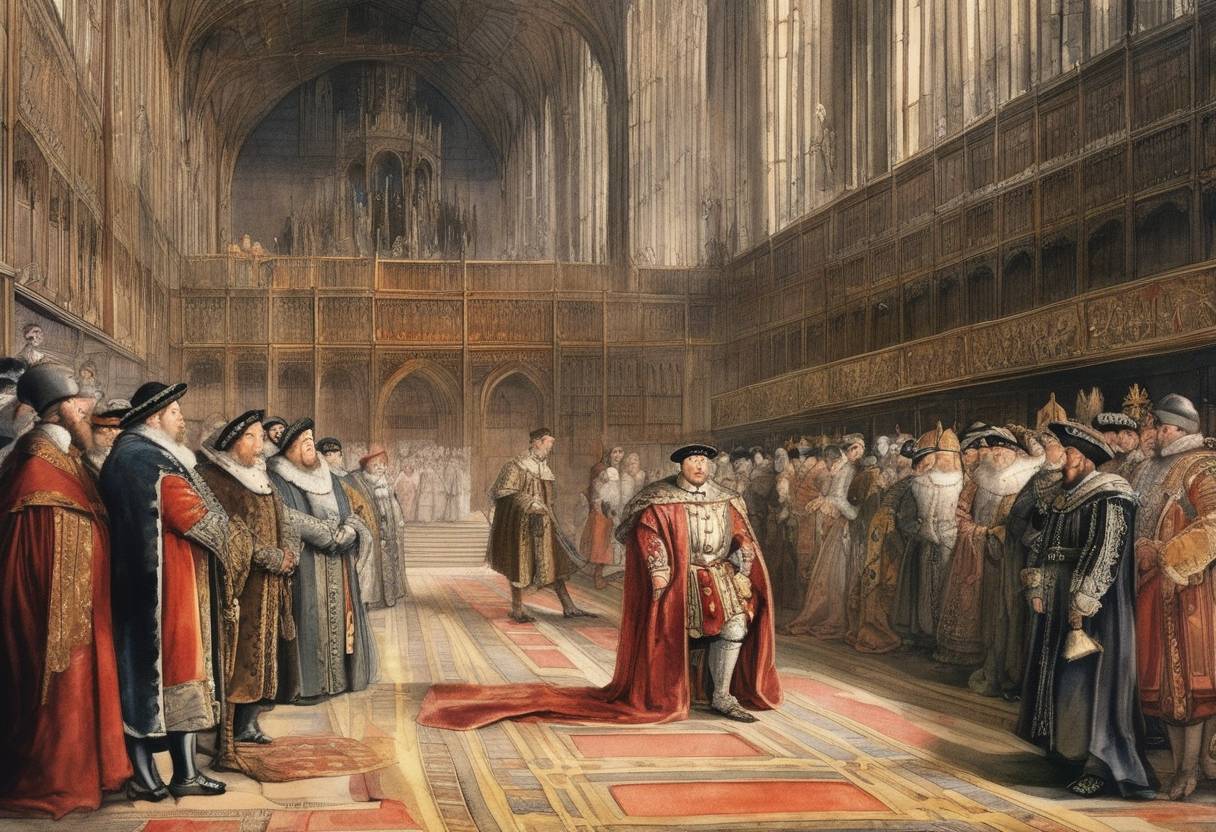
On March 10, 1535, a significant religious and political transformation was well underway in England due to the enactment of the Act of Supremacy in November 1534, although key developments continued into 1535. This critical piece of legislation established King Henry VIII as the Supreme Head of the Church of England, marking a crucial step in the English Reformation.
Background of the Schism: The move towards the Act of Supremacy arose from King Henry VIII’s desire to annul his marriage to Catherine of Aragon, which Pope Clement VII refused to sanction. The inability to obtain a papal annulment led to increased tension between the English crown and the Vatican.
Reformation Beginnings: Preceding the Act, Henry VIII had already taken steps to diminish the Roman Catholic Church’s influence in England, such as the Act of Annates (1532) and the Act in Restraint of Appeals (1533), which limited the church’s power and redirected it towards the monarchy.
Supreme Head: The Act of Supremacy declared that the king “justly and rightfully is and ought to be the supreme head of the Church of England.” This meant that Henry VIII had ultimate authority over religious doctrine and ecclesiastical appointments.
Legal Authority: The Act granted the monarchy control over the church, effectively removing the Pope’s jurisdiction in England. It was a legislative foundation for the English Reformation, emphasizing the secular power’s ascendancy over religious matters.
Dissolution of the Monasteries: Following the Act, Henry VIII initiated the Dissolution of the Monasteries (1536-1541), redistributing wealth and consolidating his power.
Consolidation of Power: By centralizing religious authority, Henry strengthened the monarchy and laid the groundwork for future religious reforms under his successors.
Resistance and Rebellions: The Act sparked resistance, including the Pilgrimage of Grace (1536), a large uprising that protested Henry’s policies and the resultant socio-economic changes.
Legacy: The Act of Supremacy was pivotal in establishing religious and political precedents in England, leading to ongoing tensions between Catholicism and Protestantism. It set the foundation for the Elizabethan Religious Settlement later in the century.
The Act of Supremacy of 1534, effective throughout 1535 and beyond, was a landmark event in English history that catalyzed the English Reformation, changing the religious, political, and social landscape of the nation. It symbolized the rise of state-controlled religion and the decline of papal authority in England.
Source: en.wikipedia.org