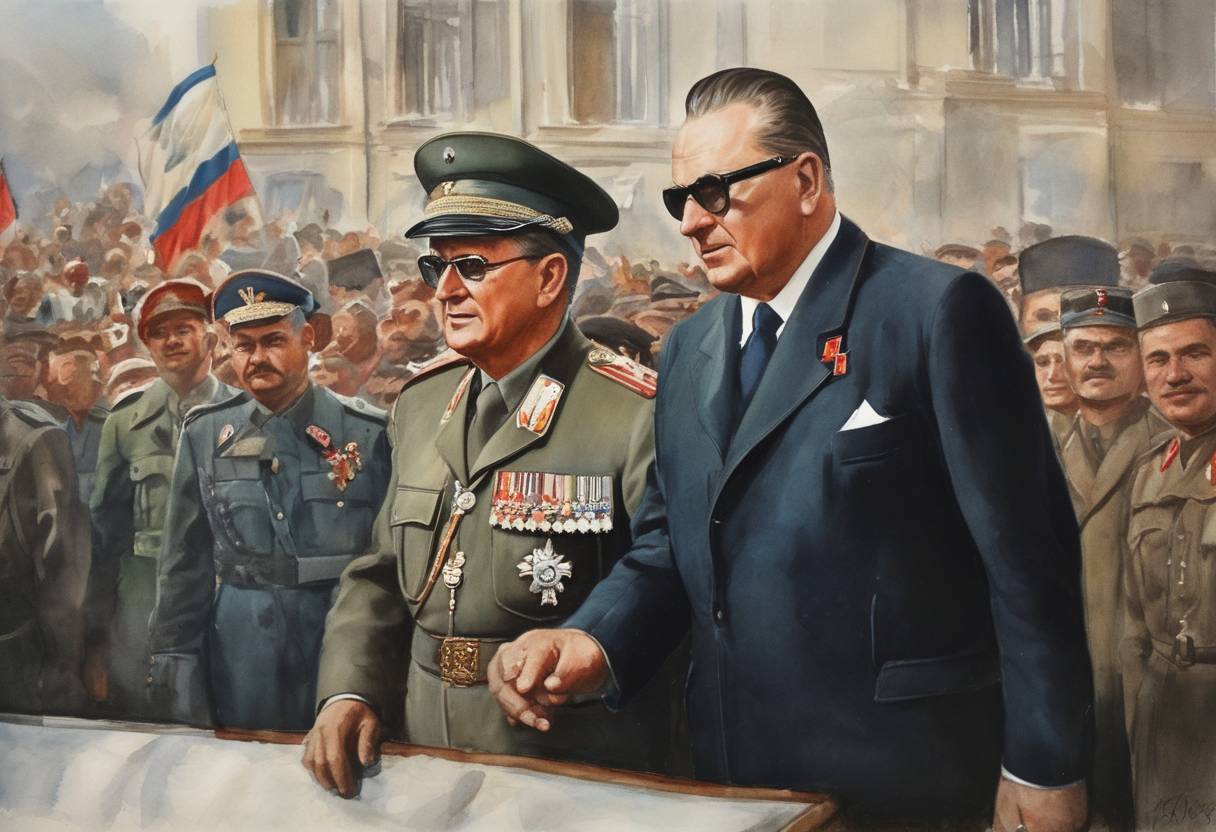
Josip Broz Tito Becomes President of Yugoslavia
On January 13, 1953, Josip Broz Tito was elected President of Yugoslavia, a milestone in the political evolution of the country. Tito’s establishment of a socialist state distinct from Soviet influence was notable for its departure from the traditional Soviet model implemented across Eastern Europe.
Background
Following World War II, Josip Broz Tito, a prominent communist leader and resistance figure, emerged as a key figure in Yugoslav politics. He had been Prime Minister since 1945 and led the Partisans during the war. Yugoslavia was initially aligned with the Soviet Union and adhered to its centralized economic model and ideological tenets.
Break with the Soviet Union
In 1948, tensions between Yugoslavia and the Soviet Union culminated in the Tito-Stalin split, driven by Tito’s refusal to submit to Soviet demands for greater control over Yugoslavia’s internal and foreign policies. This schism led to Yugoslavia being expelled from the Cominform, an organization of communist parties. Subsequently, Tito pursued a policy of non-alignment and self-reliance, steering his country along a socialist yet independent path.
Tito’s Presidency
The election of Tito as President in 1953 consolidated his control over the Yugoslav state and marked a significant step in building a unique brand of socialism. Under his leadership, Yugoslavia adopted a model of workers’ self-management, contrasting sharply with the Soviet-style centralization. This system granted workers more autonomy in managing their enterprises, aiming to create a more democratized socialist structure.
Broader Impact
Tito’s presidency and policies had profound implications not only for Yugoslavia but also for the broader Cold War dynamics. His approach offered a third way that challenged the binaries of East and West, providing a framework for the Non-Aligned Movement, which he later co-founded. This movement sought to maintain independence from both the US-led NATO bloc and the Soviet-led Warsaw Pact.
By fostering relationships with Western countries while maintaining socialist ideals, Tito ensured economic aid and support, contributing to Yugoslavia’s relative prosperity and stability compared to its Eastern Bloc counterparts.
Legacy
Tito’s presidency marked the beginning of an era of relative stability and unity in a region often fraught with ethnic and national tensions. His leadership style fostered a sense of Yugoslav identity that transcended ethnic lines, though this unity was tested severely following his death in 1980 and eventually unraveled in the subsequent decade.
The architectural shift Tito implemented by aiming for a balanced socialist state, distinct from Soviet dominance, remains a significant chapter in Cold War history and the narrative of 20th-century European politics.