Battle of Rio Salado - October 30, 1340
1340 · Tarifa, Spain
At the Battle of Rio Salado, English and Portuguese forces defeat the Marinid Muslim army in Iberia, effectively ending the last Muslim attempt to conquer the Iberian Peninsula.
July 17, 1212
The Battle of Las Navas de Tolosa took place, a pivotal encounter in the Reconquista, where a coalition of Christian armies defeated the Almohad caliphate, marking a significant turning point in the Christian efforts to reclaim the Iberian Peninsula from Muslim rule.
Sierra Morena, Spain | Christian Coalition (including the Kingdoms of Castile, Navarre, Aragon, Portugal)
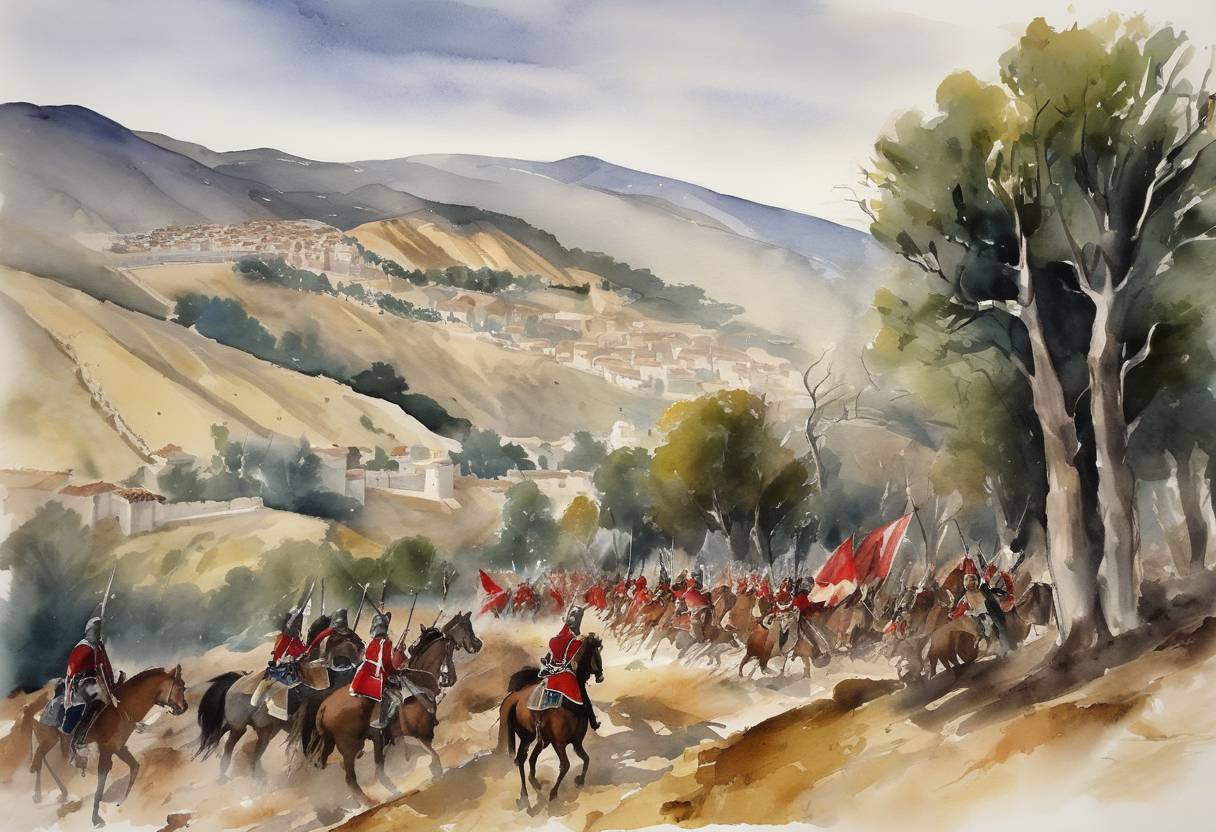
The Battle of Las Navas de Tolosa, fought on July 16, 1212, stands as a pivotal moment in the history of the Reconquista, the prolonged series of battles aimed at reclaiming the Iberian Peninsula from Muslim rule. This significant encounter saw a coalition of Christian forces defeat the Almohad Caliphate, marking a decisive shift in the power dynamics within the region.
The Almohad Caliphate, a North African Berber Muslim dynasty, had secured dominance over much of Al-Andalus (Muslim-controlled Spain) during the late 12th century, causing concern among the Christian kingdoms of Castile, Aragon, Navarre, and Portugal. A heightened sense of urgency arose when the Almohads under Caliph Muhammad al-Nasir increased their military presence in Iberia, culminating in an invasion threatening the Christian territories.
In response to the Almohad threat, Pope Innocent III issued a papal bull calling for a crusade in 1212, which galvanized support from across Christian Europe. King Alfonso VIII of Castile spearheaded the coalition, joined by King Peter II of Aragon, King Sancho VII of Navarre, and various other European nobility and military orders.
On the morning of July 16, 1212, near Las Navas de Tolosa in the Sierra Morena mountain range, the Christian coalition faced off against the Almohad forces led by Caliph Muhammad al-Nasir. The Christian forces, despite internal rivalries and logistical challenges, united under the common cause of repelling the Muslim armies.
The battle took a decisive turn when the Navarrese soldiers reportedly managed to breach the Almohad defenses, effectively collapsing their strong formation. The Christian knights utilized their cavalry advantage and inflicted heavy losses on the Almohad troops, leading to a chaotic retreat.
The victory at Las Navas de Tolosa was monumental in weakening the Almohad presence in the Iberian Peninsula. It effectively ended the Almohad Caliphate’s ability to launch large-scale offensives in Iberia, leading to a steady decline in their territorial control.
For the Christian kingdoms, the triumph underscored the potential of united collaboration and fostered further military campaigns in the heart of Al-Andalus. Within a few decades, major southern cities like Córdoba and Seville would fall to Christian forces, accelerating the Reconquista.
The Battle of Las Navas de Tolosa is remembered as a watershed event in medieval Spanish history, exemplifying the intensifying struggle between Christian and Muslim powers in Europe. It marked a significant milestone toward the eventual completion of the Reconquista in 1492 with the fall of Granada, restoring the Iberian Peninsula under Christian rule and reshaping the region’s political, cultural, and religious landscape for centuries to follow.
Source: en.wikipedia.org